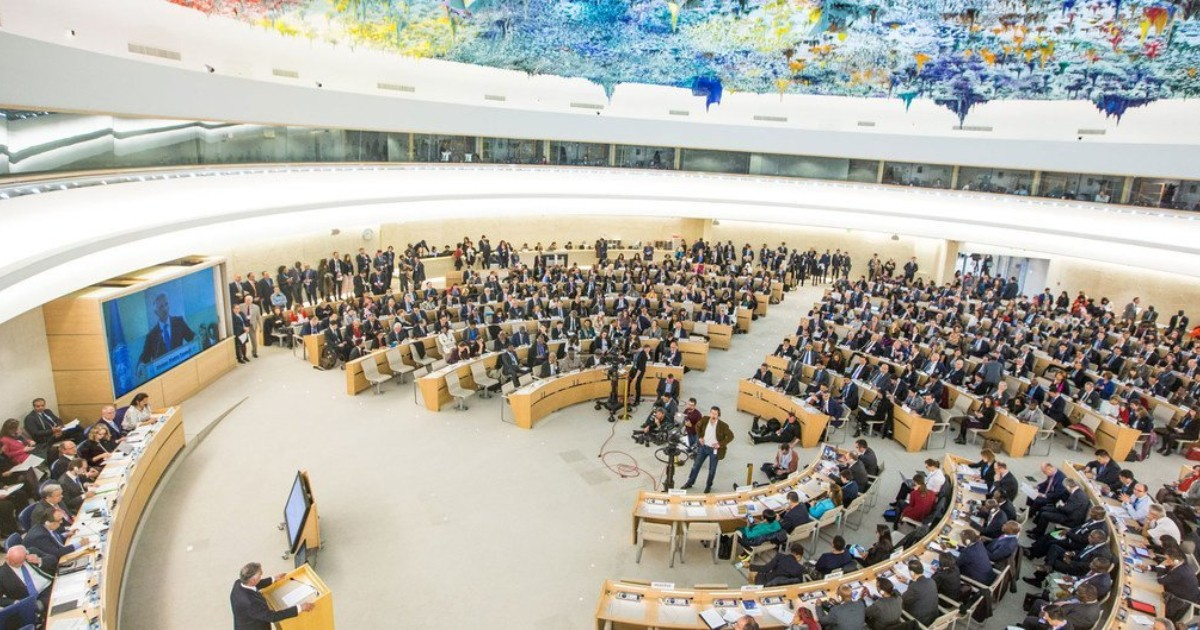
The United States on Tuesday became the first country in history to completely reject its participation in the Universal Periodic Review (UPR), the mechanism of the UN Human Rights Council that assesses the human rights records of the 193 member states, according to reported by the Associated Press.
The U.S. delegation did not attend the scheduled session in Geneva, which prevented the examination from taking place. The process requires the presence of the country being examined in order to proceed.
This is not the first time that Washington has missed this appointment: it had previously skipped its review originally scheduled for November 2025. The Council rescheduled that session in the hope that the government would reconsider its position. It did not.
The Trump administration formally withdrew from the organization through an executive order signed in February 2025, citing "anti-American" and "anti-Israeli" bias, and questioning whether the Council truly upholds the values it claims to promote. A spokesperson for the State Department was emphatic in stating to AP, "We do not lend any credibility to this organization. This irredeemable body mocks human rights through its systematic failures to uphold its own values, while promoting anti-American rhetoric."
The Council approved a new postponement of the exam until January 2027 on Tuesday, citing a lack of cooperation from Washington.
The decision has sparked a wave of criticism from international human rights organizations. Jamil Dakwar, director of the American Civil Liberties Union’s (ACLU) human rights program, warned from Geneva: "The administration is telling the world: we don’t care if we’re being monitored or not, we will continue to violate human rights without inhibition. And we say: no, enough is enough. This Council must hold the United States accountable."
Human Rights Watch demanded that the Council not grant any more indefinite extensions and proposed that the UN High Commissioner for Human Rights, Volker Türk, submit a report on the U.S. situation at the March 2027 session.
Eric Tistounet, the first secretary of the Council and currently a visiting professor at the Geneva Graduate Institute, warned about the consequences for the credibility of the system: "If the predominant global power—which has always claimed to adhere to human rights standards—fails to show up or even justify why, then you are in serious trouble."
The paradox pointed out by critics is striking: the Council includes among its members regimes classified as authoritarian or unfree —Cuba, China, Vietnam, Egypt, Eritrea, and Qatar, among others— that do participate in the review mechanism. Cuba, a one-party dictatorship, has participated in all of its UPR cycles —2009, 2013, 2018, and 2023— despite receiving repeated international criticism for arbitrary detentions, persecution of dissenters, and repression of protests.
This is the second time that Trump has withdrawn the U.S. from the organization: the first was in June 2018, during his first term. President Biden reinstated the country as an observer member in February 2021.
For the exam of this cycle, civil society organizations submitted a record of 155 reports on the U.S. in 2025, and 60 were updated in April 2026 to document new alleged violations. The ACLU and its allies have urged the High Commissioner to present its findings in the March 2027 session, with or without Washington's participation.
Related videos:
Filed under: