The Committee on International Affairs of the Russian State Duma presented this Friday a draft appeal to the UN General Assembly and foreign parliaments to demand an end to the U.S. embargo against Cuba — which the text refers to as "blockade" — along with a revelation that even the Kremlin cannot hide: since August 2026, the island has "virtually stopped importing fuel."
The Duma Council included the document in the agenda for the plenary session on November 11, according to the Russian economic newspaper Vedomosti, which is close to the Kremlin regarding foreign policy. The text describes Washington's sanctions as an "unacceptable tool of external pressure" and states that they contradict the principles of international law.
The most significant aspect of the document is not its rhetoric, but its diagnosis: the main ally of the Cuban regime acknowledges in an official text that, following the tightening of restrictions in August, Cuba was left without access to fuel imports, and that in October the country faced serious shortages of food, medicine, and electricity in hospitals.
The appeal is expected to be sent to the Russian president, the government, the Federation Council, the UN, and the parliaments of other countries. However, it does not include any material measures: no oil, no credits, no concrete economic assistance. Just words.
The contrast with the actual assistance from Moscow in 2026 is telling. The only confirmed shipment of Russian crude throughout the year was from the tanker Anatoli Kolodkin, which arrived in Matanzas at the end of March with about 100,000 tons of Urals crude —approximately 730,000 barrels—.
Its effect on the blackouts lasted barely two weeks. The Cuban ambassador in Moscow, Enrique Orta González, acknowledged in October that this was the only Russian oil vessel to arrive in Cuba all year. A second shipment announced, related to the tanker Universal, changed course in May and its arrival was never confirmed.
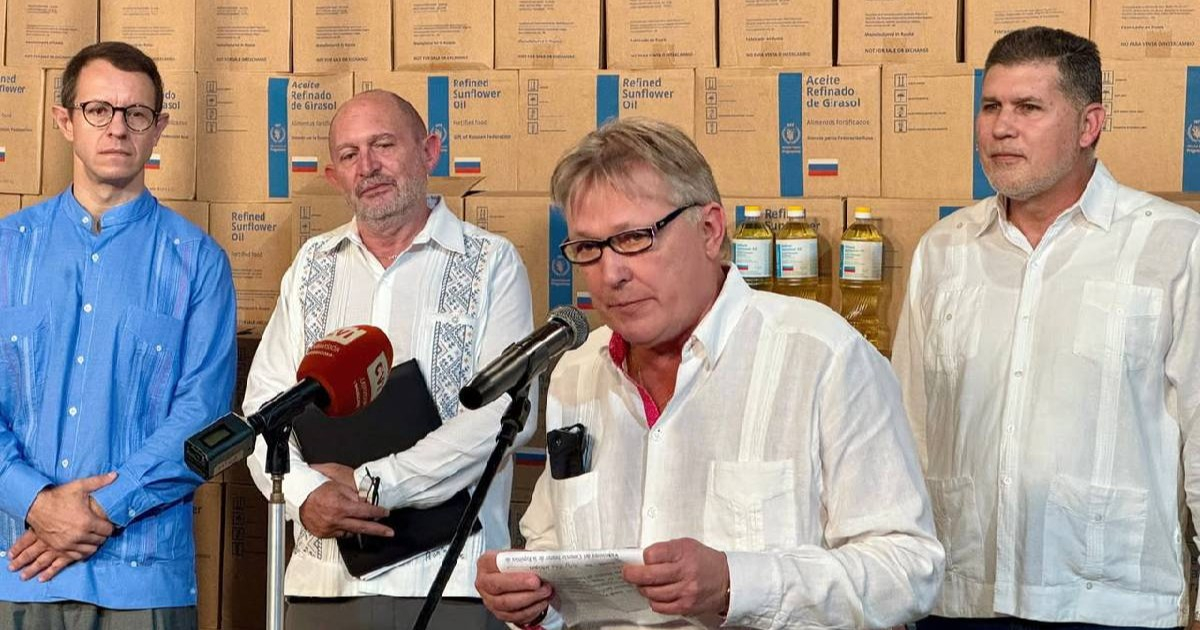
In addition to crude oil, Moscow acknowledged in October logistical difficulties in delivering aid to the island. The Russian Deputy Foreign Minister, Alexander Alimov, admitted that since June only two shipments of sunflower oil had arrived, totaling slightly over 750 tons, funneled through the World Food Programme, along with three ambulances.
The parliamentary initiative comes one day after the United States announced a new round of sanctions under Executive Order 14404, targeting oil transportation networks to Cuba: eight entities and two individuals designated, and five vessels blocked —Esperanza, Gloria C, María Cristina, Emilia, and Lourdes—, with companies from Cyprus, Panama, and Cuba among the targets.
The call from the Duma also comes just days after the regime's worst diplomatic defeat at the UN in decades. On October 28, the General Assembly approved the resolution A/81/L.5 against the embargo with only 130 votes in favor, compared to 17 against and 25 abstentions—the worst result since Cuba began presenting that resolution in 1992, far from the 187 support votes in 2024.
The crisis described in the Russian document has specific figures: Cuba needs about 100,000 barrels of oil daily but produces only around 40,000 internally; the Electric Union estimated in September a mere availability of 1,300 MW against a demand of between 2,850 and 3,300 MW; interprovincial transportation from Havana dropped from 419 daily departures in 2025 to only 11 in 2026; and hospitals reported availability of only 30% of the basic medication supply, with 98,500 patients waiting for surgery, including 12,000 children.
This is not the first time that the Duma has resorted to such gestures: it unanimously approved a similar appeal on October 28, 2025. The new project from November 2026 is the second Russian parliamentary initiative of this kind in a year, highlighting its ritualistic nature. Meanwhile, the Cuban people continue to lack fuel, medicine, and electricity.
Related videos:
Filed under: