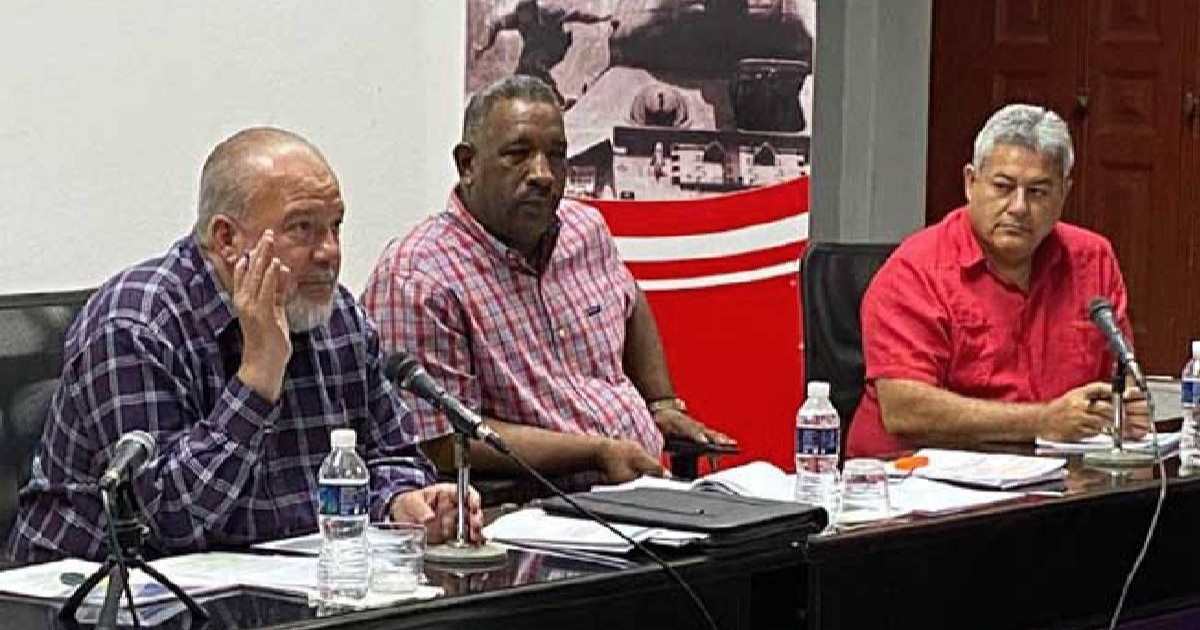
The Cuban Prime Minister, Manuel Marrero Cruz, visited Camagüey this Tuesday to assess the implementation of the so-called Economic and Social Transformations (TES) and again turned to political exhortations to promote reforms whose results have yet to translate into tangible improvements for the population.
"Let nothing hold us back" was the slogan launched by the head of Government during an extraordinary Provincial Council, as reported by the state-run Cuban News Agency.
Five months after the approval of a package of 176 measures aimed, supposedly, at revitalizing the Cuban economy, Marrero insisted on the need to move forward "with objectivity and steady steps," although he acknowledged that the challenges the country faces are "gigantic."
The speech, however, refocused on the leaders' will, collective effort, and the need to create wealth, without providing specific results that would allow for determining how much the living conditions of Cubans have improved since the reforms were implemented.
Marrero stated that it is necessary to "consolidate the stage of a process that serves as the guiding thread of the work system in the midst of the current complex scenario, to seek, with participation and collective effort, alternatives that improve the lives of the people."
He also called for finding a balance between economic recovery and addressing social issues, and defended the role of municipalities in "unleashing all productive forces and generating wealth."
Many measures implemented, few visible results
During the meeting, Yennis León Mayedo, appointed provisional governor of Camagüey following the resignation of Jorge Enrique Sutil Sarabia, presented a report that reflects the authorities' focus on the administrative implementation of the reforms.
According to official data, the province has fully implemented 164 measures, seven partially, and has five pending, making a total of 176.
Among the listed advancements are 135 entities with accounts in foreign currency, 90 contracts between state companies and non-state management forms, and 389 establishments leased under different business models.
Eighteen potential business deals that have not yet been finalized were also identified.
However, the report did not specify how much production, food availability, workers' incomes, or service quality have increased as a result of these transformations.
The provincial assessment itself acknowledged that the financial movement continues to be its main issue, a challenge that highlights the obstacles faced in the practical implementation of the measures.
Among the highlighted experiences was the payment to retirees through economic actors and workers of the Banco Popular de Ahorro, an alternative that reflects the difficulties that persist in the functioning of banking services.
The government boasts of reforms but admits that what is essential is lacking
At the national level, authorities state that 172 of the 176 transformations have approved policies and procedures. The process has generated 231 legal norms, of which 131 have been published in the Official Gazette.
However, the number of approved measures contrasts with the lack of sufficient public indicators demonstrating a noticeable economic recovery in Cuban households.
Marrero himself acknowledged in September that what was still missing was "the most important thing": for the population to see concrete results in greater production, employment, income, and better prices.
This recognition exposed one of the main contradictions of the government program: the Executive reports on the progress of the reforms, but still has not managed to demonstrate that they are fulfilling their primary objective of improving the lives of citizens.
The TES were approved during an extraordinary session of the National Assembly held on June 18 and 19, 2026. They are organized into 23 thematic axes and include provisions such as the elimination of the 100-worker limit for small and medium-sized enterprises (mipymes), the authorization of private banking and private exchange houses, as well as greater openness to foreign investment.
In July, as its implementation began, Marrero warned that Cuba was entering "the most important and perhaps the most difficult" stage of the process.
Five months later, the prime minister continues to call for effort, willingness, and commitment from the leaders, while Cubans are still facing power outages, difficulties accessing food, deterioration of basic services, and a sustained loss of purchasing power.
The question that the Government still hasn't answered is when the 176 transformations will stop being mere numbers in official reports and start to represent real improvements in the daily lives of the population.
Related videos:
Filed under: