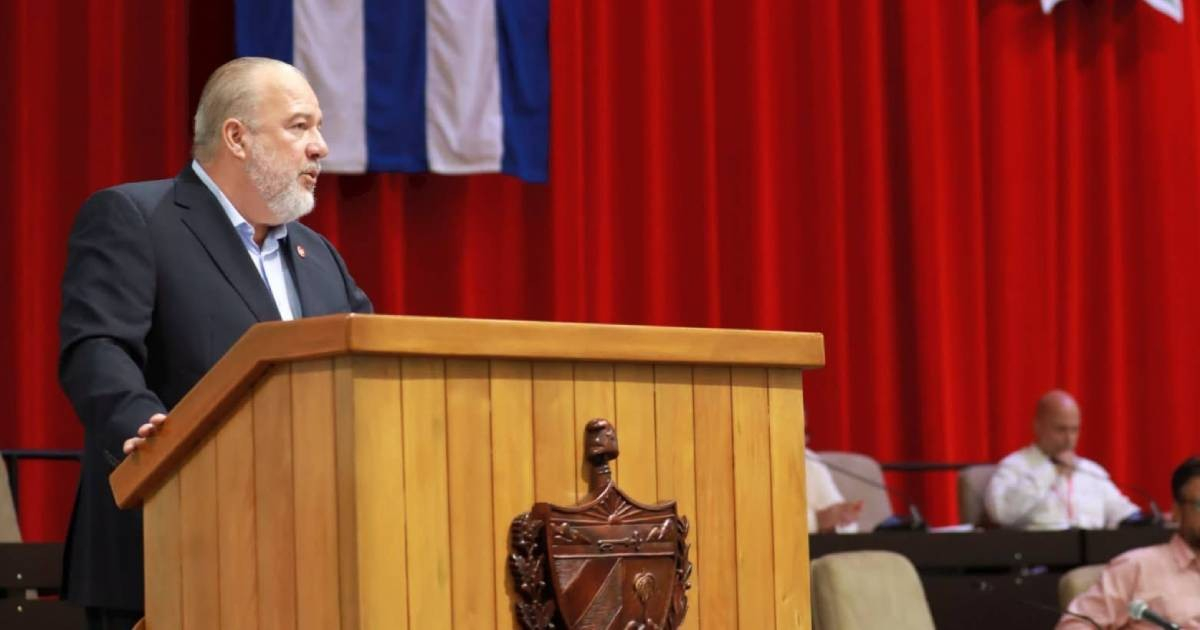
Cuban Prime Minister Manuel Marrero Cruz acknowledged this Wednesday that the most complex phase of the economic reform package promoted by the regime has only just begun, admitting that the main challenge is no longer to approve new measures, but rather to ensure they are implemented and yield results amid the profound crisis the country is experiencing.
During his appearance before the National Assembly of People's Power, Marrero presented an assessment of the economic transformations approved in recent weeks and stated that the Government is now entering a decisive phase.
«From now on, the most important and perhaps the most challenging phase begins,» he stated, according to the official media Cubadebate.
The head of government emphasized that the success of the process will depend on the ability to implement the measures, evaluate their results, and address any shortcomings that may arise during their execution.
According to Marrero, of the 121 measures scheduled for June and July, 110 have already been approved, representing 90.9% of the planned initiative. Five others are currently being partially executed, and the remaining measures will be submitted for approval before the end of the week.
However, the Prime Minister himself acknowledged that the real challenge will be to turn those decisions into tangible changes.
"The most important thing is that we already have 110 transformations approved, and it is up to us to put them into action," he stated.
The statement reveals one of the main challenges that economic reforms in Cuba have historically faced: the gap between the approved regulations and their effective implementation.
More autonomy for state-owned enterprises
Among the key measures is a new decree law that expands the powers of state-owned enterprises.
Based on that regulation, entities will be able to establish their own salary systems, set prices and rates, make financial investments, and decide on the termination of their employees' contracts.
Marrero described this modification as the most important transformation in salary matters in recent years.
Changes for MSMEs
In the private sector, the Government reported that more than 15,000 small and medium-sized enterprises and non-agricultural cooperatives are now operational.
Additionally, as of Tuesday, the Decree 160 came into effect, which eliminates 46 prohibitions for non-state economic actors and partially relaxes another 36. The new regulation replaces Decree 107 of 2024, which restricted 125 economic activities.
Despite the relaxation, the regime has banned 79 activities, which shows that the opening to the private sector remains limited.
Tourism and power outages reflect the depth of the crisis
During his speech, Marrero also acknowledged the decline affecting one of the strategic sectors of the Cuban economy.
The Prime Minister reported that 73% of hotel facilities remain closed, keeping around 25,000 workers in a state of labor availability.
This is compounded by the departure of seven international hotel chains from the island, including Meliá, Iberostar, and Barceló, which managed approximately 46% of the rooms operated under that model, according to data released by the EFE agency.
Regarding the energy crisis, Marrero admitted that prolonged blackouts remain one of the biggest problems for the population, although he assured that 1,464 MW of generation through renewable sources have already been added, equivalent to 13.8% of the national electrical capacity.
As part of the state restructuring, the Government announced the elimination of over 92,000 positions in the Ministries of Public Health, Education, Culture, and Sports.
According to Marrero, the reduction mainly affects administrative positions that remained vacant, while the other state bodies must complete that process before September.
Doubts persist about the scope of the reforms
The measures are announced in a particularly unfavorable economic context for the island.
The Economic Commission for Latin America and the Caribbean (ECLAC) projects a contraction of 6.5% in Cuba's Gross Domestic Product (GDP) in 2026, while various economists believe that the reforms are arriving late and fail to address the structural issues of the economy.
The economist Mauricio de Miranda Parrondo has warned that the process could lead to a authoritarian capitalism controlled by the Communist Party, without political transformations that would allow for a true institutional change or a substantial improvement in the living conditions of the population.
At the end of his speech, Marrero referenced quotes from Fidel Castro and Raúl Castro to emphasize that the measures do not signify a departure from the socialist model.
“It is not a turn towards capitalism, but rather an update of the socialist model,” he stated, emphasizing that the process requires “audacity, intelligence, realism, and the participation of the entire population.”
Related videos:
Filed under: