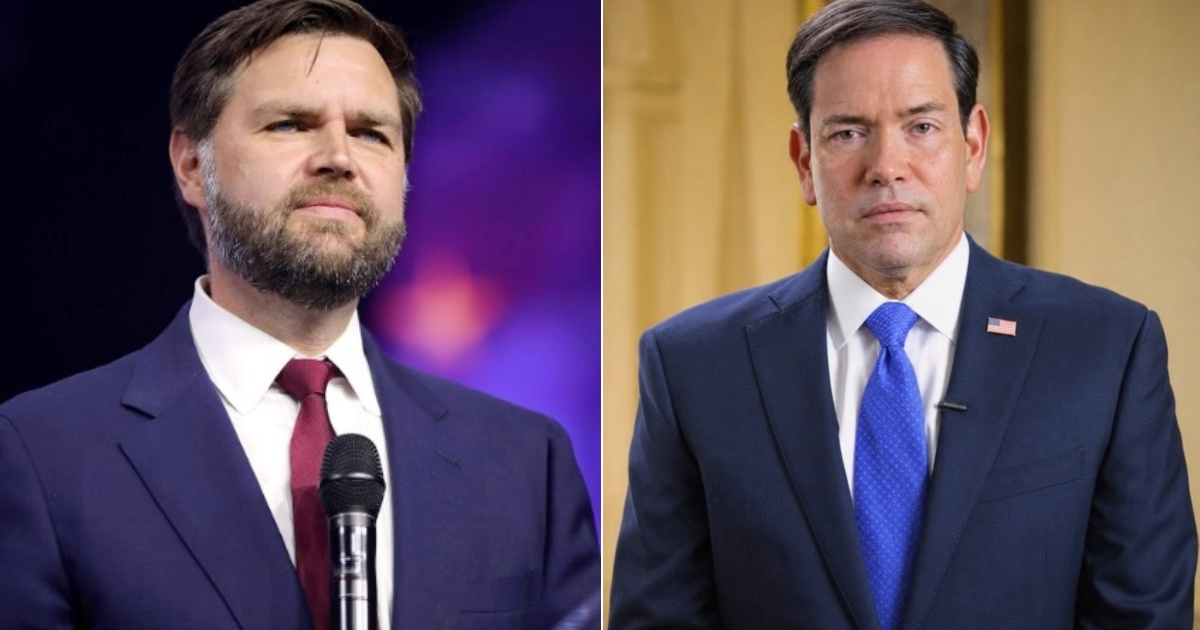
The United States Secretary of State, Marco Rubio, is two points ahead of Vice President J.D. Vance in the rating of "excellent candidate" for the 2028 presidential elections, according to a Reuters/Ipsos survey conducted after the legislative elections on November 3.
According to the poll results, 36% of Republicans and Republican supporters believe that Rubio would be an excellent presidential candidate, compared to 34% who give that rating to Vance.
The difference falls within the margin of error of the survey and does not allow for a statistically conclusive advantage to be established. Furthermore, when the categories "excellent" and "good" are combined, the vice president achieves better results.
The study was conducted by Ipsos using its KnowledgePanel between November 6 and 9, 2026, with the participation of 1,705 adult Americans. The reported margin of error for the overall sample was 2.4 percentage points, and for the subgroup of Republicans, it was 4.6 points.
Rubio and Vance face to face
Among Republicans and those leaning towards the party, 36% consider Rubio an excellent candidate and another 22% rate him as good. Altogether, 58% give him one of the two most positive ratings.
In the case of Vance, 34% consider him excellent and 28% see him as a good candidate, totaling 62% positive evaluations.
The vice president therefore surpasses Rubio by four points when both categories are combined, although the Secretary of State registers fewer negative opinions: 9% believe he would be a poor presidential candidate, compared to 13% who feel the same about Vance.
Among those who identify exclusively as Republicans, excluding independent supporters, 41% view Vance as an excellent candidate, compared to 40% who rate Rubio similarly.
Rubio generates less rejection among Americans
The survey also reveals differences in the public image of both leaders. Rubio and Vance receive 34% favorable opinions among all surveyed Americans, but the vice president has a 53% unfavorable rating, compared to 43% for the Secretary of State.
The difference is even more pronounced among those who express a very unfavorable opinion: 39% for Vance and 25% for Rubio.
| Opinión favorable | 34% | 34% |
| Opinión desfavorable | 43% | 53% |
| Opinión muy favorable | 19% | 16% |
| Opinión muy desfavorable | 25% | 39% |
| No ha oído hablar de él | 19% | 9% |
Source: Reuters/Ipsos. Survey conducted from November 6 to 9, 2026. The figures reflect opinions about each politician, not voting intentions.
Within the Republican Party, Vance holds a stronger position. 79% of Republicans have a favorable opinion of the vice president, compared to 69% who view Rubio positively.
Among independents and other respondents, Rubio receives 26% favorable opinions and Vance 25%, a difference too small to establish a significant advantage.
| Todos los estadounidenses | 34% | 34% |
| Votantes registrados | 38% | 38% |
| Republicans | 69% | 79% |
| Demócratas | 11% | 6% |
| Independientes y otros | 26% | 25% |
Percentage of favorable opinions about each politician. Source: Reuters/Ipsos, November 2026.
Another factor is public recognition. 19% of the surveyed Americans claim they have not heard of Rubio, compared to 9% who say the same about Vance.
The results show that Vance is better known and has greater acceptance among Republicans, while Rubio has a lower level of rejection among Americans in general.
The war with Iran and the Republican divisions
The survey was conducted just days after the legislative elections on November 3, in which the Democrats gained control of both chambers of the U.S. Congress.
The war with Iran, driven by the Donald Trump administration, has led to political tensions and growing discontent among Americans, according to information published by Reuters.
The survey indicates that 62% of Americans disapprove of military attacks against Iran, compared to 33% who approve of them. Among Republicans, 71% support the attacks while 27% oppose them.
In addition, 71% of Americans support the new Congress passing legislation to end the conflict, a position shared by 51% of the Republicans surveyed.
According to Reuters, Vance publicly attributed the Republican defeat in the midterm elections to the war, while Rubio's absence from numerous peace talks with Iran has drawn attention due to his responsibility as Secretary of State.
Republicans disagree on Trump's legacy
The survey also reflects differences regarding the direction the Republican Party should take after Donald Trump.
Among Republicans and Republican supporters, 52% prefer the next presidential candidate to take a different approach to governance than Trump's, while 46% support maintaining a similar stance.
However, among those who exclusively identify as Republicans, 53% prefer a candidate who follows an approach similar to that of the current president, compared to 45% who want a different one.
The survey did not directly ask which of the two leaders, Rubio or Vance, better represents continuity or change in relation to Trump.
Trump has not chosen a successor for 2028
According to Reuters, Trump has asked his allies whom they would prefer as a potential Republican presidential candidate, whether Rubio or Vance. However, in an interview broadcast by CBS, he stated that he would "not necessarily" endorse a contender during the primaries.
The survey also assessed other potential Republican candidates. Florida Governor Ron DeSantis received a 28% rating as an excellent candidate among Republicans and supporters, lower than Rubio's 36% and Vance's 34%.
Other names included in the survey were Senators Ted Cruz and Tim Scott, as well as Donald Trump Jr., Nikki Haley, and Tucker Carlson.
Among the potential Democratic candidates, Jon Ossoff and Pete Buttigieg received 20% approval ratings as excellent candidates among Democrats and their supporters, followed by Kamala Harris with 17% and Gavin Newsom with 16%.
None of the main Republican contenders mentioned have formally announced a candidacy for the 2028 presidential elections.
Related videos:
Filed under: