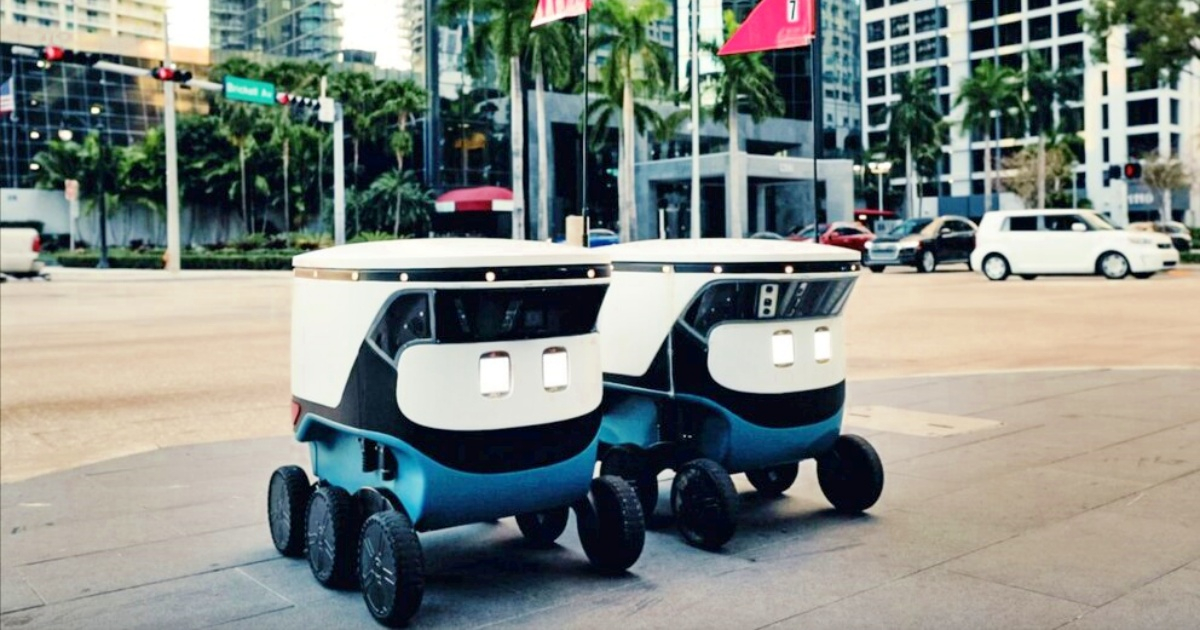
The Miami-Dade County Commission will vote on next Tuesday, November 17 on an ordinance to regulate autonomous delivery robots that operate on sidewalks, with speed limits, mandatory permits, new safety measures, and fines of up to $500 for operators who violate the rules.
The proposal, led by Commissioner Micky Steinberg, aims to establish a regulatory framework for these devices, which are becoming increasingly common on the streets of South Florida.
According to WLRN, the initiative aims to balance the development of this technology with the safety of pedestrians and the use of public spaces.
The ordinance project 261932, which is up for a second reading before the Commission, sets a maximum speed of 8 miles per hour (mph) on sidewalks, 6 mph in high pedestrian traffic areas, and 10 mph at crosswalks.
What will delivery robots have to adhere to?
Devices must yield to pedestrians at all times and come to a complete stop before entering a crosswalk.
They will also be prohibited from driving in school zones during the hours when special speed limits are in effect.
The ordinance prohibits robots from stopping at crosswalks or blocking accessibility ramps, public transport stops, fire hydrants, and other necessary spaces for circulation.
Moreover, it establishes a 30-minute inactivity limit on sidewalks, except when the robot is making a delivery or is in an area expressly authorized to remain stationary for a longer period.
Operators must remove any damaged or out-of-service device from public thoroughfares within a maximum period of six hours from when they become aware of the malfunction or should have detected it.
In terms of equipment, the robots must be equipped with front white lights and rear red lights, reflectors visible from different angles, obstacle detection systems, brakes capable of stopping them immediately, and audible alerts that can be heard from a distance of approximately 4.6 meters.
They should also incorporate geofencing technology, which allows for automatic speed control and prevents them from operating in restricted areas.
If you lose communication with the operator, you will need to have an automatic stop system in place.
Each unit must display an identification number and a QR code with the operator's contact information, or a phone number to reach them.
Permits, insurance, and fines of up to 500 dollars
The proposal requires companies to obtain a permit before deploying their robots.
These authorizations may have a maximum validity of one year and must be renewed in accordance with the established requirements.
The applications will need to identify the devices, the size of the fleet, the service areas, and the security protocols. Operators will also be required to provide a contact available 24/7.
Companies will be required to maintain a liability insurance of at least $100,000 and submit the corresponding certificate annually.
Operating without permission or failing to meet the insurance requirement will result in a fine of 500 dollars. For other violations, the penalties will be 250 dollars for the first offense and 500 dollars for a second or subsequent violation.
The regulations will also require real-time monitoring of robots and communication to the relevant department, within a maximum period of 24 hours, of any incidents related to their operation that cause material damage or personal injury.
Will robots be able to carry advertising?
Commercial advertising was one of the issues discussed during the analysis of the ordinance in the county's Transportation Committee.
Representatives from Serve Robotics emphasized the importance of the announcements for the company's business model, while several commissioners suggested the possibility of allowing them through specific agreements.
The version that will be put to a vote allows robots to display commercial advertising when there is a separate agreement between the operator and the county, approved by the Commission.
Without that agreement, they will only be able to display the commercial identification of its owner under the conditions set forth by the ordinance.
The text also acknowledges that the municipalities of Miami-Dade will be able to establish their own regulations for these devices, even with requirements that differ from those of the county.
A regulation that could be reviewed after a year
During the debate on the proposal, Steinberg explained that the goal is not to hinder the operation of delivery robots, but to find a balance between pedestrian safety, quality of life concerns, and the development of this activity.
The commissioner also argued that the regulations should be reviewed in light of the rapid evolution of the sector, to avoid unforeseen consequences and excessive regulation.
The project stipulates that, 12 months after it comes into effect, the county administration must present a report on its implementation and compliance to the Commission.
If the ordinance is approved, it will come into effect ten days later, unless it is vetoed by the county mayor. In the event of a veto, it will only take effect if the Commission overturns it through a new vote.
Related videos:
Filed under: