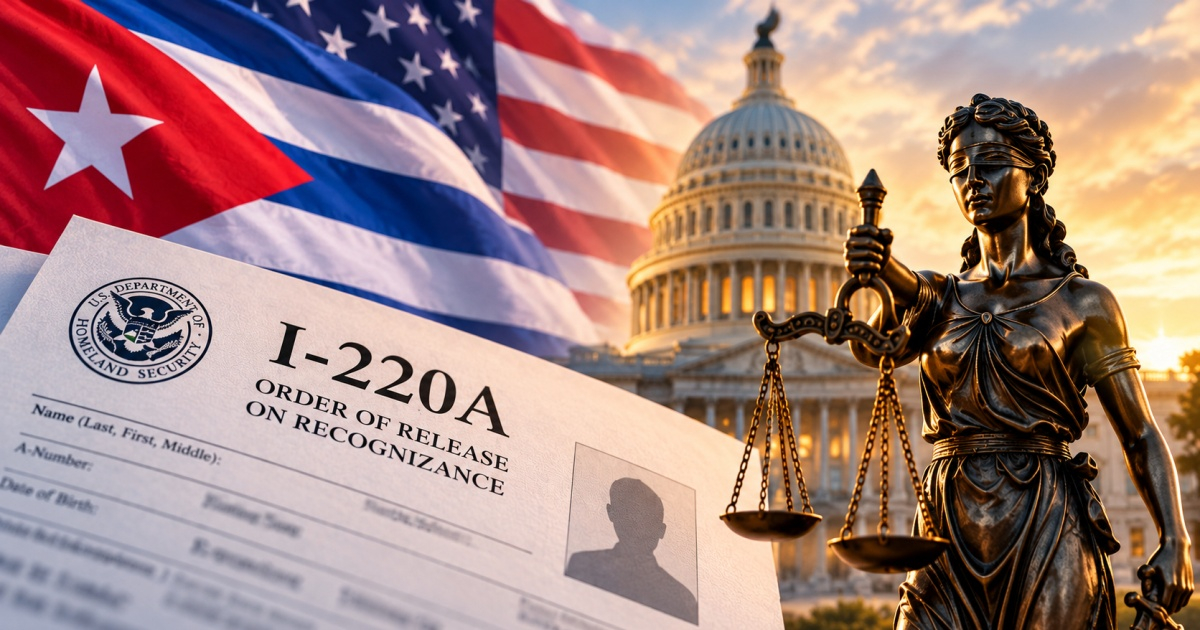
A federal court in Kentucky ordered the immediate release of a Cuban citizen who had been detained for nearly six months by Immigration and Customs Enforcement (ICE), concluding that his detention violated his constitutional rights, among other reasons, for not providing him with the I-286 form at the time of his arrest.
The ruling by Judge Rebecca Grady Jennings of the U.S. District Court for the Western District of Kentucky, signed on Tuesday, November 10, presents arguments that could be cited in other cases involving Cubans detained by ICE.
The case involves D.J.V.C., identified in the file as Damichel Jesús Viamontes Castellano, a native of Cuba. He was arrested by the Texas Border Patrol in 2022, received a Notice to Appear, and was released on his own recognizance.
In May 2026, ICE launched a targeted operation against him upon detecting charges of driving under the influence of alcohol and reckless driving, filed in February 2025. He was never convicted and completed all the required counseling programs.
On May 19, ICE arrested him, revoked his release, and transferred him to the Oldham County Detention Center in La Grange, Kentucky.
They were given the forms I-862, I-200, and I-826, but not the I-286. On July 28, an immigration judge ordered their deportation to Cuba. The appeal before the Board of Immigration Appeals (BIA) was still pending at the time of the ruling, so the order was not final.
What is the I-286 and why does it matter?
Form I-286, known as the Notice of Initial Custody Determination, is the regulatory mechanism that ICE must provide when detaining someone under section 1226(a) of the Immigration and Nationality Act.
Its importance lies in allowing the detainee to request a bail hearing before an immigration judge. Without that document, a person may remain locked up unaware that they have that right.
When the court specifically requested the I-286 for D.J.V.C., the Government was unable to provide it. Judge Jennings concluded that the form simply does not exist, which amounts to saying that ICE never conducted the individualized custody assessment required by federal regulations.
The judge rejected the government's argument that the detainee should first exhaust administrative remedies. "It would be unfair and absurd to require Castellano to exhaust an administrative process that the defendants themselves did not follow," she wrote in her ruling.
The defense also argued that D.J.V.C. had gone more than 120 days without any neutral judicial review of his detention, a situation that the court deemed harmful to his constitutional rights.
The judge also ruled that due process requires it to be the Government—and not the detainee, as established by the BIA precedent—who bears the burden of proof by clear and convincing evidence in bail hearings. If ICE arrests D.J.V.C. again without a material change in circumstances, it must hold a hearing with that burden of proof reversed.
Among the personal factors considered in the analysis, the resolution highlights that he is the father of a U.S. citizen born in Louisville in 2024, that the child's mother is a lawful permanent resident with an approved I-130 petition, and that he runs an active construction business in Kentucky.
What Cubans with I-220A detentions should check
Although the ruling was issued by a federal court in Kentucky, within the Sixth Circuit, and does not bind judges in Florida, the argument of I-286 could be invoked in habeas corpus petitions for Cubans detained in Krome, Broward, or the center known as "Alligator Alcatraz," depending on the circumstances of each case. The Eleventh Circuit already acknowledged in May 2026 the right to a bail hearing under §1226(a) for detainees within the country.
In the event of any detention of a family member with an I-220A, it is advisable to verify if ICE provided all the forms at the time of the arrest: the I-200 (arrest order), the I-826 (notice of rights), and critically, the I-286. If the latter is missing, its absence may provide a significant basis to challenge the detention through a habeas corpus petition in federal court, depending on the circumstances and the applicable legal framework.
The landscape varies drastically depending on the location of detention. The Fifth Circuit —Texas, Louisiana, and Mississippi—, where the largest ICE detention infrastructure is concentrated, ruled on October 23, 2026, that certain immigrants without formal admission do not have an automatic constitutional right to a bond hearing, closing that avenue for many detainees in that area. In the event of any arrest, experts emphasize the importance of consulting an immigration attorney immediately.
Related videos:
Filed under: