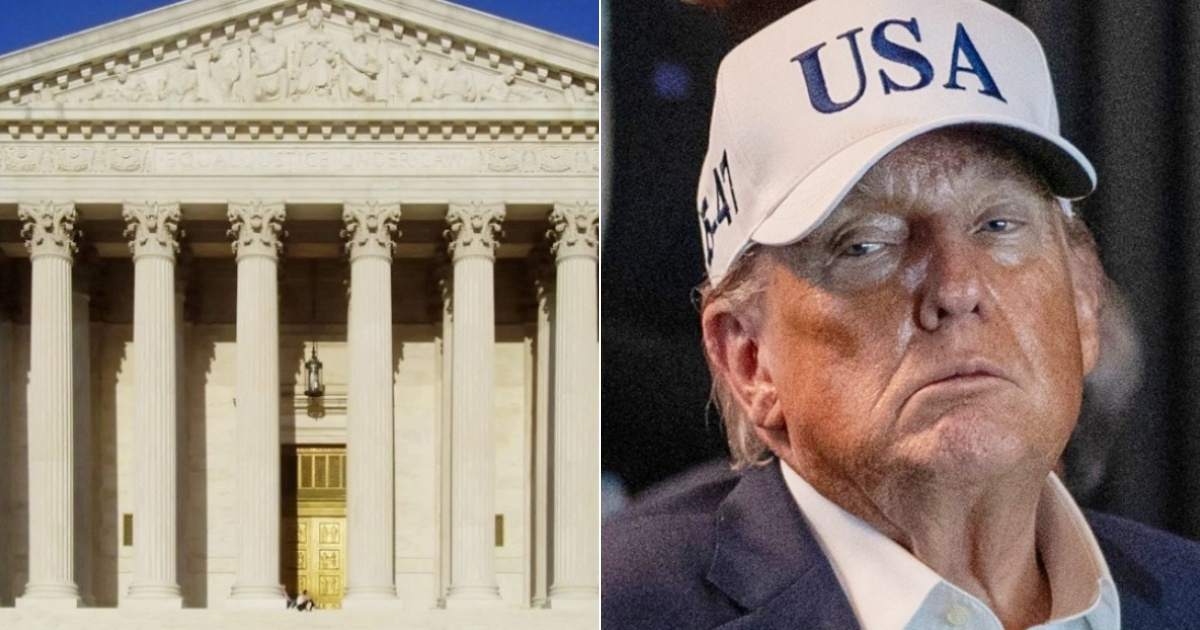
The Supreme Court of the United States agreed this Friday to review the legality of the asylum ban imposed by the Trump administration at the southern border, in a decision that could redefine access to international protection for thousands of migrants, including Cubans.
The case, Mullin v. Refugee and Immigrant Center for Education and Legal Services (No. 26-239), was granted limited admission to two questions: whether the presidential proclamation suspending asylum is legal, and whether federal law prohibits the classwide relief issued by a lower court.
The Proclamation No. 10,888, signed by Trump on January 20, 2025, declared an alleged "invasion" at the southern border and invoked presidential emergency powers to suspend the entry of foreigners crossing irregularly and block their access to the asylum process.
The measure also ordered the immediate repatriation of those who violated it, and the informal guidelines from the Department of Homeland Security instructed agents not to ask questions about fear and to refer only those who spontaneously expressed fear of torture to a restricted evaluation under the Convention Against Torture.
Two federal courts have already declared that proclamation illegal. The district court for the District of Columbia struck down the measure in July 2025, and the D.C. Circuit upheld that decision in April 2026. However, the mandate of that ruling remains suspended, meaning that the ban is still effectively in place while the litigation continues.
La decisión del Supremo sobre el asilo podría tener consecuencias directas para miles de cubanos en la frontera. Sigue todos los detalles y novedades en nuestra sección de
For Cubans attempting to reach the southern border, this does not change anything immediately: anyone who crosses between ports of entry cannot access the regular asylum process. In the best-case scenario, if they spontaneously express a fear of being tortured, they may be referred to a CAT evaluation, a narrower pathway that does not lead directly to permanent residency.
It is essential to distinguish between asylum and the Cuban Adjustment Act, as they are completely different pathways. The Cuban Adjustment Act does not require proving persecution, but it does require having been inspected, admitted or granted parole, and having accumulated at least one year of physical presence.
Many Cubans who crossed between 2021 and 2023 received an I-220A form — order of release on recognizance — which does not equate to parole and does not meet that requirement, as confirmed by the Board of Immigration Appeals.
This case is the third in a particularly dense period for the Supreme Court regarding immigration matters. Oral arguments will be held on December 9 in DHS v. D.V.D. (No. 26-426), concerning deportations to third countries without prior notice, a case led by a Cuban who is litigating under a pseudonym.
Also pending is Rhoney v. Barbosa da Cunha (No. 26-104), concerning the detention without bail of individuals who entered without formal admission, which directly affects Cubans detained in Texas and Louisiana.
The situation for detainees in those states is particularly dire. Cuban-American attorney Wilfredo Allen warned this week that the Fifth Circuit, which covers most immigration detention centers, is the worst place for a detained immigrant in the country, following a recent ruling that severely hampers access to habeas corpus in that jurisdiction.
The government defends the proclamation by arguing that it has reduced irregular crossings by 93%, bringing them to the lowest levels since the 1960s. The Secretary of Homeland Security, Markwayne Mullin, referred to it as an "essential tool for maintaining operational control of the border."
The American Civil Liberties Union (ACLU), which represents the plaintiffs, rejected that justification. "The president does not have the right to unilaterally revoke the protections that Congress granted to those fleeing danger," stated Lee Gelernt, the lead attorney on the case. "We look forward to presenting our arguments before the Supreme Court."
Oral arguments in Mullin v. RAICES are expected in the spring of 2027, with a final decision anticipated before the end of June that year. Given the complexity of the legal landscape, experts recommend that any Cuban with an open immigration case consult an immigration attorney before making any decisions.
Related videos:
Filed under: