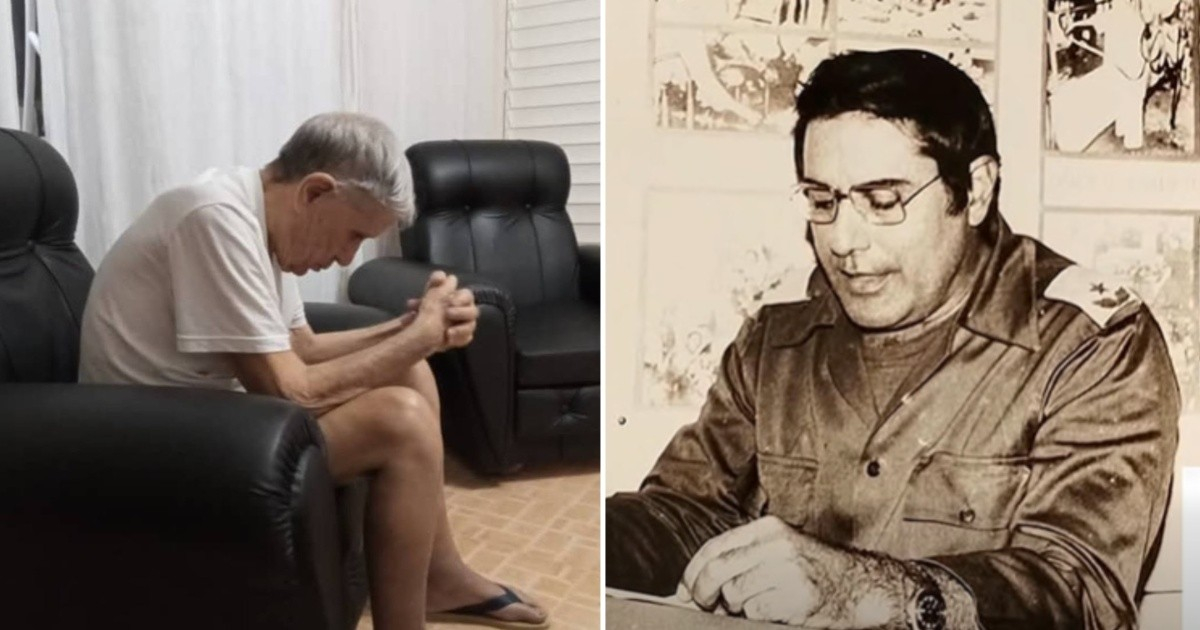
The death of Gustavo Fleitas Ramírez, a reserve brigadier general, sparked a heart-wrenching testimony this week: his own son publicly revealed that when he was imprisoned by the Cuban regime, his father requested that he be executed for being a “traitor to the homeland.”
One of Fleitas' sons, identified on Facebook as Guitera Antonio, announced his father's death in a post filled with pain and contradiction. "He devoted his entire life to that damned Revolution, leaving his family behind," he wrote, before adding the phrase that encapsulates decades of hurt: "He was my executioner but my heart refused to hate him."
The text, written with the irregular spelling of spontaneous pain, concludes with a "Rest in peace, General," which encapsulates both the resentment and the love of a son for a father who prioritized ideological loyalty over blood ties.
The son himself had shared on social media that his father was living in complete neglect after having served the regime.
The Ministry of the Revolutionary Armed Forces (MINFAR) announced the death in an official statement read on the National Television News, with the usual solemn and laudatory tone: it presented Fleitas Ramírez as an exemplary figure without mentioning the family fracture at any point.
According to that note, the general joined the Movimiento 26 de Julio from a young age and in February of 1958 he joined the insurrectional struggle in the Sierra Maestra, in the Third Front "Doctor Mario Muñoz", under the command of Commander Juan Almeida Bosque.
Upon the triumph of the Revolution, he was promoted to first lieutenant, and throughout his career, he held positions of high responsibility: chief of the tank battalion, commander of the Holguín Army Corps, second chief of the Western Army, and chief of the Central Army, among others.
He fulfilled four internationalist missions: two in Angola —as the head of the southern troops grouping and deputy head of the military mission— and two in Ethiopia —as the tank brigade chief and head of the Cuban military mission—.
He also participated in the battles of Playa Girón and in the so-called "clean-up of Escambray." He was a founder of the Communist Party of Cuba and received decorations that include the orders of valor Antonio Maceo, Camilo Cienfuegos, and Ernesto Che Guevara.
His body was cremated. The ashes will be placed in the Veterans' Pantheon of the Colón Necropolis for later transfer to the Mausoleum of the Third Front in Santiago de Cuba, where he will receive military honors.
The coexistence of both narratives —the official one that constructs a hero, and the intimate one that exposes a father who requested the execution of his son— illustrates a fracture that the Cuban regime has never acknowledged: the systematic subordination of family ties to ideological loyalty.
The passing of Fleitas Ramírez marks the gradual disappearance of the historic military generation of the Revolution. So far in 2026, several reserve generals have died, including William Gálvez Rodríguez in July, at the age of 92, and Alcibíades Wilmer Pérez Rivero, also in July, in addition to Claro Orlando Almaguel Vidal in January.
Related videos:
Filed under: