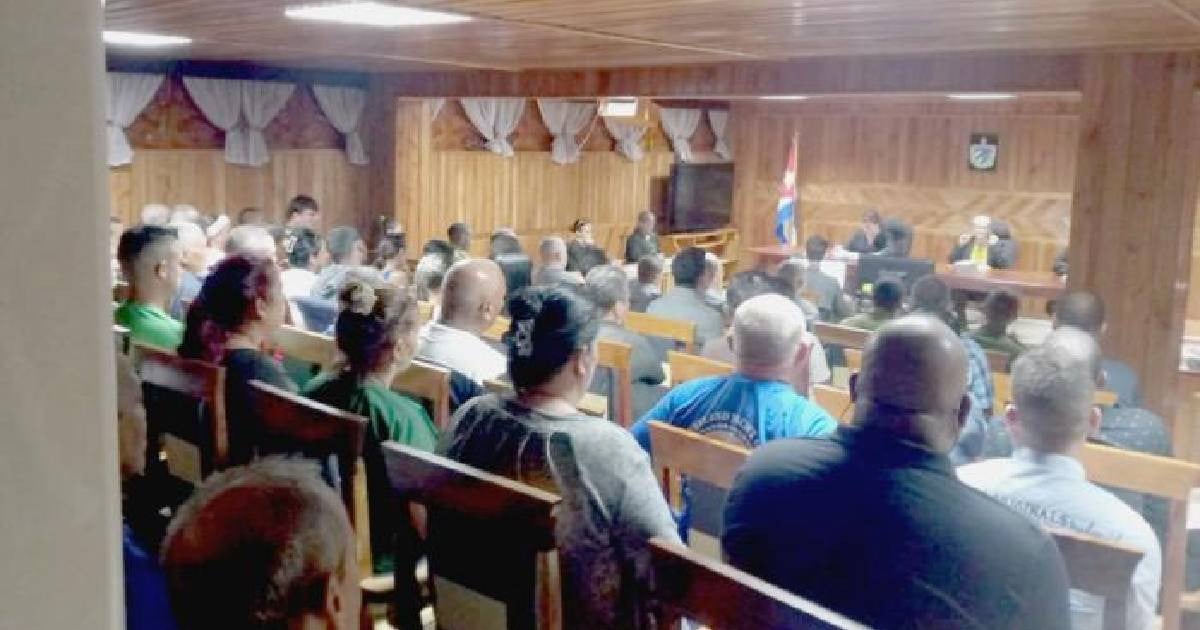
Five men were sentenced in Ciego de Ávila for stealing 600 liters of dielectric oil from an electrical substation, a crime that disrupted service to four rural communities.
The two perpetrators received sentences of 12 and nine years of imprisonment, respectively, while three other men were penalized for receiving stolen goods after knowingly purchasing part of the oil taken illegally.
The case was published on Monday by the official newspaper Granma, which reported on the judicial process without specifying the exact date of the trial. The case was tried by the First Criminal Chamber of the Ciego de Ávila Tribunal, operating under the State Security Crimes Chamber of the Provincial People's Tribunal of Camagüey.
The events took place in the early hours of March 28, when the perpetrators broke the screws securing the cover of the transformer at the Cítrico Uno substation, located on the road to Purial in Ceballos, and extracted 600 liters of oil, which they stored in 20-liter containers.
The shipment was transported by an animal-drawn vehicle to the vicinity of the Casualidad farm, owned by the father of one of the accused. There, three men purchased it to use on the land they cultivated together.
A raid conducted by officials from the Ministry of the Interior that same afternoon led to the recovery of 440 liters. The remaining 160 liters never surfaced, resulting in an economic impact on the provincial Electric Company.
The theft rendered the transformer unusable and left about 1,750 customers in Benítez, El Purial, Los Sánchez, and Guillet without service for hours. Among the consequences were food loss and the shutdown of water pumps, the source reported.
The Provincial Prosecutor's Office charged the five men, one of whom is just 19 years old, with the crime of sabotage, as outlined in Article 125 of the Penal Code. However, the court convicted the two individuals responsible for the theft of that crime, while the other three were convicted for receiving stolen property, as specified in Article 425.1.3.
In addition to prison sentences, all received supplementary penalties of deprivation of rights and prohibition from leaving the national territory, as well as the obligation to compensate for the material damage caused to the Electric Company.
Among the evidence presented was a report from criminal olfactometry that established matches between an odor trace found at the substation and the impressions taken from two defendants. A chemical analysis was also presented, confirming that the recovered samples corresponded to dielectric oil used in transformers.
The case adds to a series of dielectric oil thefts that worsen the problems of electrical infrastructure in Cuba. The scarcity of fuels and the demand from the black market have turned this product into a commodity that is resold as a substitute for diesel for tractors and agricultural machinery, at prices ranging from 600 to over 1,000 pesos per liter.
Only in Ciego de Ávila, one of the provinces most impacted by this type of crime, 32 incidents were recorded in 2024 and 41 in 2025, affecting 84 transformers and resulting in more than 14,440 liters stolen during that last year. A
Between 2025 and the first half of this year, more than 460 criminal investigations were initiated for offenses against the National Electric System (SEN), including sabotage, damage, burglary, theft, and receiving stolen goods, officials confirmed in early September during the official television program Hacemos Cuba.
The province has also recorded at least two deaths since 2025 in incidents related to attempts to rob the electrical system, according to previous reports.
The publication by Granma sparked questions from readers regarding the proportionality of the penalties and the criminal treatment of those who purchase stolen goods. "Once again, the penalties are very lenient. If it is sabotage, why such lenient penalties for the criminals and the receivers?" wrote a user.
Another reader argued that buyers should also receive punishments equivalent to those of the primary perpetrators. "Participants in a crime should be penalized with the same sentence, including the receivers; they encourage the crime," he commented.
The legal framework invoked for these processes includes Opinion 475/2025 from the People's Supreme Court, approved in May 2025, which classifies acts aimed at damaging or stealing components of the electrical system as sabotage and imposes penalties ranging from seven to 30 years in prison, life imprisonment, or the death penalty in aggravated cases.
Related videos:
Filed under: