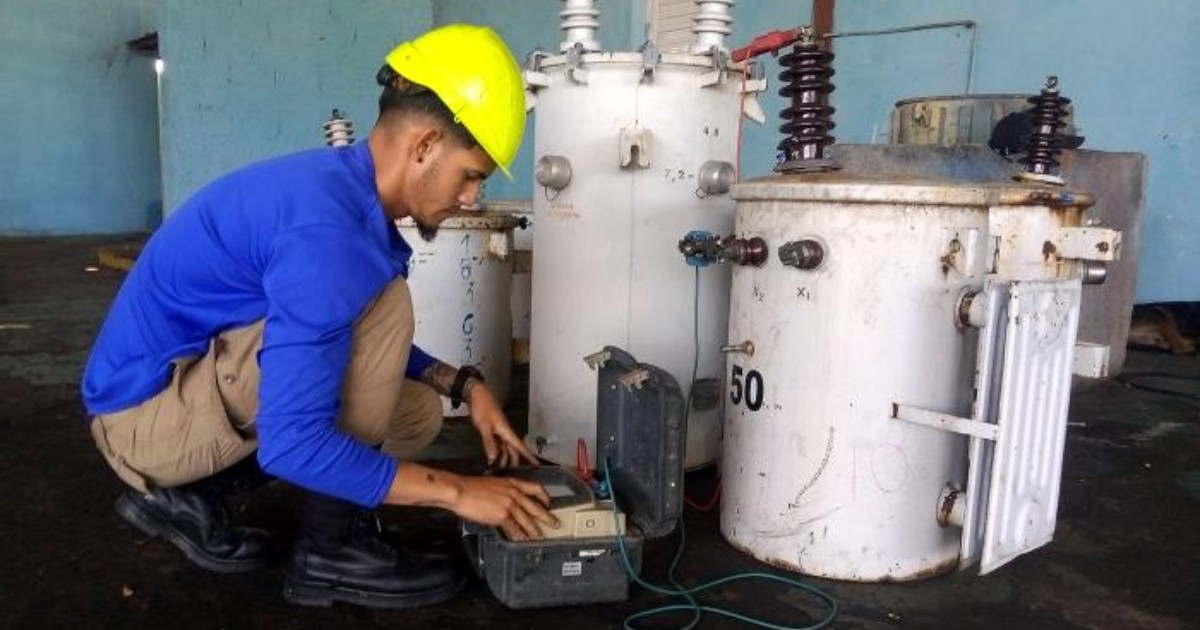
At least two people have died since 2025 in Ciego de Ávila in incidents related to attempts to steal components from the electrical system, a practice that Cuban authorities themselves acknowledge has spread throughout the country and particularly affects transformers.
The official newspaper Granma addressed this phenomenon on Wednesday and detailed two fatal cases that occurred in that province, as well as the economic damages and the illegal market surrounding dielectric oil.
The most recent case occurred on August 16 in the Gutiérrez settlement, Baraguá municipality, where, according to the report, a man died from electrocution after climbing a bank of transformers presumably to extract dielectric oil.
The other incident occurred in 2025, in a peripheral neighborhood of the city of Ciego de Ávila, where a man received a shock of 13,000 volts and fell from about six meters high while supposedly attempting to steal electrical wiring.
The article from Granma initially reported that "so far in 2026," at least two people have died in the province while attempting to extract dielectric oil.
However, one of the very cases he uses to support that figure occurred in 2025 and was related to an attempt to steal cable, not oil.
Beyond that temporal inconsistency, the data released reveals the extent of the problem.
According to figures attributed to the Attorney General's Office, there have been more than 300 reports of theft of dielectric oil and other components of the electrical system between 2025 and 2026.
The provinces with the highest incidence would be Matanzas, Ciego de Ávila, Mayabeque, Santiago de Cuba, and Artemisa, according to official information.
The dielectric oil serves two essential functions in transformers: to electrically insulate their components and to help dissipate heat.
Its removal can cause overheating, short circuits, and damage that may render the equipment inoperable.
Only in Ciego de Ávila, between January and April of this year, the damages related to the theft of oil exceeded one million Cuban pesos and affected 88 transformers, some of which had to be technically decommissioned, according to Granma.
The replacement also poses a problem for an electricity grid marked by a shortage of equipment.
The regime's official newspaper claims that acquiring a transformer can cost more than 45,000 dollars in the international market, while the lack of available units may prolong service disruptions in affected communities for days or even months.
The economic incentive is found in the illegal market. According to the publication, the stolen oil can be sold for up to 600 Cuban pesos per liter and used as fuel in vehicles and agricultural machinery.
The provincial courts have already judged multiple cases of these crimes. In May, it was reported that several individuals accused of stealing dielectric oil and cables in Ciego de Ávila faced charges of sabotage with sentences ranging from seven to 12 years in prison.
The data released at that time indicated that in 2024, 32 incidents and more than 13,700 liters of oil stolen were recorded in the province, while in 2025, 41 incidents, 84 affected transformers, and more than 14,440 liters stolen were counted.
The deadly risks associated with handling transformers are not limited to Ciego de Ávila.
In April, a man died and another suffered severe burns in Santiago de Cuba, following an explosion that occurred during an attempt to steal dielectric oil, as reported at the time by the provincial Electric Company.
In that same province, another man lost his life in September 2025 while attempting to extract oil from a transformer on the Siboney road.
Additionally, last July a young man was seriously injured after an electric shock in Santiago de Cuba in another alleged attempt to steal oil.
Related videos:
Filed under: