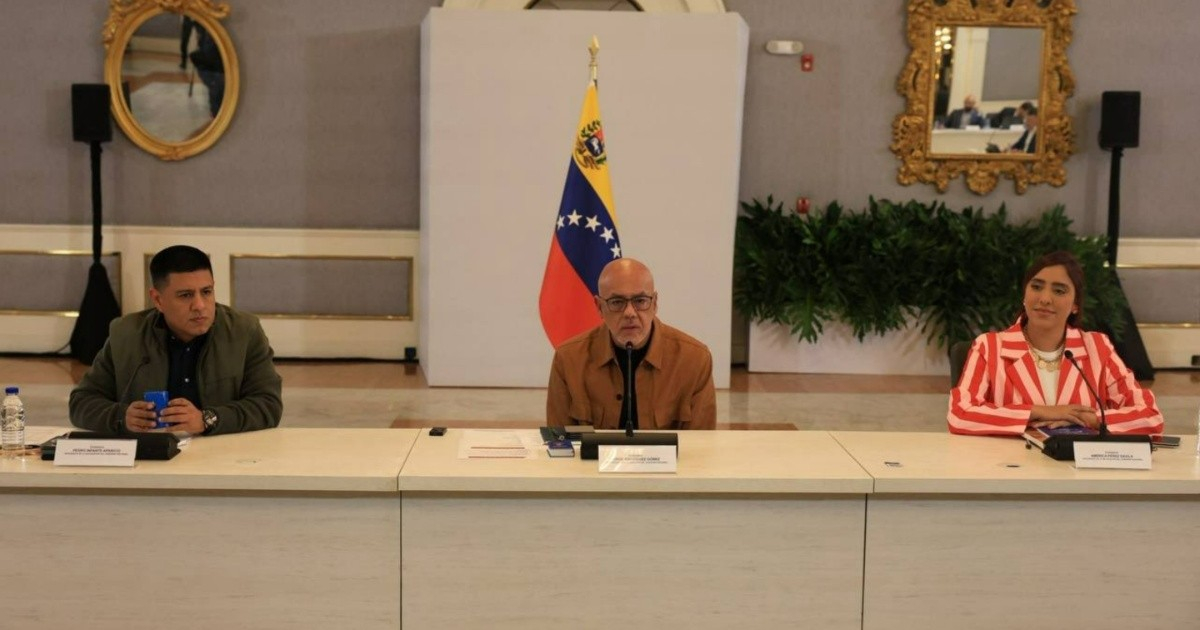
Chavismo and a sector of the Venezuelan opposition inaugurated the fourth cycle of negotiations driven by the United States this Friday, meeting behind closed doors at the Gran Meliá Caracas Hotel with the aim of laying the groundwork for a potential electoral call, according to EFE agency.
The delegation of the Chavista regime is led by Jorge Rodríguez, president of the National Assembly, while the opposition is led by Dinorah Figuera. The party of María Corina Machado —Nobel Peace Prize 2025— does not have direct representation at the table, although the opposition leader has expressed her support for the process and is hopeful that it will lead to elections.
This is the first round of conversations since Machado returned to Venezuela on October 25, after nearly ten months abroad. Since her return, the former congresswoman has met with activists, families of political prisoners, and university students, but her direct participation in the meetings is not expected.
The appointment is expected to last approximately a week, with the possibility of being extended.
The agenda for the fourth cycle focuses on pending legal reforms. The former opposition deputy Desiree Barboza, a member of the technical committee on political guarantees, explained to EFE that the Political Parties Act, the Anti-Terrorism Financing Act—commonly used to accuse protesters—and the Organic Law of the General Comptroller's Office of the Republic will be reviewed, specifically "the matters related to political disqualifications" that have affected dozens of opponents, including Machado herself, who has been disqualified by the regime from participating in the 2024 presidential elections.
The situation of exiled opponents and the release of political prisoners is also expected to be addressed, although the release of prisoners has not formally appeared on previous agendas, and continuing to make progress on the renewal of the Supreme Court of Justice, the nomination process for which must conclude on December 11 with the appointment of new judges.
Chavismo, for its part, maintains among its main demands the lifting of sanctions and the unlocking of Venezuelan gold held in the Bank of England, a point agreed upon in the first cycle but that has yet to be realized.
The negotiation process officially began on August 7 at the La Carlota airbase in Caracas. In the three previous rounds, the parties agreed on a complete renewal of the Supreme Court, the unblocking of previously restricted websites, and the review of disqualification laws. The second round ended with the release of 39 political prisoners. However, the renewal of the National Electoral Council and the call for presidential elections remain unresolved.
Figuera estimates that “fair and secure elections” could be held at the end of 2027 or the beginning of 2028, but warns that it is necessary to “dismantle the apparatus surrounding” the electoral system first.
The roadmap supported by Washington, detailed by Secretary of State Marco Rubio on November 9, outlines that the new Supreme Court should be established by mid-December and that the new electoral council should be formed "shortly thereafter." According to this plan, the interim president Delcy Rodríguez would then need to declare the presidency vacant, opening a six-month period for the calling of elections. Rubio noted that there are still issues to resolve, including ensuring the vote of the over seven million Venezuelans living abroad.
Machado, whose team has expressed willingness to meet with Rodríguez, recently stated that the political transition in Venezuela is "irreversible" and that he hopes the dialogue will achieve its fundamental goal: the call for elections.
Related videos:
Filed under: