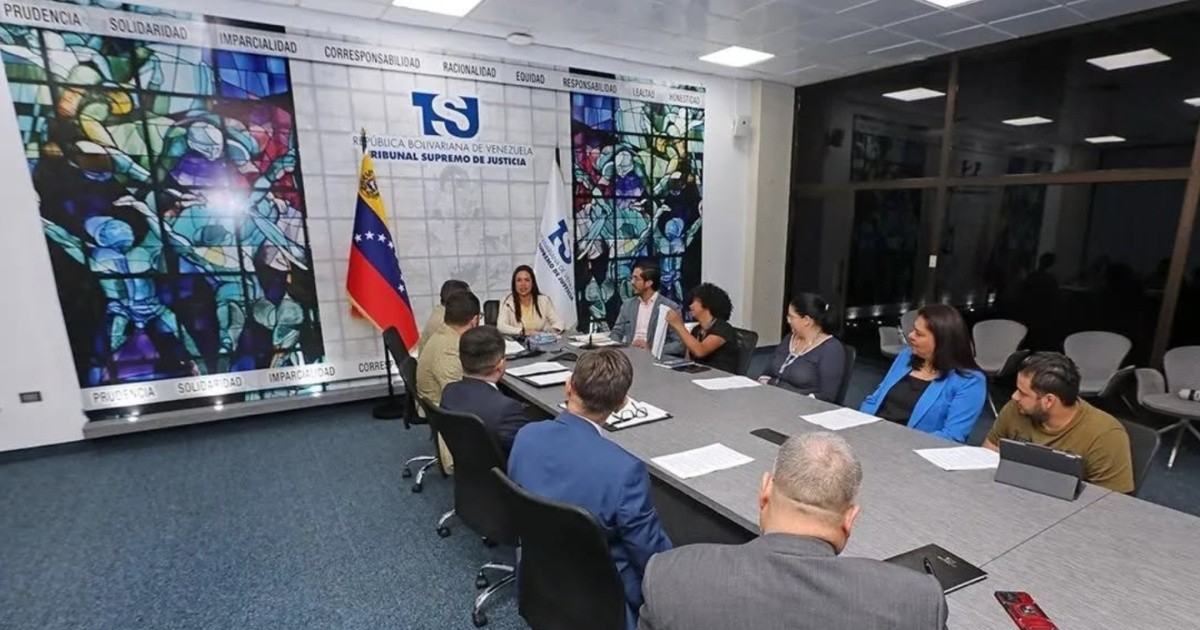
The Chavista regime and the Venezuelan opposition represented by the National Assembly of 2015 (AN) signed a joint statement this Wednesday in Caracas that concludes the First Cycle of Conversations and includes specific agreements to completely renew the Supreme Tribunal of Justice (TSJ) of Venezuela.
The document was signed by Jorge Rodríguez, head of the Venezuelan government delegation, and by Dinorah Figuera, president of the 2015 National Assembly and leader of the opposition delegation, within the framework of the transition dialogue formally initiated on August 7 at La Carlota airbase in Caracas.
The agreement regarding the TSJ includes four steps: reforms to the Organic Law of the court and other laws of the justice system; renewal and expansion of the judicial nominations committee; activation of a new nomination process for the appointment of all magistrates; and the establishment of a council for reviewing the credentials and requirements of the candidates, based on the Constitution and evaluation standards.
The statement specifies that "the timetable for implementing the agreements will begin this August with official announcements and concrete actions, under a continuous working mechanism that ensures the strict adherence to each commitment."
Figuera had previously noted that the schedule includes the appointment of the new TSJ in November and the renewal of the National Electoral Council in December, which would signify the conclusion of the process before the end of 2026.
The dialogue was prompted by the United States seven months after the capture of Nicolás Maduro, and it represents the ninth attempt at negotiation between chavismo and the opposition, although it is the first with explicit and active support from Washington.
The statement also agreed to work on the recovery of Venezuela's international reserve assets deposited in the Bank of England to assist the victims of the double earthquake on June 24, which left at least 6,125 dead and nearly 18,000 people homeless.
The parties committed to establishing "mechanisms for transparency, traceability, and auditing in the efficient use of the same."
The process faces, however, significant fractures. The Democratic Unitary Platform (PUD), which includes María Corina Machado and the opposition figure Edmundo González Urrutia, was excluded from the table for not being members of the 2015 National Assembly.
From that perspective, the PUD demands "the cessation of political persecution and the restoration of civil rights as essential conditions to advance towards a true national reconstruction."
From the other end, hardline sectors of chavismo protested in Caracas against the dialogue, labeling it as an imposition from Washington.
The agreement regarding the TSJ has direct precedents: in April 2026, the AN activated a commission to renew magistrates; in May, it approved a reform that expanded the court from 20 to 32 magistrates; and in June, 561 applications were recorded to fill the vacancies. Analysts at the time noted that these reforms did not alter the political dominance of chavismo over the judiciary.
The agreement of August 12 represents the first concrete and verifiable outcome of this cycle of discussions, and it is the first time that the opposition has formally participated in the design of the judicial renewal process in Venezuela.
Related videos:
Filed under: