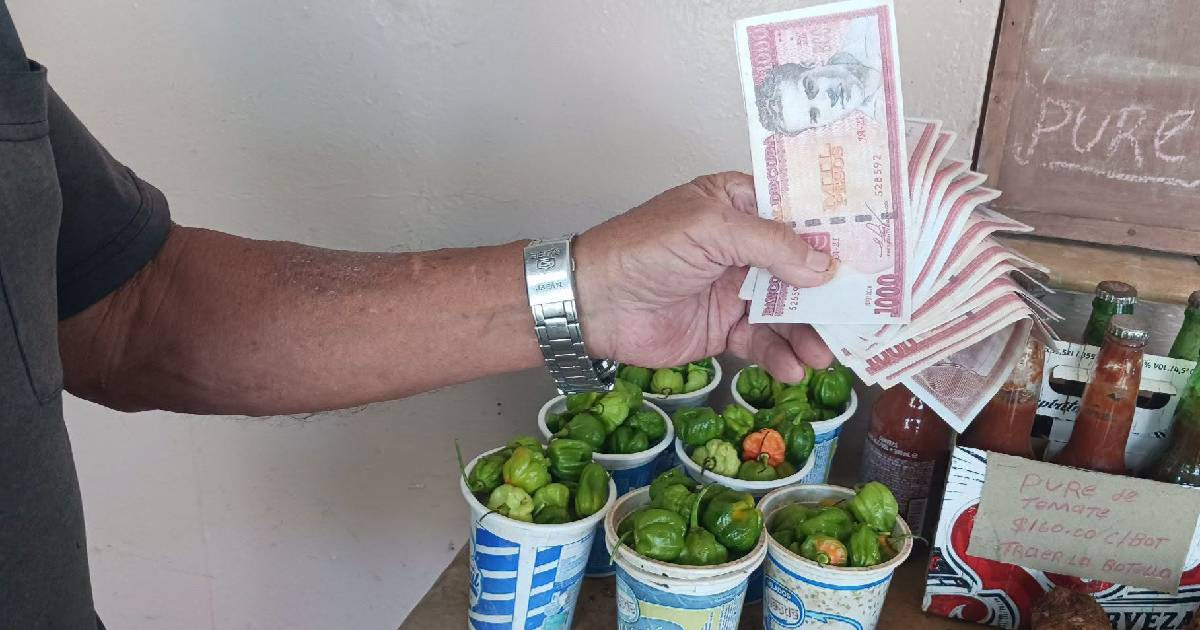
A Cuban retiree identified as Salvador received 25 counterfeit 1,000 peso bills as payment for a purchase of rice at his small produce stand, according to a report published this Friday on Facebook.
The alert was issued by Marlene Caboverde, an employee of the station Radio Jaruco and a resident of San José de las Lajas, Mayabeque province, who described the bills as mere prints made on a home printer, lacking security features to ensure their authenticity.
According to the publication, the individual in question would be a man between 30 and 40 years old, white, well-dressed, and wearing glasses, who approached the stall as a customer and bought rice.
Caboverde highlighted that Salvador is a retiree who makes a living selling food and, at times, helps people who have nothing to eat. For this reason, he characterized the deceit as an act of particular cruelty against someone trying to survive honorably.
"While some are earning a living honestly, there are abusers and heartless individuals out there deceiving and harming others. BE CAREFUL," he warned.
The complaint sparked outrage among those who commented on the post. "I don't know how they can go to bed and sleep peacefully," one person remarked. Another shared that her mother had experienced a similar scam.
There were also those who asked not to hold Salvador accountable for failing to detect the counterfeit, as the bills can be difficult to identify at first glance. Some users recommended checking their physical characteristics, while others defended electronic transfers as an alternative to reduce these frauds.
The case adds to other alerts regarding the circulation of counterfeit currency in Cuba. In July, a report from Guantánamo detailed a method that used authentic 200 peso bills that were altered to resemble denominations of one thousand. In August, warnings emerged about counterfeits of 500 peso bills made from five peso bills.
In September, six people were arrested in Manzanillo, Granma, for circulating counterfeit bills of the new denominations of 2,000 and 5,000 pesos. More recently, a police operation in Cárdenas, Matanzas, led to the seizure of 82 counterfeit 100 dollar bills at an individual's residence.
Counterfeiting adds another risk for those who rely on cash sales in a country marked by challenges in accessing banking services and conducting electronic transactions.
The Cuban Penal Code imposes penalties of four to ten years of imprisonment for manufacturing, altering, introducing, or distributing counterfeit currency.
Related videos:
Filed under: