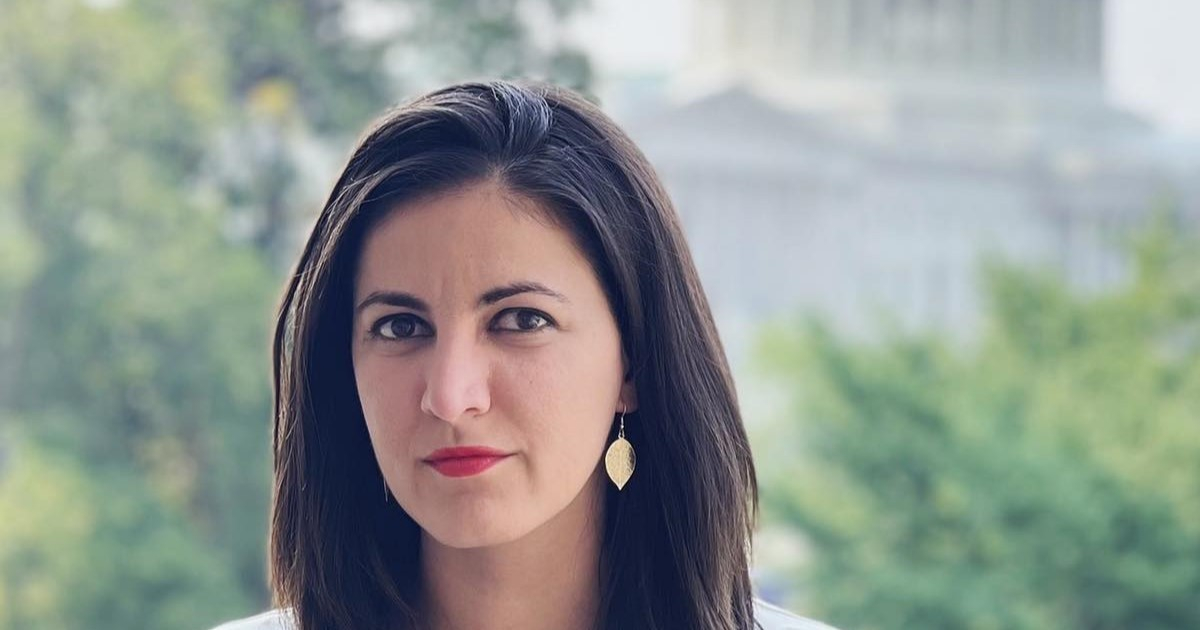
The Cuban opponent Rosa María Payá accused the Government of Spain of having ignored the suffering of the Cuban people and expressed her hope that the general elections on the upcoming 29th of November will bring about a change in Spanish policy towards the dictatorship in Havana.
The activist urged Spaniards to vote "for freedom" and for the next government to abandon what she considers a complacent attitude towards the regime.
According to an interview published this Sunday by El Nacional, whose statements were also reported by Europa Press, Payá criticized Pedro Sánchez's government for maintaining a lenient stance towards the Cuban dictatorship.
"It is inconceivable how the current Spanish Government has ignored the suffering of the Cuban people," stated the founder of Cuba Decide, who also criticized what she views as a favorable attitude towards the advancement of communism and leftist forces in Latin America.
Nonetheless, he maintained that the Spanish government can still change its position before leaving power, if there is a change in leadership following the elections.
«They have a few days left. Hopefully, they reconsider, because change in Cuba is going to happen with or without the support of Europe. One can only hope that, when that happens, the Spanish and the Europeans will be on the side of the Cuban people,» he stated from Madrid.
Payá expressed his confidence that the Spanish would "vote for freedom" on November 29 and linked the electoral outcome to the possibility of changing Spain's and the European Union's stance towards the Cuban regime.
I hope that the new Spanish government is, from day one, on the side of the Cuban people and that it is bold in front of the European Union to change the position of silence and inaction of the community Executive regarding the Cuban dictatorship," he declared.
The opposition member recalled that Spain hosts, in her words, the second largest Cuban diaspora in the world, which is why she considers Madrid's stance on the island's political future to be especially important.
He also demanded measures against the assets he attributes to the leadership of the Cuban regime and their relatives outside of Cuba.
"The assets held by the Castro royal family in Madrid and elsewhere in the world belong to the Cuban people and should be frozen," he stated.
When comparing the international position of different governments, Payá identified the United States as the main external support for those advocating for political change in Cuba.
The activist stated that Washington is "at this moment, the best ally of the Cuban people" and highlighted the U.S. measures aimed at increasing pressure on the leaders of the regime.
He also mentioned Costa Rica and Ecuador as countries whose governments have altered their diplomatic relations with Havana, decisions he interpreted as signs of international support for the democratic aspirations of Cubans.
In his statements, Payá also linked Nicolás Maduro's exit from power in Venezuela to a shift in the expectations of Cuban leaders.
According to the opposition figure, the impunity of those governing the island "is over," a sentiment through which she expressed her confidence that accountability can also be demanded from the leadership of the Cuban regime.
Payá defended the so-called Agreement of Liberation, signed on March 2 in Miami by opposition organizations led by the Assembly of the Cuban Resistance and Steps for Change, and later ratified in Madrid.
The document outlines what its promoters consider to be the "minimum terms" to initiate a democratic transition in Cuba. Among them is the removal of the Castro family and the generals who, according to Payá, have upheld the political system for decades.
The opposition leader stated that those leaders "are incompatible with a real transition process that ends in free elections."
Another condition is the immediate release of political prisoners. Payá affirmed that this decision could be implemented within hours if there were political will.
"The doors of those dungeons can be opened in 24 hours, and the more than 1,300 political prisoners in Cuba must be freed," he declared.
The agreement also requires an end to political persecution and the guarantee of fundamental rights such as freedom of expression, association, and civic participation.
"There is no transition with repression. The end of repression means immediately guaranteeing certain fundamental rights that are essential in a real process of transition to democracy," he stated.
Payá's proposals are part of the strategy he presented on November 3rd in Madrid during the meeting "Cuba on the Threshold," conceived as a roadmap to organize a democratic transition on the island.
The plan includes an initial phase of liberation, followed by a period of stabilization and reconstruction aimed at reestablishing institutions, addressing the needs of the population, and preparing for the country's democratization.
Among its proposals is the formation of a provisional Government with a limited mandate of 18 to 36 months, without the possibility of extension, as well as the holding of a constitutional plebiscite and free elections.
For Payá, the process must be led by the Cubans themselves and involve the participation of citizens residing both inside and outside the island.
He insisted that international support must accompany this initiative and help ensure the conditions for change.
The opposition leader described the situation in Cuba as a "humanitarian catastrophe" and warned about the demographic decline of the country.
“Last year, twice as many people died as were born in Cuba. People are dying,” he reported.
His statements come during the Spanish electoral campaign, after the Popular Party included in its program a commitment to support the democratization of Cuba and demand the release of political prisoners if it comes to power.
This week, Payá also met in Madrid with Isabel Díaz Ayuso, President of the Community of Madrid, expressing her gratitude for support of the Cuban democratic cause.
Related videos:
Filed under: