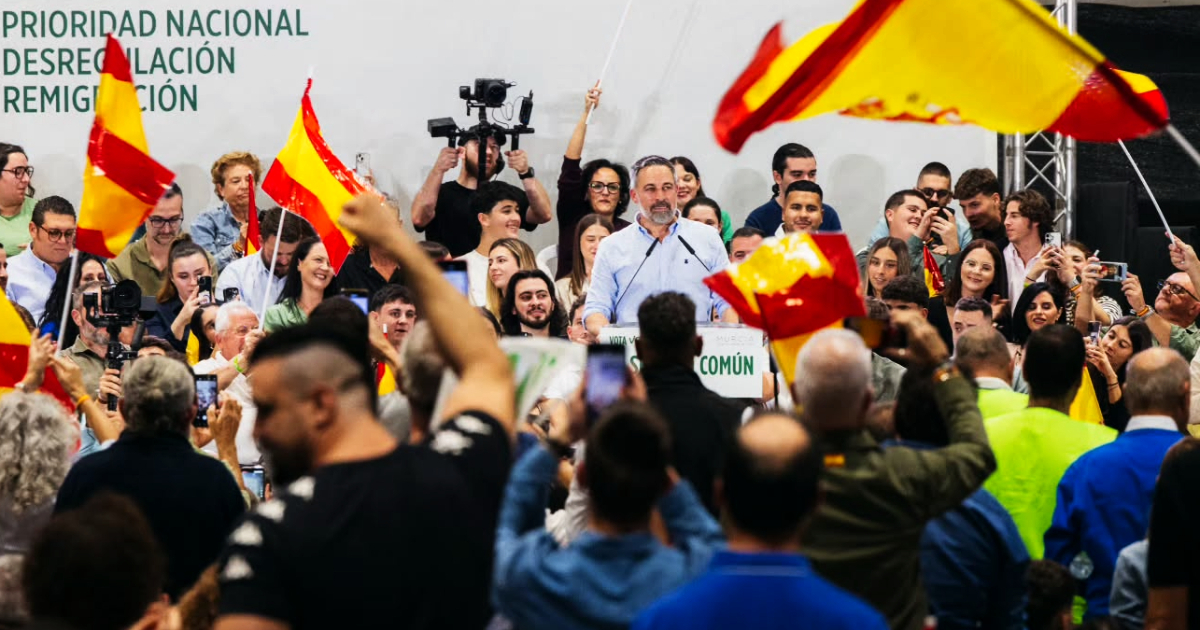
Vox presented on Thursday its electoral program for the general elections on November 29, a 65-page document with 115 measures grouped into thirteen blocks centered around three key axes: «national priority», «deregulation», and «remigration».
Several of these proposals would directly affect the more than 252,000 Cubans residing in Spain.
The measure that stands out the most is the “tax on remittances abroad,” included in the national priority block under the title It’s Common Sense. The statement is brief: “The money generated here should improve the economy and services for those living in Spain.”
A single line without a percentage, without exemptions, and without specifying whether the tax would apply only to foreigners or also to Spaniards sending money abroad—which would include Cubans who have already been naturalized.
The economic impact of this measure is considerable. According to the Bank of Spain, in 2025, around 12.4 billion euros left the country in remittances, which is equivalent to about 34 million daily and 0.7% of the GDP.
Spain currently does not impose any general tax on money transfers abroad; the transfers are only subject to bank fees. There is no official breakdown of what Cubans send from Spain to the island, although academic estimates place the average amount sent by a Cuban resident in Madrid at around 1,600 dollars annually.
The dilemma posed by the program is specific to this community.
Vox is the party that most harshly criticizes the Cuban dictatorship —Santiago Abascal received the dissident José Daniel Ferrer in May and described the regime as "criminal"— and, according to microdata from the CIS analyzed by El Debate, it holds 27% of the voting intention of Cubans in Spain, ahead of the PP with 26%.
However, that same program toughens the living conditions for those who do not yet have Spanish nationality.
Beyond remittances, Vox's immigration package includes three other measures that will directly impact Cubans without proper documentation.
In housing, the program would require proof of legal residency in order to rent, which would close the rental market to those in irregular situations.
In healthcare, the attention to irregular immigrants would be limited to cases of severe urgency, eliminating access to the ordinary care that is currently guaranteed by existing legislation.
In social benefits, the Minimum Vital Income would be reserved "exclusively" for Spaniards with fewer resources, even excluding foreigners with legal residency.
The program adds the prohibition of mass regularizations, the elimination of residency status as a means of regularization, and a "remigration" plan for foreigners who do not contribute economically or depend on subsidies.
The electoral context adds another layer of complexity.
Vox and Iustitia Europa appealed to the Supreme Court the electoral decisions related to the application of the so-called "grandchildren's law". The high court provisionally suspended the external voting of 162,454 individuals naturalized through this law but declined to extend the restriction to their adult children.
However, on November 11, Iustitia Europa submitted a new appeal against this latest decision, meaning the controversy remains unresolved just two weeks before the elections on November 29.
Of the 252,000 Cubans residing in Spain, approximately 63% —around 159,000 people— already hold Spanish nationality and the right to vote, according to data analyzed in a report on the Cuban community in Spain.
All these proposals are electoral commitments, not currently applicable regulations. Their implementation would depend on the results of November 29, parliamentary agreements, and constitutional and European limits.
Surveys place Vox at around 19% in terms of voting intention and foresee a parliamentary majority between PP and Vox. The latest poll by 40dB., published this Sunday by El País and Cadena SER, allocates 192 seats to both parties, compared to the 176 needed for an absolute majority.
To find out what the other major right-wing party proposes in the same areas, you can consult the analysis of the PP's program and its implications for Cubans published a few days ago.
Related videos:
Filed under: