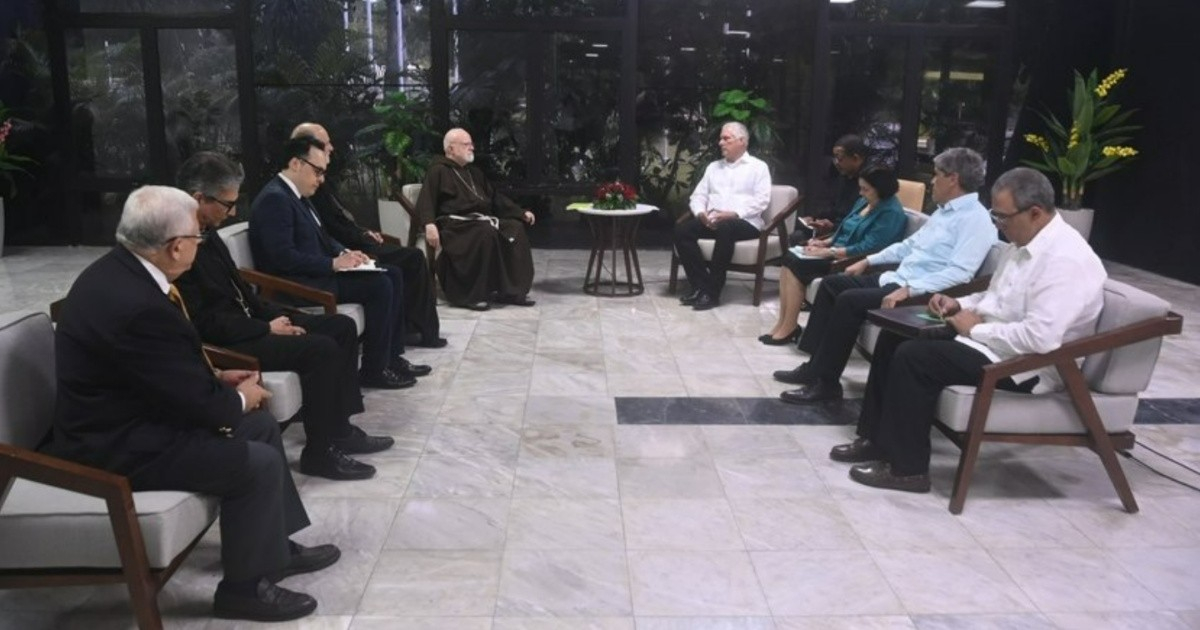
Miguel Díaz-Canel received a delegation from the United States Conference of Catholic Bishops (USCCB) this Saturday at noon at the Palace of Conventions in Havana, in a meeting focused on the humanitarian aid that the Catholic Church is channeling to Cuba.
The delegation was led by Cardinal Sean Patrick O'Malley, Archbishop of Boston, and also included Archbishop Borys Gudziak, President of the USCCB's Justice and Peace Commission; Christopher Ljungquist, Director of the International Justice and Peace Office of the Conference; and Mario Jesús Paredes, Executive Director of the medical organization SOMOS Community Care.
Díaz-Canel himself confirmed the meeting on his X social media account: "We discussed the national reality of both countries and the international scenario."
According to the official website of the Cuban presidency, the leader expressed his gratitude during the meeting for "the role of the Church and its organizations in facilitating the humanitarian aid coming from various countries," a direct reference to the program that Catholic Relief Services (CRS) —an international agency of the USCCB— and Cáritas Cuba have been implementing since May 2026.
This program, financed with 60 million dollars from the U.S. State Department as part of a total package of 100 million, aims to deliver food and hygiene items to nearly 200,000 households —more than 500,000 people— across the country, without the involvement of the Cuban government or GAESA: CRS acquires the supplies in the United States and Cáritas Cuba distributes them directly through parishes and home visits.
The meeting was also attended by Monsignor Juan Gabriel Díaz Ruíz, recently appointed Archbishop of Santiago de Cuba by Pope Leo XIV just a week earlier, on November 7, having been transferred from the Diocese of Matanzas. His presence at the meeting with the American delegation is one of his first public acts in his new role.
The Cuban delegation included Caridad Diego Bello, a member of the Central Committee of the Communist Party and head of the Office for Religious Affairs, and Carlos Fernández de Cossío, deputy minister of Foreign Affairs.
The regime presented the visit as a demonstration of the "respectful ties" it maintains with the Catholic Church and its representatives in the United States, while omitting any reference to the situation of political prisoners on the island.
It is not the first time O'Malley has sat down with Díaz-Canel. In September 2021, amidst a wave of repression following the protests of July 11, the cardinal visited Havana and called for clemency for those detained. On that occasion, Chancellor Bruno Rodríguez expressed gratitude for the statements from the USCCB that favored improving bilateral relations.
In April 2023, following a meeting between Díaz-Canel and Cuban Catholic bishops, the secretary of the Episcopal Conference, Ariel Suárez, stated to Reuters that the situation of political prisoners was discussed and that the conversation was "open and frank," adding that “the door was open” to an amnesty, a promise that the regime never fulfilled.
Related videos:
Filed under: