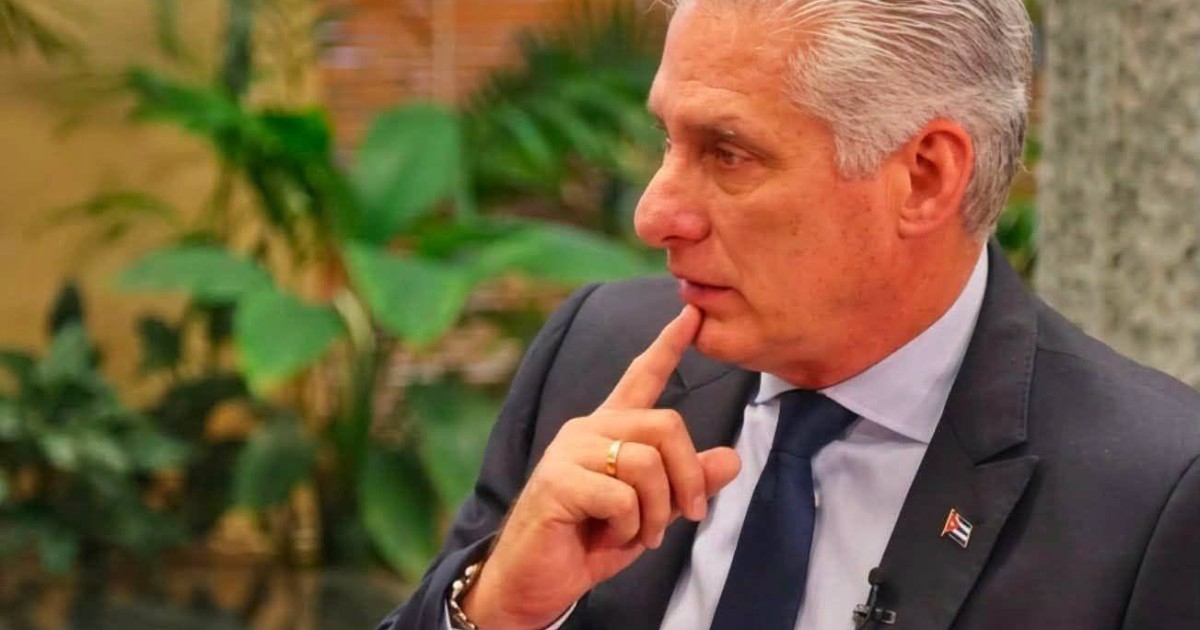
Miguel Díaz-Canel joined the congratulations that Raúl Castro extended to the Border Brigade on the occasion of the 65th anniversary of its founding, the unit of the Revolutionary Armed Forces that guards the perimeter of the U.S. Naval Base in Guantanamo, triggering an avalanche of mockery and criticism on social media.
In his Facebook post, the leader wrote: "We join in congratulating the Army General to the Border Brigade on its 65th anniversary. A strong embrace and all our recognition to those who protect national sovereignty at the border with the illegal U.S. naval base in Guantánamo."
The message was based on a letter that Castro signed on November 9 and which the Communist Party of Cuba disseminated three days later. In it, the 95-year-old general promised the fighters that, "in the midst of the complex situation the country faces today, we will achieve VICTORY" (emphasized in capital letters), after labeling the Guantánamo base as an usurpation of national territory.
The martial rhetoric was not well received among Cubans. The phrase that likely had the most impact in the comments was striking: "They live in war, with paper generals and clay soldiers." Another internet user asked bluntly, "What are we finally defending ourselves against?" A third person was direct regarding those who applauded the post: "All those people must be fake profiles, considering the hardships faced in this country."
Several users took advantage of the leader's wall to report what the regime prefers to ignore. One pointed out that the gc19 circuit in Guanabacoa had been "without electricity for over 24 hours" and that food was rotting without any response from anyone. Another person described that in Las Guasimas, Arroyo Naranjo, an entire block had been accumulating 16 days without power due to a broken transformer, with elderly people among those affected.
The electrical context explains it all: this Saturday, the Electric Union anticipates disruptions of up to 1,860 MW during the nighttime peak hours, with a mere availability of 970 MW compared to a projected demand of 2,800 MW.
An internet user summarized the contradiction with a phrase that could well serve as the epitaph for the official discourse: “They have had 67 years to build an empire and have destroyed a prosperous country, turning it into rubble [...] in the largest prison in the world, where [...] millions of Cubans live without water, without food.”
The irony deepens when one examines who is truly guarding what the regime celebrates. Active Military Service is mandatory from the age of 17, and many of the troops stationed along the border are young recruits. The Cuban Observatory of Citizen Audit documented at least 97 deaths of recruits during Mandatory Military Service between 2001 and 2026, with an average age of 18.7 years.
No less striking is the source of the greeting. Castro, who missed the central event on July 26 for the first time in at least three decades, has made letters his only visible channel: the message directed to the Brigade was the third public letter in just four days, after congratulating Military Counterintelligence and Nicaraguan dictator Daniel Ortega.
Díaz-Canel himself described the veteran military officer in April as "retired for health reasons" and "fragile." While the regime celebrates its "defenders of the homeland" with rhetoric of victory, Cubans question the purpose of defending a border when the country is crumbling from within.
Related videos:
Filed under: