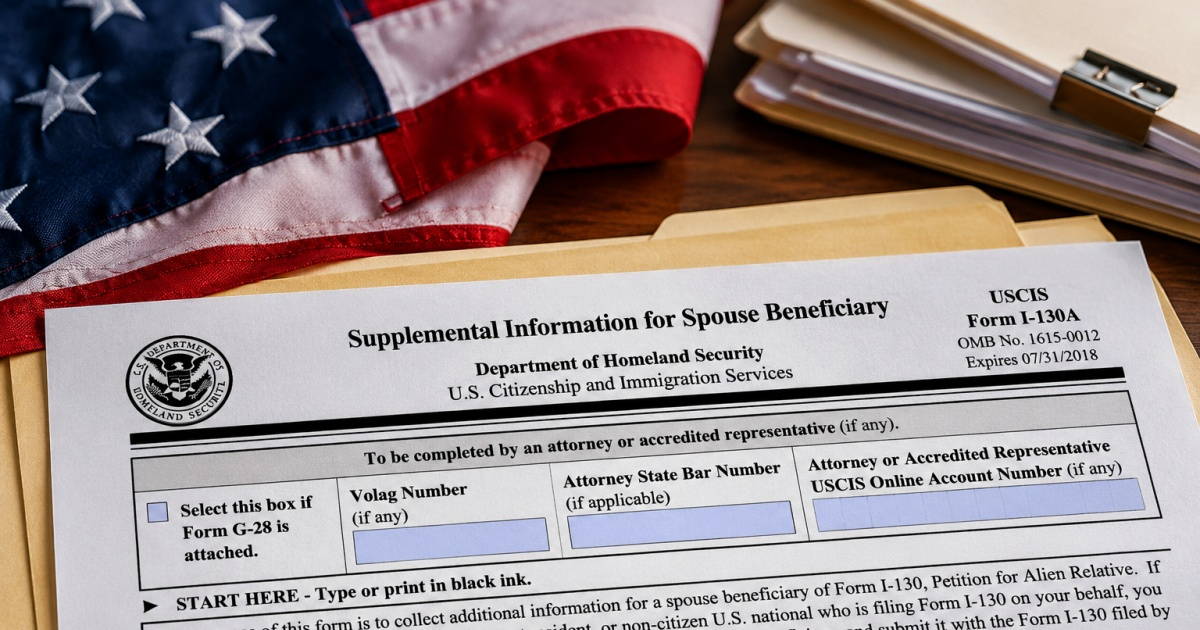
If you are a U.S. citizen or permanent resident and want to bring a relative who lives in Cuba, you may be wondering if it makes sense to submit the family petition now, given the restrictions on immigrant visas for Cubans.
The short answer is that the I-130 form can still be submitted, even though immigration restrictions currently prevent the issuance of visas in many cases.
For those belonging to family preference categories, submitting the petition as soon as possible can be especially important as it allows for the establishment of the priority date, which determines their position on the waiting list.
Immediate family members of U.S. citizens, on the other hand, are not subject to annual visa quotas. Although they can also file the I-130, they do not benefit from the same advantage of reserving a spot on a waiting list for visa availability.
It's important to understand this difference to avoid creating false expectations. The approval of a family petition does not guarantee that the beneficiary will be able to receive a visa or travel to the United States soon.
The Presidential Proclamation 10998 maintains restrictions on the issuance of immigrant visas for nationals of Cuba, although an additional suspension affecting 75 countries was lifted in August 2026.
This guide explains who can claim against whom, how the process works, what restrictions remain in place, and what is advisable to do in the meantime.
Two distinct stages: USCIS approves, the Department of State issues
The family claim has two main phases, handled by different agencies:
- The petition to USCIS. El ciudadano o residente presenta el formulario I-130 (Petition for Alien Relative, petición de familiar extranjero) para demostrar el parentesco. Según el federal regulation (8 CFR 204.1), este es el formulario que debe utilizar un ciudadano o residente permanente para pedir a un familiar.
- The visa before the State Department. Una vez que USCIS aprueba la petición, el caso puede pasar al National Visa Center (National Visa Center, NVC), encargado de preparar el trámite consular cuando corresponde.
The travel restriction primarily affects the issuance of visas and entry into the United States. It does not, by itself, prevent the submission of the I-130 or USCIS from approving a petition that meets the legal requirements.
Who can claim against whom
The law distinguishes between two groups of relatives, and this distinction is very important for wait times.
Immediate relatives of U.S. citizens. The Immigration Act (8 U.S.C. 1151) includes in this category spouses, unmarried children under the age of 21, and parents of U.S. citizens.
To petition for parents, the citizen must be at least 21 years old. In the case of children, the immigration age may be protected under the Child Status Protection Act (CSPA).
These relatives are not subject to the annual numerical limits on immigrant visas, although they must meet other requirements and may be affected by entry or issuance restrictions.
Family preference categories. The remaining eligible relationships are subject to annual visa limits, according to section 1153 of the law:
- F1: single sons and daughters, 21 years old or older, of U.S. citizens.
- F2A: spouses and unmarried children under 21 years of age of permanent residents.
- F2B: single sons and daughters, 21 years of age or older, of permanent residents.
- F3: married sons and daughters of U.S. citizens.
- F4: brothers and sisters of U.S. citizens, when the citizen is at least 21 years old.
A permanent resident can only petition for their spouse and unmarried children. They cannot claim parents, siblings, or married children; in order to file petitions for those relationships, they must first obtain U.S. citizenship.
Why it's beneficial to secure the priority date
In the family preference categories, visas are subject to annual quotas and are allocated based on priority dates and the corresponding availability rules.
The federal regulation establishes, as a general rule, that the date on which USCIS properly receives the I-130 petition determines the priority date.
That date represents the beneficiary's position on the waiting list. Each month, the State Department publishes the Visa Bulletin, which indicates which dates may advance in each category.
If a family waits for the restrictions to be lifted before submitting a preference petition, they could lose accumulated waiting time. CiberCuba recently explained how the Visa Bulletin moved up several family categories by a year.
The situation is different for the immediate family members of U.S. citizens. Since they are not subject to annual quotas, their primary reason for applying early may be to expedite the processing of the petition, rather than reserving a spot in a visa queue.
Additionally, under certain circumstances, a petition can change category while retaining its priority date. The regulation (8 CFR 204.2) allows for several conversions:
- If a permanent resident who filed a petition for their spouse becomes naturalized, the beneficiary generally moves to the immediate relative category. In the case of children, the category will depend on their immigration age and the applicable rules.
- If the unmarried adult child of a permanent resident has an F2B petition and their father or mother naturalizes, they generally shift to F1 status while retaining their priority date, although there may be legal options to remain in F2B.
- If the single son of a U.S. citizen gets married, he can move to F3, as long as the requirements to maintain the petition are met.
Turning 21 does not necessarily mean losing the status of a minor. The CSPA can protect the beneficiary's age based on the category, relevant dates, and the circumstances of the case. Therefore, before assuming that a petition must switch to another category, it is advisable to check if there is legal protection of the age.
What restrictions are still in place for Cubans?
The Presidential Proclamation 10998, signed on December 16, 2025, and effective from January 1, 2026, keeps Cuba among the countries subject to partial entry restrictions and visa issuance.
The measure affects all categories of immigrant visas for Cuban nationals subject to the proclamation, as well as certain non-immigrant visas.
Immigrant visas for immediate relatives of U.S. citizens, such as IR-1/CR-1, IR-2/CR-2, and IR-5, no longer have an automatic general exception.
The proclamation establishes, among other provisions:
- It does not revoke valid visas issued prior to its entry into force.
- It does not apply to legal permanent residents of the United States.
- It contemplates exceptions for individuals with dual nationality who apply for or travel with a valid passport from a country not subject to the suspension, as applicable.
- It allows for certain individual exceptions for national interest and other expressly provided categories.
- It applies to individuals who were outside the United States when it came into effect and who did not have a valid visa at that time.
A second suspension, affecting 75 countries, including Cuba, has been lifted. The Department of State had paused the issuance of immigrant visas for nationals of those countries since January 21, 2026, due to issues related to public charge assessment.
However, the State Department confirmed on August 28 that this pause ceased to be in effect on August 21, 2026, in compliance with a court order.
The lifting of this measure did not eliminate the restrictions independent of Proclamation 10998. Therefore, Cuban nationals subject to the latter continue to face limitations in obtaining immigrant visas, even when their family petitions have been approved.
The U.S. Embassy in Havana states that it processes immigrant visa categories, but warns that individuals subject to the proclamation may submit applications and attend interviews without any guarantee of visa issuance or admission to the country.
To learn about the affected categories and exceptions, consult our guide on which visas remain suspended for Cubans.
What can cause the request to be denied
Filing the I-130 can be beneficial, but it's also important to keep the case active during the waiting period. Here are some of the main risks:
- Do not respond to the NVC. El Departamento de Estado warns que, cuando corresponde iniciar el trámite de visa, la falta de respuesta puede tener consecuencias. Según la law, el registro puede cancelarse si el beneficiario no solicita la visa dentro del año siguiente a la notificación de disponibilidad. Existen mecanismos de recuperación cuando se demuestra, dentro del plazo legal, que la demora obedeció a circunstancias ajenas al control del solicitante. Es importante mantener actualizados los datos de contacto y responder a las comunicaciones oficiales.
- Death of the petitioner. El regulation (8 CFR 205.1) contempla la revocación automática de determinadas peticiones aprobadas cuando fallece quien las presentó, aunque existen excepciones y mecanismos de protección, incluida la posibilidad de solicitar el restablecimiento por razones humanitarias en casos elegibles.
- Divorce. The legal termination of marriage can undermine a petition filed by one spouse.
- Marriage of the child of a permanent resident. If the beneficiary gets married while the petitioner remains a permanent resident, they lose eligibility in the F2A or F2B categories. If the petitioner is already a U.S. citizen, conversion to F3 may apply.
What to do now?
- Identify your family member's category. Check if you are a citizen or a permanent resident and if your family member falls into an immediate or preference category. If you are a resident and can naturalize, consider how it would change the classification of your relatives.
- Gather the evidence of the relationship. Prepara actas de nacimiento, matrimonio y otros documentos exigidos. En la ficha del encontrarás información sobre el trámite.
- Evaluate when to submit the petition. In the family preference categories, doing it early can allow you to establish the priority date sooner. For immediate family members, submitting the petition can expedite processing, although it does not eliminate visa restrictions. Keep in mind the costs, requirements, and specific circumstances of the case.
- Keep the documents and respond to the NVC. Save the USCIS receipt, update your contact information, and address official communications within the applicable deadlines.
- Check for any exceptions. If your relative has another nationality, such as Spanish, check if they can fall under the exception for individuals with dual nationality who are using a valid passport from a country not subject to the suspension.
- Beware of anyone who promises to bypass restrictions for money. Consulta las fuentes oficiales y sigue las novedades sobre los active procedures at the United States Embassy in Havana.
Aviso legal: este artículo ofrece información general y no constituye asesoría legal. Las leyes y políticas migratorias de Estados Unidos pueden cambiar. Para evaluar un caso concreto, licenciado o un representante acreditado por el Departamento de Justicia.
Related videos:
Filed under: