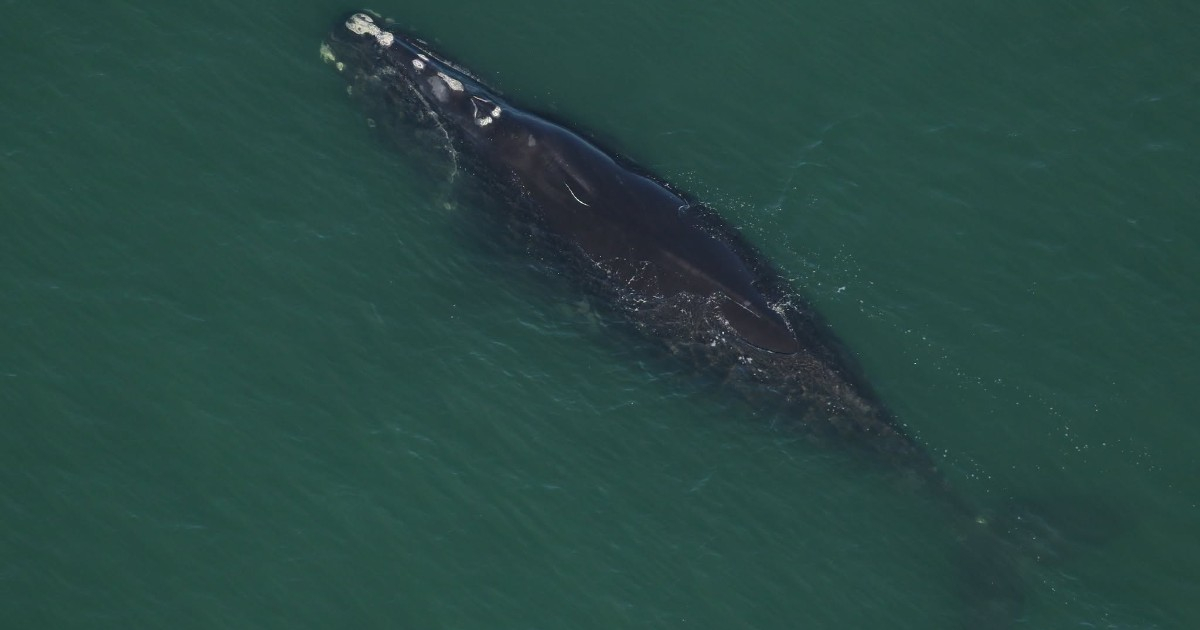
A new life has brought hope to the waters of Florida: a North Atlantic right whale (Eubalaena glacialis), one of the most endangered species on the planet, was spotted with its first calf off the coast of St. Augustine, an especially hopeful event for a population that barely has around 73 reproducing females.
The Florida Fish and Wildlife Conservation Commission (FWC) reported on Thursday that the subject of the sighting is Curlew, a whale identified by the number 4190 in the scientific catalog, which was observed with her calf on the 10th, about 11 nautical miles (20 kilometers) from the St. Augustine maritime entrance.
Curlew is 16 years old and has just become a mother for the first time and her appearance alongside the chick marks the first confirmed sighting of a mother and chick pair during the 2026-2027 breeding season, which officially started on November 15.
The news takes on extraordinary significance due to the situation of the species. According to a scientific update released this Monday by the New England Aquarium, the population of North Atlantic right whales is estimated at only 382 individuals, with about 73 breeding females.
Although the figures correspond to the population estimate for 2025, they do demonstrate how vulnerable the species continues to be.
The calculation indicates a decrease of 1.8% compared to the revised estimate for 2024, which is 389 animals. Scientists warn that the population is still not on a clear path to recovery, so each birth holds special significance for its survival.
The encounter with Curlew was made possible thanks to two navigators, Sean Roberts and Mike Konopko, who observed the mother and her chick and notified the presence to the sighting line of the National Oceanic and Atmospheric Administration (NOAA).
The released photographs show the two animals moving very close to the surface, hardly disturbing the water. This characteristic, combined with their slow movements, makes right whales particularly difficult to detect for vessels.
According to the official NOAA information about the calving season, Curlew was born in 2011 and is the daughter of another whale known as Tusk. Her name refers to a scar on her back that resembles the curved beak of a bird called a curlew.
The organization also emphasizes that the whale had previously followed an unusual route through the waters of the southeastern United States alongside another female named Koala. Both were documented in the Bahamas in 2025, an exceptional movement for this species.
The waters of Florida and Georgia are crucial for the survival of North Atlantic right whales. Every winter, pregnant females migrate to this region to give birth and nurse their calves, before returning to the feeding areas in the northern Atlantic.
The reproductive period typically extends from November 15 to April 15. The appearance of Curlew five days before the official start of the season has sparked particular interest among researchers. Another adult female, Calvin, identified by the number 2223, was also detected while migrating south.
But the hope represented by this birth coexists with significant threats. NOAA identifies collisions with vessels and entanglements in fishing gear as two of the main causes of serious injuries and deaths among these animals.
The calves are particularly vulnerable because they spend a lot of time near the surface alongside their mothers. In February 2021, a right whale calf was found dead on a beach near St. Augustine, with injuries attributed to the impact of a vessel.
The latest scientific report also notes that during 2026, two deaths of specimens of this species have been documented, along with several cases of injuries associated with human activities.
The previous breeding season, 2025-2026, resulted in 24 identified offspring, the highest number since 2009. However, specialists emphasize that these births will only contribute to recovery if the animals manage to survive to adulthood.
In light of the return of whales to Florida, authorities have urged the public to exercise extra caution at sea. Federal regulations prohibit approaching within 500 yards (about 457 meters) of a North Atlantic right whale, while NOAA recommends reducing boating speed in areas where these animals may be present.
Those who observe a right whale can report the sighting to the phone 877-WHALE-HELP (877-942-5343) or to the United States Coast Guard via VHF radio channel 16. These notifications help locate the animals, monitor their condition, and assist in protecting them during the first months of their calves' lives.
Related videos:
Filed under: