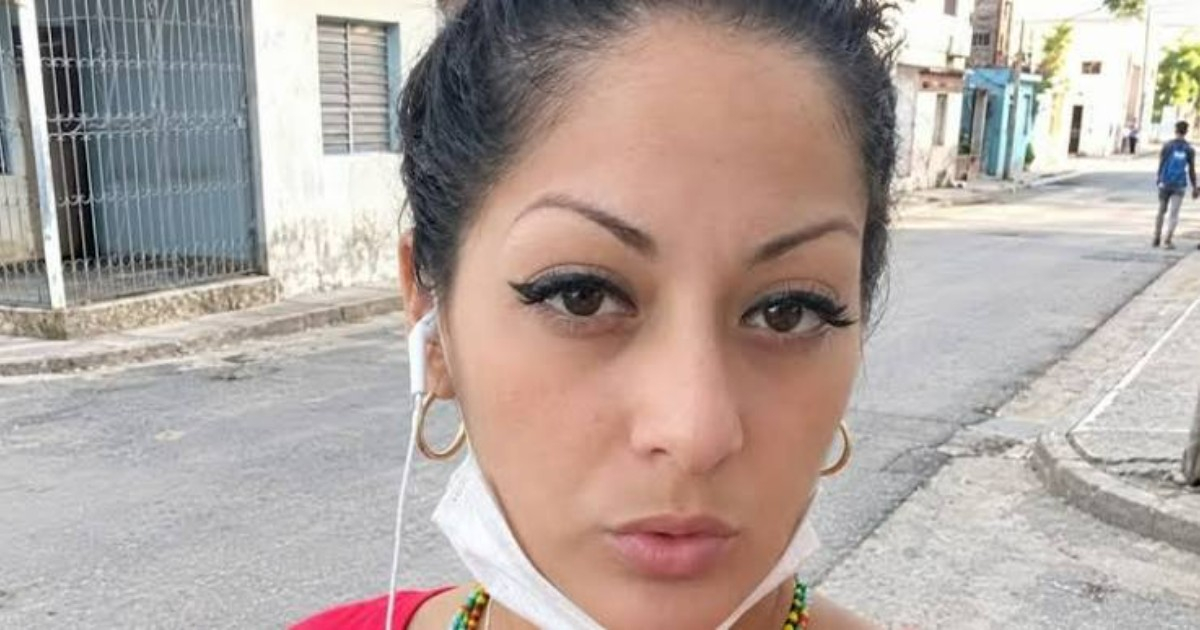
A handwritten letter from the women’s prison La Veguita, in Las Tunas, summarizes the ordeal of Ana Ibis Tristá Padilla in one sentence: "They took my life and stole my freedom."
The Cuban Observatory of Human Rights (OCDH) disseminated a text this Monday, in which the 37-year-old activist denounces the irregularities in her judicial process, the separation from her loved ones, and the devastating impact of imprisonment on her life.
In the letter addressed to "my Cuban People, those who live inside and outside my dormant Caiman," Tristá Padilla describes herself as "a woman of ideas, of a concept of struggle, a woman who does not silence the truth," and reaffirms her commitment to the freedom of Cuba despite serving a sentence of 14 years that human rights organizations deem unjust.
The regime accused her in 2023 of organizing a peaceful march called for Vicente García Park in Las Tunas that never took place, of putting up political posters, and of allegedly planning to launch Molotov cocktails. She was charged with "propaganda against the constitutional order" and "other acts against state security."
What makes her case particularly revealing is the trajectory of the judicial process. In November 2024, the Provincial Popular Court of Santiago de Cuba acquitted her along with fellow activist Jarol Varona Agüero due to insufficient evidence. "I truly believe this is incredible. The ruling states that both Jarol and I are acquitted for lack of evidence," she stated at that time to Martí Noticias.
However, the Prosecutor's Office appealed the ruling, the Supreme Court annulled the acquittal in May 2025, and ordered a new trial, held in Santiago de Cuba — a province different from the defendants' place of residence — where she was sentenced to 14 years.
The Supreme Court upheld both sentences on appeal on August 8, 2026, exhausting all avenues for appeal. Varona Agüero received 13 years in the same case. The OCDH described the case as "a political operation disguised as a judicial process" in which "everything is based on reports and interpretations from the Ministry of Interior and Counterintelligence."
The injustice of the process is compounded by a serious deterioration of her health that the Cuban authorities have publicly ignored. In October 2026, Tristá Padilla herself described in another letter that she suffers from anorexia, chronic asthma, and kidney failure, and that she must take furosemide continuously to avoid renal collapse. However, the medication has caused her legs to harden and damaged her tendons: “I can barely walk and I have daily pain”, she wrote at that time.
Ana Ibis's activism was born out of the repression her family endured. Her husband, Damián de Jesús Hechavarría Labrada, was arrested in April 2021 in Las Tunas after shouting “Down with the dictatorship! Homeland and Life!” during a protest against a fine for selling ornamental plants, in one of the first documented acts with that slogan prior to July 11. He was sentenced to five years in prison. It was then that Ana Ibis publicly took on the defense of political prisoners and became a target of the regime.
From the OCDH, the organization reiterated its demand this Monday for the "immediate release" of Ana Ibis Tristá Padilla.
Related videos:
Filed under: