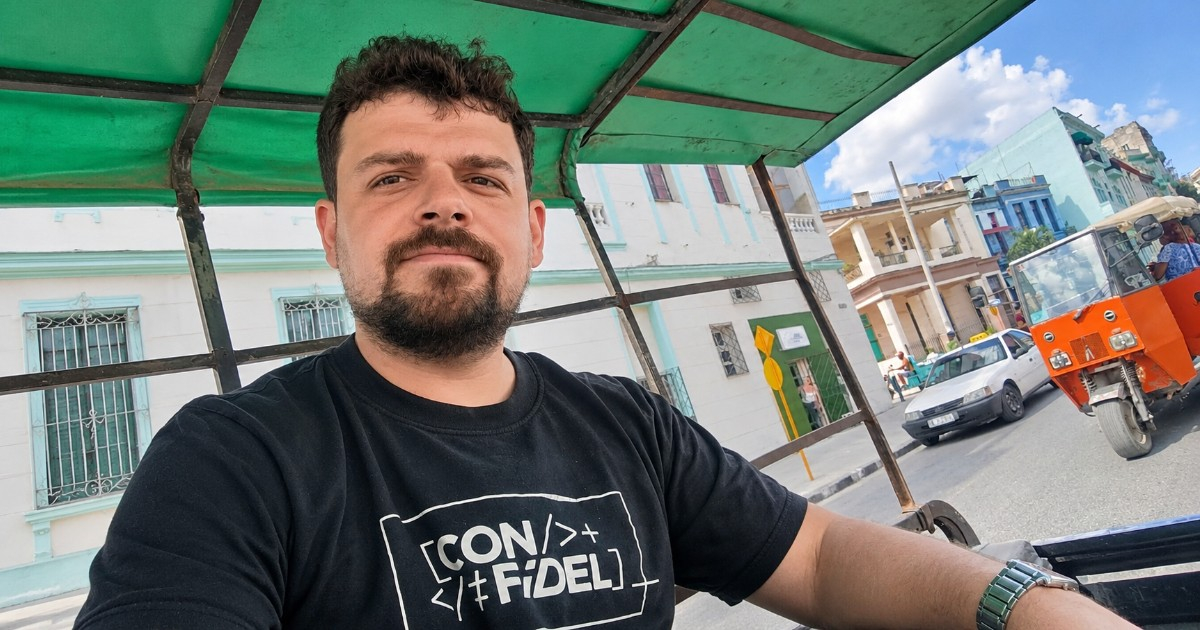
Michel Torres Corona, host of the state-supported program "Con Filo" and director of the Nuevo Milenio Editorial Group, posted on his Facebook profile a lengthy personal reflection in which he reaffirms his communist activism with a phrase that encapsulates decades of Castroist doctrine: "I became a communist to fight for a world without millionaires or kings, a world free from the dirty principality of capital."
In the text, Torres presents himself as "a poor and honest man" without political power or fortune, whose only weapon is his ideas and whose only wealth is his culture: "I am, in summary, another grain of this sand. A poor and honest man, trying to be the second without dying of the first."
The regime's spokesperson declares that it is «immoral for there to be rich people while there are individuals (and children) dying of hunger or curable diseases» and states that he became a communist «so as to have nothing to lose, except for chains».
The statement directly clashes with a reality that Torres himself overlooks: it is precisely private companies and entrepreneurs—the "millionaires" who irritate him so much—who generate employment, invest capital, innovate, and create wealth. Economic history shows that economies that pursue private accumulation do not produce widespread prosperity but, rather, the exact opposite: the poverty that Torres claims to combat.
The regime that Torres defends has been applying the same logic in Cuba for over six decades, resulting in documented outcomes: chronic shortages, mass exodus, and a population surviving on salaries equivalent to just a few dollars a month.
Meanwhile, the leadership that preaches this equality lives surrounded by million-dollar luxuries both inside and outside of Cuba, remaining unaffected by the problems and shortages faced by the people to whom it demands resilience and forbids protesting.
The military conglomerate GAESA, which controls between 40% and 70% of Cuba's formal economy, is said to have accumulated more than $18 billion in bank accounts abroad, according to accusations made before that international body.
Miguel Díaz-Canel himself criticized in July of this year that in the United States "the power elites are enriching themselves obscenely," a phrase that many pointed out as a perfect mirror of Cuban reality. The irony did not go unnoticed.
Torres has also starred in episodes that illustrate the contradictions of the system he defends. In April of this year, the regime censored a segment of "Con Filo" in which he criticized Sandro Castro—grandson of Fidel—for declaring himself pro-capitalist from a position of hereditary privilege, and Torres had to publish the excerpt on his personal Facebook because the episode that aired completely ignored the topic.
The episode highlighted the double standard that Torres claims to detest: “It irritates me when someone poses as a proletarian but lives like a bourgeois, practically disconnected from those dispossessed individuals that they 'think about so much',” he wrote in his most recent post, seemingly unaware that this description fits precisely the nomenclature he himself represents.
"With Filo," the program that Torres has been presenting since August 2021 — launched weeks after the protests of July 11 of that year — serves as a tool for attacking opponents, independent journalists, and critics of the government, funded by the state and broadcast by Cubavisión. In March of this year, Torres referred to those who protested in Morón, Ciego de Ávila, as "beasts."
The U.S. Ambassador to the UN, Michael Waltz, summarized in October the contradiction that Torres seems unable to see: "Fuel and resources should reach the population and farmers, not the yachts, private kitchens, or airplanes of the ruling elite."
Related videos:
Filed under: