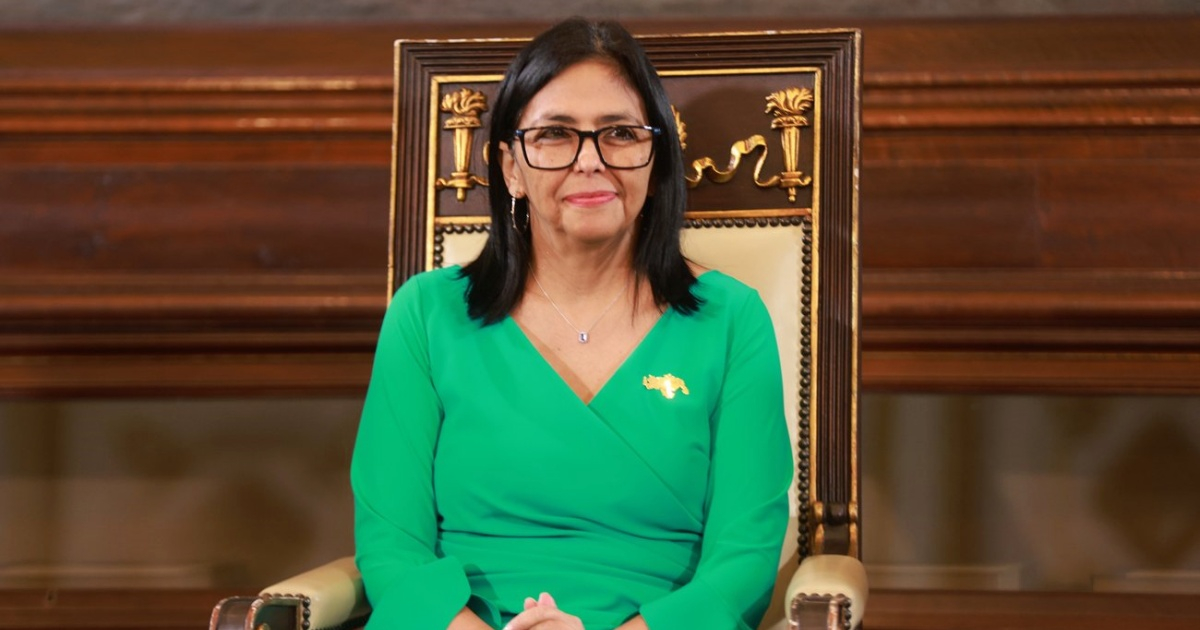
The acting president of Venezuela, Delcy Rodríguez, surprised many by stating that she has never wanted to participate in elections, despite currently holding the highest office in the country and leading a transitional process that includes the organization of new presidential elections.
In an interview granted to journalist Jon Lee Anderson, published on Monday, November 16, in The New Yorker, Rodríguez was questioned about her political aspirations and the possibility of becoming a presidential candidate.
His response drew attention because, after explaining the difficulties of governing Venezuela, he acknowledged that competing for the popular vote has never been part of his personal ambitions.
"I can tell you that it is a very difficult and complex job. I like being Venezuelan, and I like standing up for Venezuela. I like defending our identity. I like defending our history. I enjoy being able to serve those in greatest need," Rodríguez stated.
“Well, you say something very clear: that I have never wanted to participate in elections, because that has not been my thing”, he added next.
Anderson then insisted that, given his current position, it was now his responsibility to submit himself to a popular vote.
The official responded with just two words: “I don’t know”.
Rodríguez did not rule out a candidacy, but she also did not confirm that she is willing to present herself to voters in an attempt to remain in the presidency.
The journalist interpreted her response as a possible indication that her political future does not depend solely on her, although he also suggested it might reflect her desire to remain in power.
He promised elections, but there is still no date
The statements contrast with the public commitment that Rodríguez made on October 29, when he assured that Venezuela would hold new elections in accordance with what is established in the Constitution.
"There will be elections, all those mandated by our Constitution, organized by a renewed electoral authority and with the world as witness," he stated in a message to the nation.
The Chavista leader also made it clear that she does not consider it a priority to set an immediate date for voting, but rather to first establish the institutional conditions that, in her view, would ensure political stability.
"The political horizon of Venezuela is not measured by a date on the calendar, but by a sequence of objectives we must achieve," he stated.
Among those objectives, he mentioned democratic coexistence, an orderly legal reform, and guarantees for the participation of various political forces.
Rodríguez has been governing Venezuela since January 5, 2026, two days after U.S. forces captured Nicolás Maduro and his wife, Cilia Flores, during a military operation in Caracas. Until that point, he had held various appointed positions within Chavismo, including the Vice Presidency.
The electoral negotiation and the role of María Corina Machado
The uncertainty regarding Rodríguez's candidacy coincides with the fourth cycle of negotiations between chavismo and a sector of the opposition, which began on November 13 in Caracas with the support of the United States.
The conversations are led by Jorge Rodríguez, brother of the acting president and president of the National Assembly, and opposition leader Dinorah Figuera.
Among the pending issues are the renewal of the National Electoral Council, guarantees for candidates, and the necessary legal reforms to hold presidential elections.
The opposition leader María Corina Machado, who returned to Venezuela on October 25 after being abroad, is calling for new elections, but her organization is not directly participating in the negotiation table.
Figuera has expressed that he hopes for "fair and secure" elections by the end of 2027 or the beginning of 2028, although this forecast does not constitute an officially agreed-upon schedule.
The renewal of the Supreme Court of Justice is underway, while that of the electoral body remains pending agreement. It has not been established when Rodríguez will have to leave the acting presidency to allow for an electoral call.
Related videos:
Filed under: