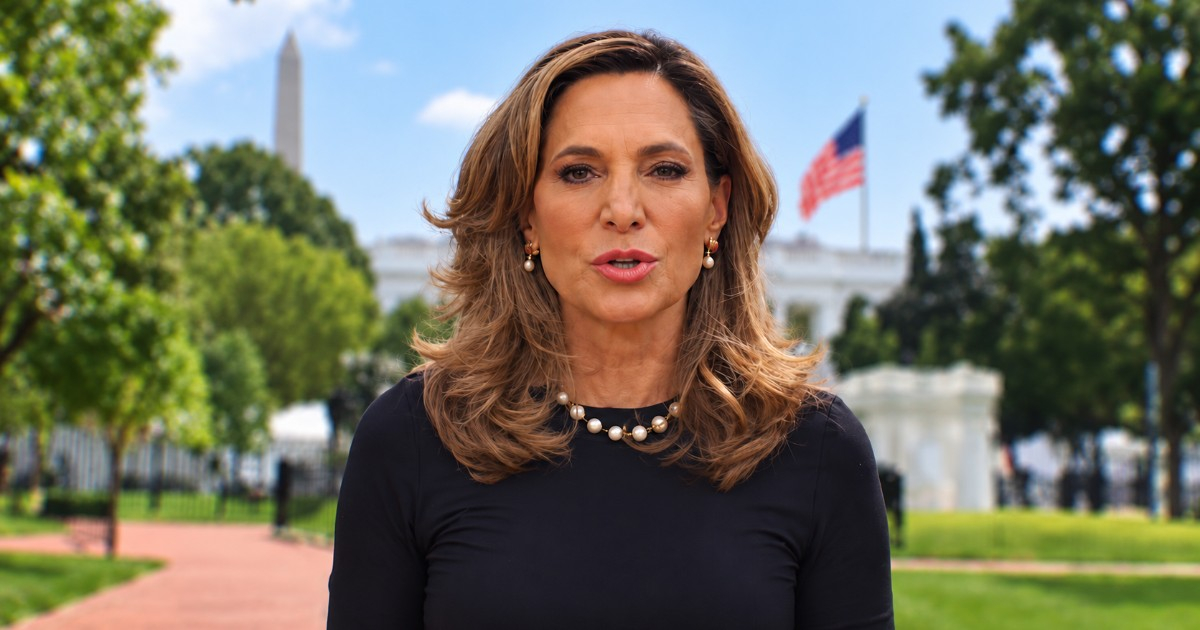
The Cuban-American congresswoman María Elvira Salazar (R-FL-27) announced this week the addition of 16 new co-sponsors to the DIGNITY Act (H.R. 4393), bringing the support for the initiative to 56 legislators in the United States House of Representatives.
Among the new supporters is the Cuban-American congressman Carlos Giménez (R-FL-28), who formally joined on November 9, according to the Congress record.
The other 15 new co-sponsors are Democrats, including Steven Horsford, Angie Craig, Seth Moulton, Raja Krishnamoorthi, Sharice Davids, and Josh Gottheimer.
The announcement represents a new step forward for a proposal presented in July 2025 by Salazar and Democrat Verónica Escobar, whose support has increased from 35 legislators in early 2026 to the current 56.
"Sixteen more members of Congress are joining an initiative that has been growing throughout the year, both in the Capitol and across the country. This demonstrates that Republicans and Democrats can still come together to find a solution to the immigration crisis in the United States,” Salazar stated in his official statement.
The congresswoman defended that her proposal aims to combine immigration control with solutions for immigrants who have been established in the country for years.
“We are building a coalition around a simple principle: the United States can have law and order, economic prosperity, and human dignity. We don't have to choose,” he stated.
Carlos Giménez joins a proposal with implications for Cubans
The inclusion of Giménez is particularly significant for Cubans who are seeking a solution to their immigration status, especially for those who were released by U.S. authorities with Form I-220A.
The legislator has participated, along with Mario Díaz-Balart and Salazar herself, in efforts with the federal administration to seek alternatives for this group, which is facing difficulties in obtaining permanent residency through the Cuban Adjustment Act.
Her support for the project reinforces the backing of Florida's Cuban-American Republican congress members for an initiative that combines border security measures, reforms to the immigration system, and pathways for the regularization of certain immigrants.
What would change for immigrants if the DIGNITY Law is approved?
The project includes the establishment of the Dignity Program, aimed at certain undocumented immigrants who can demonstrate continuous physical presence in the United States since December 31, 2020.
Applicants would have to undergo biometric and background checks, meet the established legal requirements, and make an initial payment of at least 1,000 dollars.
During their seven-year participation, they would receive a temporary suspension of deportation measures, as well as authorization to work and travel according to the program's conditions.
They should also periodically inform about their address and personal situation, fulfill their tax and labor obligations, and make restitution payments until reaching 7,000 dollars, with certain exceptions.
The text also establishes a tax of 1% on the labor income subject to that provision.
After successfully completing the program, the beneficiaries could obtain a non-immigrant legal status called Dignity Status, valid for seven years with the possibility of consecutive renewal.
That mechanism does not automatically grant permanent residency or U.S. citizenship.
Unlike the legislative proposal of 2023, the 2025 version does not include the former Redención Program as a general pathway to residency.
However, it includes provisions that could facilitate status adjustment through other legal means when the relevant requirements are met.
The project also establishes specific measures for undocumented youth known as Dreamers, who could access permanent residency under certain conditions.
The provision that could benefit Cubans with I-220A
For Cubans, one of the most important provisions appears in section 1503(e) of the bill.
That section establishes that, for the purposes of the Cuban Adjustment Act, individuals released in the United States through an Order of Release on Recognizance issued by the Immigration and Customs Enforcement (ICE) **until January 31, 2023, inclusive**, would be considered as individuals who received a parole.
The measure could pave the way for certain Cubans with an I-220A to apply for permanent residency under the Cuban Adjustment Act, as long as they meet the other required conditions.
However, the benefit would not automatically extend to all individuals with an I-220A.
It would be necessary to verify the circumstances of the release, the authority that issued the document, and the remaining immigration requirements.
The relevance of this proposal increased after the ruling from the Eleventh Circuit Court of Appeals on November 17, which determined that the release under section 1226 of U.S. immigration legislation does not equate to the necessary humanitarian parole required to qualify for the Cuban Adjustment Act.
The ruling establishes a binding precedent in Florida, Georgia, and Alabama on that legal issue.
If Congress were to approve the provision proposed by Salazar, it could change the legal treatment of certain cases that currently face that obstacle. However, the initiative still does not have legal effects.
More political support, but without Congressional approval
According to Salazar's statement, the DIGNITY Act also has the support of more than 100 national organizations linked to business, agricultural, industrial, religious sectors, and advocates for immigration reform.
The initiative has also received the formal backing of the bipartisan group Problem Solvers Caucus, made up of lawmakers who advocate for agreements between Republicans and Democrats.
The project, however, continues to face resistance from Republican sectors who believe that its regularization mechanisms amount to an amnesty.
Congressman Brandon Gill termed it "mass amnesty," a characterization dismissed by Salazar, who insists that his proposal requires controls, adherence to the law, and economic responsibilities for the beneficiaries.
The DIGNITY Law has not yet been approved. Presented on July 15, 2025, it was sent to seven committees in the House of Representatives and has not passed the necessary legislative process to become law.
The increase in co-sponsors does not imply their approval nor guarantee a vote. To come into effect, the initiative would need to receive support from both chambers of Congress and the president’s signature.
Related videos:
Filed under: