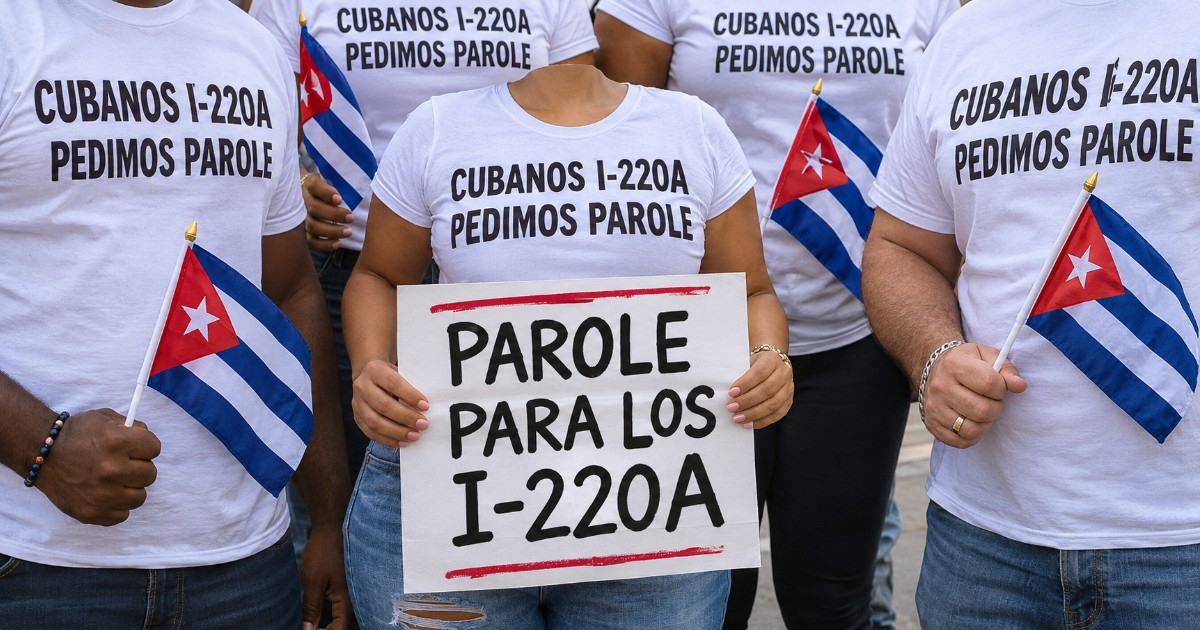
The Eleventh Circuit Court of Appeals of the United States issued a ruling this Tuesday that represents a significant setback for Cubans who hoped to equate the I-220A form with a parole, according to journalist Alexis Boentes from Telemundo 51. The court determined that this document does not, by itself, constitute a valid parole to qualify under the Cuban Adjustment Act.
The decision, outlined in a 16-page opinion identified as the case Aguiar-Fernandez v. U.S. Attorney General (file 24-12318), arises from the petition of a Cuban family — Yoan Aguiar-Fernandez, his wife Yenisley Gonzalez-Sanabria, and their daughter — who crossed the border with Mexico in 2021, was detained by Border Patrol, and later released with an I-220A.
The judges concluded that release under section 1226 of the Immigration and Nationality Act is legally distinct from the humanitarian parole outlined in section 212(d)(5)(A), which is precisely the requirement mandated by the Cuban Adjustment Act to apply for permanent residency.
Este fallo vinculante sobre el I-220A y la Ley de Ajuste Cubano podría afectar el futuro migratorio de cientos de miles de cubanos en EE.UU. Sigue de cerca estos y otros desarrollos en nuestra sección de
When it comes to a published opinion, the ruling establishes a binding precedent for all federal courts in Florida, Georgia, and Alabama on the legal issues it addresses.
The I-220A is a supervised release order issued by the Immigration and Customs Enforcement (ICE) that allows migrants to await the progress of their immigration process in freedom, but does not grant immigration status nor does it, in itself, pave the way for residency under the Adjustment Act.
The new precedent comes at a critical moment for the class action Bello-Rubio v. Noem, which is being processed before federal judge Jacqueline Becerra in the Southern District of Florida and was filed by 992 Cubans.
The lawsuit seeks to have the circumstances under which numerous Cubans were processed and released at the border legally recognized as a parole, which would allow them to apply for residency under the Cuban Adjustment Act. Its proponents estimate that a favorable decision could benefit between 500,000 and 600,000 Cubans in similar situations.
However, the ruling on Tuesday does not automatically dismiss that class-action lawsuit nor does it imply that all Cubans with an I-220A have a deportation order. The actual impact of the precedent on the litigation will depend on the remaining arguments and the decisions made by Judge Becerra.
The judge Becerra already rejected in September the federal government's first attempt to dismiss the case, determining that it has jurisdiction to review the key issues of the litigation. In October, the government filed a second motion to dismiss, to which the plaintiffs responded on the 23rd of that month.
This ruling is not the first to draw that dividing line. The Board of Immigration Appeals had already established in September 2023, in the case Matter of Cabrera-Fernández, that release under section 236 of immigration law is "legally distinct" from humanitarian parole, a criterion it reaffirmed in June 2025. What changes now is that the Eleventh Circuit makes it a binding precedent.
The context is particularly sensitive: the immigration arrests of Cubans increased by 463% during the first year of Trump's second term, reaching an average of 1,008 per month, according to an analysis by the Cato Institute.
Attorney Mark Prada, representative of the plaintiffs in Bello-Rubio v. Noem, had previously warned that even a judicial victory would not automatically protect all affected individuals from deportation nor would it directly grant them residency.
Related videos:
Filed under: