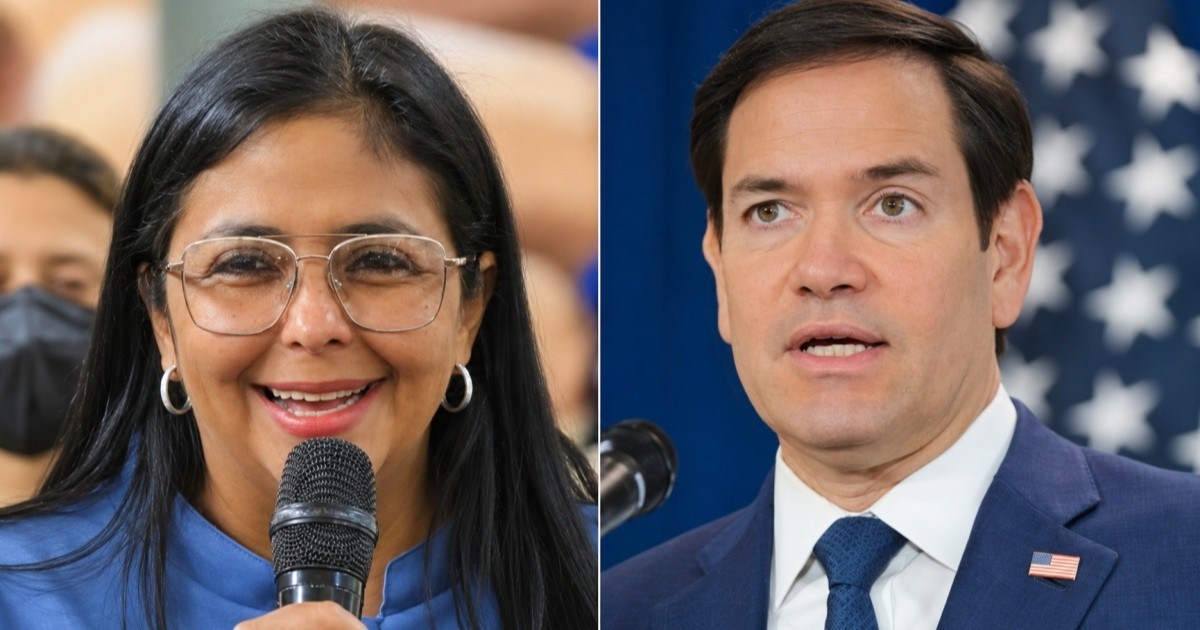
Delcy Rodríguez, the acting president of Venezuela, resorted to an unusual demonstration during an interview with The New Yorker: she turned her phone around and showed journalist Jon Lee Anderson the WhatsApp chat she maintains with U.S. Secretary of State Marco Rubio.
He did it to make it clear that their relationship is strictly formal and not the informal friendship that some media outlets have suggested.
The gesture arose in response to a report by The New York Times that described her exchanging gossip and photographs with Rubio.
Rodríguez rolled his eyes at that characterization and read aloud the greeting he directed to the official: “Good afternoon, Secretary.”
Then he added emphatically: “I do not call him Marco or Marquito.”
An "official and respectful" relationship
The official was unequivocal in defining the relationship: «I will not share our private conversations, but we maintain an official relationship. Official. When we have had the opportunity to discuss work on specific matters, it has been official. And respectful, which is important, right?».
The interview, published this week under the title Venezuela's Collaborator-in-Chief, took place at La Estancia, a estate owned by the Venezuelan state oil company that Rodríguez uses as an alternative office in Caracas.
The meeting takes place in a context of tremendous political tension.
Rodríguez assumed the acting presidency on January 5, 2026, two days after U.S. special forces captured Nicolás Maduro and his wife Cilia Flores in a military operation.
Since then, the relationship between Caracas and Washington has been described by analysts as the most overtly imperial that the United States has maintained in decades.
The shadow of the "viceroy" Rubio
Rubio's influence over the Venezuelan government goes far beyond WhatsApp messages.
According to a report from the New York Times, the Secretary of State oversees sanctions, determines which companies can operate in Venezuela, and manages, through the U.S. Treasury, the revenues from Venezuelan exports under conditions that he himself dictates.
That same report revealed that Rodríguez submitted drafts of social media posts for Rubio's approval before sharing them, something that sparked widespread reaction in July.
Trump himself has been explicit about the nature of that relationship.
When referring to Rodríguez, he stated: "He was very kind, but he really has no other option."
During a speech in Las Vegas this summer, he boasted: "We're getting a lot of oil from Venezuela and we're getting along wonderfully with them... It's the old-fashioned way. To the victor belong the spoils, right?"
Drones, political prisoners, and the electoral future
The interview with Anderson revealed more details about Rodríguez's early days in power. The president recounted that during the initial cabinet meetings, following Maduro's capture, around 300 drones were flying over the area and followed her wherever she moved.
Among the measures of his government, the report highlights the opening of the oil industry to private companies, an amnesty that freed nearly 200 political prisoners, and the closure of El Helicoide, the prison associated with Venezuelan intelligence services.
In September, Rodríguez met with Trump in New York on the sidelines of the UN General Assembly, marking the first in-person meeting between a US president and a Venezuelan leader in over 11 years.
"I have never wished to participate in elections."
Regarding his political future, Rodríguez was evasive yet revealing. “I have never wanted to participate in elections. It has not been my thing,” she stated.
When Anderson pointed out that he might now have to compete in an election, he responded with three words: "I don't know."
Critics' voices are not in short supply. A former advisor to Hugo Chávez described her to The New Yorker as "the Pétain of Venezuela," referencing the leader of the Vichy collaborationist government during World War II.
A former high-ranking U.S. official was more nuanced: "I believe Delcy has had to betray chavismo. The question is: does she want to maintain power or become an agent of change?" The decision on when to call for elections, according to the New York Times, is not in Rodríguez's hands but in Rubio's.
Related videos:
Filed under: