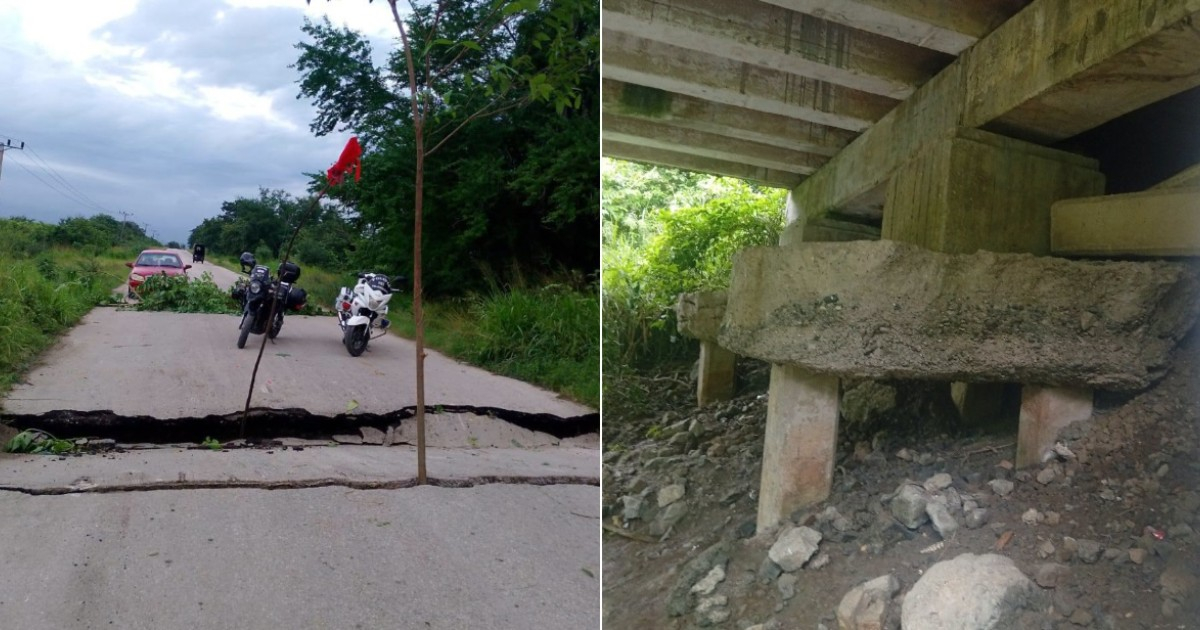
The intense rains that have hit eastern Cuba in recent days caused the collapse of the support base that connects the structure of a bridge to the roadway at the entrance known as "Italiana," on the road leading to Los Pinos, in the municipality of Banes, province of Holguín.
The Citizen Portal Banes and Radio Banes issued a notice to the public informing about the incident and urged to enhance road safety measures to prevent accidents.
The Municipal Transportation Directorate of Banes immediately prohibited traffic on that route and established the Flores-Cortaderas highway as an alternative.
"Due to the inclement weather of the past few days, the support base that connects the bridge structure and the roadway at the entrance to Italiana, on the road to Los Pinos, suffered a collapse," stated Radio Banes in its official announcement.
The circulated photographs show deep cracks and severe sinkholes in the hydraulic concrete pavement, with rudimentary danger signals — poles with red fabric — positioned at the site.
The images also reveal advanced structural deterioration in the intermediate support of the bridge: loss of concrete cover, exposure of coarse aggregate, and visible cracking, indicating years of neglect in maintenance.
Uniformed emergency personnel and at least one police motorcycle were seen inspecting the area alongside civilians.
The collapse occurred following rainfall that resulted in accumulations ranging from 71 to 98.5 millimeters in Holguin towns such as Güirabo, Birán, Sagua, Mayarí, and Nipe, as reported by the state media Telecristal.
These same rains raised the reservoirs of the province to 85.1% of their capacity, adding 4.478 million cubic meters.
The incident in Banes is not an isolated event. On November 14, the rising waters of a river in Palma Soriano, Santiago de Cuba, swept away the temporary bridge of La Cuchilla —installed after the damage from Hurricane Oscar and still without a permanent replacement— leaving its residents cut off.
The outlook for this Wednesday is concerning. Independent meteorologist Alejandro Adonis warned of the arrival of new severe storms with intensities of up to 98 millimeters per hour, with a risk of flooding, strong winds, and possible hail in the eastern and western parts of the island, including areas of Holguín such as Moa and Baracoa.
"These storms not only have strong electrical activity; there can also be strong winds, and there may even be hail... along with intense rain that, of course, can lead to flooding," warned Adonis.
The response capacity to these episodes is also limited by the state of the country's meteorological infrastructure. Meteorologist Yosmelvi Páez reported on November 12 that the INSMET radar network has been out of service for months due to a lack of fuel, with only the Pilón radar operational but with data restricted to internal use, which forces the population to rely on the radar from Key West, Florida.
The official forecast from Canal Caribe for this Wednesday predicts "a predominance of clouds with showers, rain, and thunderstorms especially in the central and eastern regions, as well as in the far western area," with rainfall that "may become heavy in specific locations and will continue until late at night."
Related videos:
Filed under: