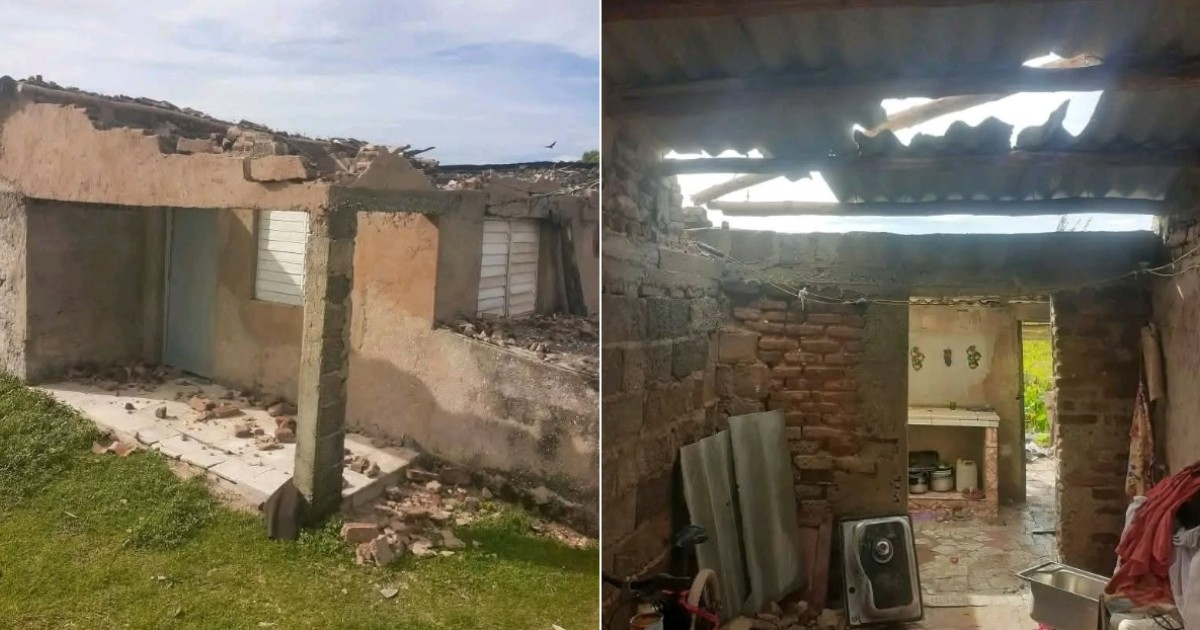
A severe local storm hit Playa Caletones, a small coastal community northwest of Gibara in the province of Holguín, during the early hours of Tuesday, causing significant damage to the roofs and structures of several homes.
According to the report from Radio Gibara, prepared by journalist Daniel Ferrás, the phenomenon occurred around 1:30 AM and caught the residents of that locality on the northern coast of Cuba by surprise.
The photographs provided by residents of the area show completely collapsed roofs, destroyed block walls, and debris scattered both outside and inside the affected homes.
The meteorological analysis from Radio Gibara indicates that storm activity had been developing for hours over the sea and the north coast. "By close to midnight, a very active storm cloud had fully formed over land and released heavy rains in the area," Ferrás clarified.
The localized and destructive nature of the damage leaves open the possibility that the phenomenon may have been a waterspout that moved in from the sea or even a tornado that formed on land. "Given the type of destruction that occurred, it is evident that the winds were very strong and localized," the report stated, although it clarified that with the available data, it is not possible to confirm this.
The episode in Caletones falls within a period of intense weather instability that has affected eastern Cuba during November 2026.
This Wednesday, the heavy rains recorded in areas of Holguín such as Güirabo, Birán, Sagua, Mayarí, and Nipe—amounting to between 71 and 98.5 millimeters—caused the collapse of the base of a bridge support at the entrance known as "Italiana" on the road to Los Pinos in the municipality of Banes, necessitating the closure of this road to traffic.
The recent rainfall has raised the reservoirs in the province to 85.1% of their capacity.
The vulnerability of communities like Caletones is exacerbated by the pre-existing structural deterioration of Cuban housing, which amplifies the impact of any weather event, even those of moderate intensity.
Additionally, the network of radars from the Institute of Meteorology (INSMET) has been out of service for months due to a lack of fuel, with only the Pilón radar operational but with data restricted to internal use. This situation forces the population to rely on the radar in Key West, Florida, for monitoring rapidly forming severe weather phenomena.
Independent meteorologist Alejandro Adonis warned this Wednesday about new severe storms in eastern and western Cuba, with intensities of up to 98 millimeters per hour. "These storms are not only characterized by strong electrical activity; there may also be high winds, and even hail... along with intense rainfall that, of course, can lead to flooding," he cautioned.
Radio Gibara also warned that the weather will remain unstable in the coming days: "Conditions persist for showers and rain to continue in the central and eastern parts of the country, where they could again be strong in some areas."
Related videos:
Filed under: