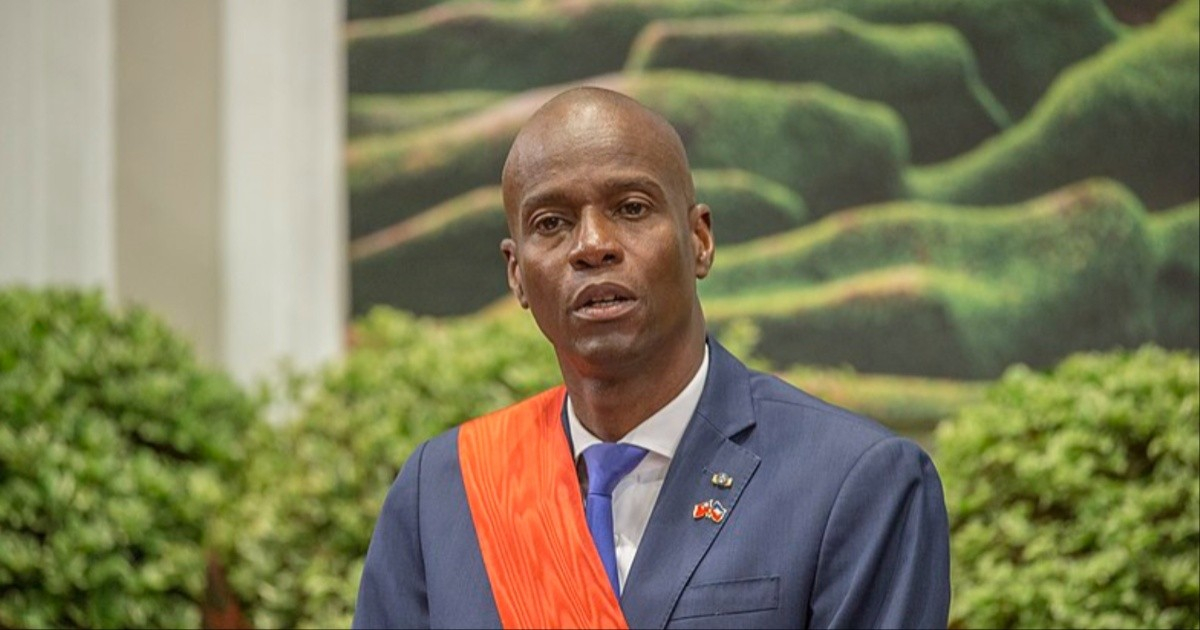
A federal jury in Miami found Haitian-American pastor Christian Emmanuel Sanon, 68, guilty this Wednesday on all eight counts related to the conspiracy to kidnap and murder the President of Haiti, Jovenel Moïse, in July 2021.
The verdict came after nearly eight weeks of trial in a federal court in Miami. Sanon, who had pleaded not guilty, could face a life sentence.
Among the accusations was the conspiracy to kidnap or murder a person outside the United States, deemed the most serious of the charges.
According to Deutsche Welle (DW), Sanon's sentencing, who remains in federal custody, is scheduled for February 10.
The Associated Press noted that the defendant showed little reaction when the verdict was announced in the federal courtroom in Miami.
The U.S. Attorney's Office argued during the proceedings that South Florida operated as a planning and funding hub for the plot to oust Moïse from power and install a leader chosen by the conspirators.
According to Televundo 51, the prosecutors presented Sanon as the group's primary choice to replace the Haitian president and stated that he helped raise funds, as well as organizing travel and accommodation in Haiti for himself and other individuals involved.
Sanon aimed to replace Moïse as part of a plan to install a person chosen by the conspirators in the presidency and subsequently secure lucrative contracts from the Haitian government.
The plot of the conspiracy
The indictment placed one of the key moments in the plot in April 2021, when Sanon met in South Florida with other involved parties to discuss an alleged "regime change" in Haiti.
Telemundo 51 detailed that from the accusation, Sanon met with a former Haitian senator and American businessmen during that time.
The agreement stipulated that, if he came to power, he would award contracts to the Florida companies Counter Terrorist Unit Federal Academy and Counter Terrorist Unit Security, collectively known as CTU, for projects related to infrastructure, security, and military equipment.
According to the authorities cited by both sources, CTU initially hired Colombian citizens with military training.
Telemundo 51 estimates the initial group at about 18 Colombians, while DW notes that in May, Sanon commissioned equipment for an alleged private military force composed of around twenty Colombians with military training.
Prosecutors also stated that for months the conspirators tried to obtain weapons and bulletproof vests and to establish contacts with Haitian gangs.
The plan changed before the assassination. By June 2021, the conspirators concluded that Sanon did not meet the constitutional requirements nor had sufficient popular support to become president, so they shifted their support to Wendelle Coq Thélot, a former judge of the Supreme Court of Haiti who later remained a fugitive and died in January 2025.
By mid-June, the group had stopped backing Sanon and chosen another potential successor to Moïse.
Sanon acknowledged during his testimony that he had maintained communication with individuals interested in replacing Moïse, but he asserted that the group had chosen another candidate long before the assassination and denied knowing of a plan to kill the president.
The media added that Sanon was born in Haiti, moved to the United States during his adolescence, and stated that he had worked with churches in communities of Haitian immigrants in Florida and the Midwest.
The assassination of the president
Moïse was assassinated in the early hours of July 7, 2021, at his residence in Pétion-Ville, on the outskirts of Port-au-Prince.
A group of former Colombian soldiers broke into the home and shot the president in his bedroom. His wife, Martine Moïse, was seriously injured during the attack.
Prosecutors also claimed that part of the money allocated to pay approximately two dozen foreign mercenaries came from funds obtained through U.S. government programs created to assist businesses during the COVID-19 pandemic, according to court records cited by Telemundo 51.
U.S. authorities have charged over 40 individuals with crimes related to murder, and around a dozen have already been convicted, including five who are serving life sentences.
Sanon was initially set to be tried alongside four other men from South Florida, but his trial was separated and postponed for health reasons. Those four defendants were previously found guilty by another jury in Miami, according to the sources consulted.
On September 20, U.S. agents transferred another 18 suspects related to the case from Haiti to Miami: 17 Colombian citizens and Joseph Felix Badio, a former official of the Haitian Ministry of Justice.
The assassination of Moïse left Haiti without a president and ushered in a new phase of political instability in a country that had already been grappling with decades of institutional crises.
Related videos:
Filed under: