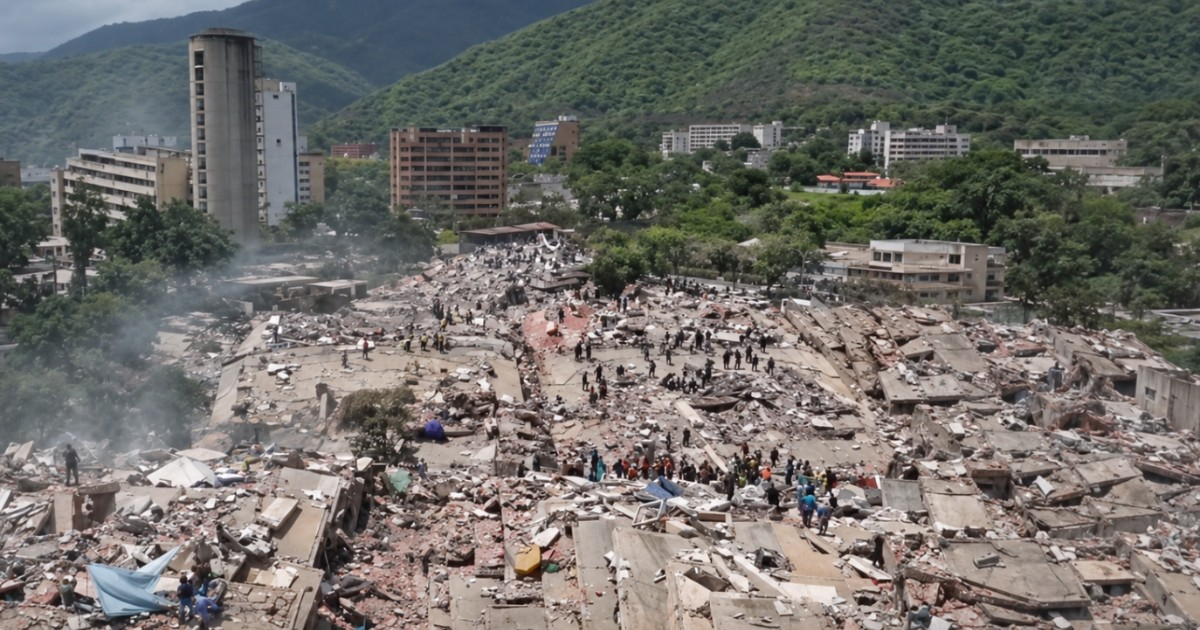
The College of Engineers of Venezuela (CIV) presented a proposal this Wednesday to transform the coastal state of La Guaira into a "coastal aerotropolis," an urban model in which the airport serves as the central axis of the city, in response to the devastation caused by the double earthquake on June 24.
The plan, called the Urban Reorganization, Reconstruction and Transformation Plan for La Guaira (PRUR), has a timeline of 15 years and aims to operationally integrate the Maiquetía International Airport —the country's main airport— with the Port of La Guaira through dense, resilient, and Caribbean-oriented urban development.
The proposal arises in a context of urgency: nearly five months after the disaster, the Venezuelan government has removed 1.43 million tons of debris and demolished 282 buildings with severe structural damage, but formal reconstruction efforts have yet to begin.
In locations such as Caraballeda and Catia La Mar, hundreds of buildings collapsed following the earthquakes of magnitude 7.2 and 7.5, separated by just 39 seconds, which resulted in over 6,500 fatalities according to the official report as of August 25th.
The CIV warned in its press release that "rebuilding should not simply mean physically replacing what was damaged, at the risk of reproducing past vulnerabilities."
Instead, the guild proposes to leverage the catastrophe as a turning point: "This challenge presents a unique historical opportunity to restore planning as a state public policy, consolidating a secure, competitive, inclusive, and sustainable territory. A cutting-edge vision: the concept of a coastal aerotropolis."
Among the technical components of the plan is the creation of a "green coastal buffer zone" with linear parks and lightweight zero-mass architecture to dissipate marine energy, alongside the sanitation and dredging of sediment retention dams in the upper basins.
The PRUR also includes smart electrical grids, decentralized modular desalination plants, and circular waste management for construction.
In economic terms, the school proposes a hybrid terminal integrating port-airport-city, a district for creative industries, free trade zones, specialized tourism corridors, and regulations aimed at attracting national and international private investment.
The plan is structured in stages: an initial phase of six months for humanitarian stabilization and road recovery; a second phase of up to two years to restore services and create a land bank; and a long-term phase dedicated to housing reconstruction and territorial transformation.
The CIV also proposes to create a technical commission, a development corporation, and a digital transparency platform to oversee the process, as well as to promote a multilateral fund with tripartite management.
The World Bank estimated the direct physical damages at 19.6 billion dollars, equivalent to about 18% of Venezuela's GDP, and warned that a slow reconstruction could keep the country's economy below its pre-disaster levels until 2036.
Related videos:
Filed under: