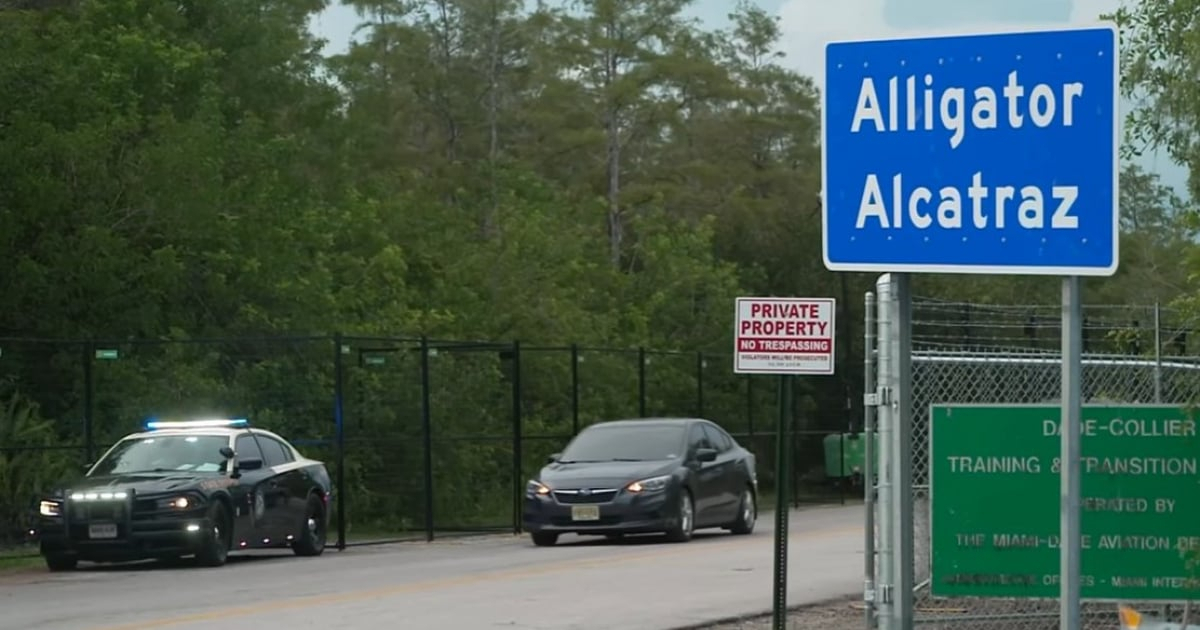
Mandi Mitchell, the inspector general of the Florida Division of Emergency Management (FDEM), the state agency that operated the Alligator Alcatraz migrant detention center, reported this Thursday that she was fired for “political reasons” after being barred from overseeing that center, as reported by the Tampa Bay Times.
Mitchell, who held the position for approximately four years, made her complaint public through LinkedIn. According to her account, she was initially asked to resign; when she refused, she was dismissed on the grounds of a "government transition," referring to the change of leadership between Governor Ron DeSantis and elected Governor Byron Donalds, scheduled for January 2027.
The official rejected that argument and asserted that the measures taken were not "legally sufficient or appropriate." Furthermore, she pointed out that her office was blocked from exercising "independent and objective" oversight over Alligator Alcatraz and other immigration initiatives of the FDEM. Mitchell indicated that she would assess her next steps in accordance with applicable laws and professional standards.
Neither Governor DeSantis' office nor the FDEM responded to requests for comments at the time of publication.
The dismissal comes at a time of increasing scrutiny over the management and spending of the center. The FDEM missed two accountability deadlines: the report on the emergency fund that was due on July 15, 2026, was submitted nearly two months late, and the quarterly report due on October 15 had not yet been delivered when Mitchell announced their termination. State legislative leaders confirmed they had not received it.
Mitchell's dismissal also coincides with a series of departures of high-ranking officials in the final stretch of DeSantis's mandate, including the heads of State, Law Enforcement, and Commerce.
Alligator Alcatraz operated between July 2025 and June 2026 at Dade-Collier Airport in the Everglades, with a capacity of 4,100 people and a fee of 249 dollars per detainee per night. It processed and deported over 22,000 people before closing due to cost overruns.
In September 2026, the Inspector General of the Department of Homeland Security published a report that confirmed the use of metal cages measuring between 1.5 and 1.7 square meters as "calm zones," extreme overcrowding, and deficiencies in medical care, food, and hygiene. The document characterized these structures as "unprecedented" among the inspected facilities and warned that they posed "significant risks to the health and safety of the detainees."
The impact on the Cuban community was considerable. More than 4,000 Cubans received deportation orders in Florida between October 2025 and June 2026, making them the fourth most affected nationality.
Documented testimonies include that of Raúl Suárez Herrero, who reported having spent more than 15 hours in a cage without food and unable to lie down, and that of Arístides Fernández García, who was deported to the Central African Republic after 96 days in the center, where he stated he lost about 27 kilograms.
This Thursday, a court sentenced former guard Andre Junior Seenaraine to 12 months of probation for assaulting the Cuban Rigoberto Rodríguez Arce on January 25, 2026, in the first known case where a facility worker was held criminally accountable for mistreating a detainee.
Florida has spent more than 1.2 billion dollars from its emergency fund on the migration offensive, and the FDEM projects a deficit of up to 1.5 billion for the fiscal year 2026-27. The dismissal of the only official responsible for auditing that expenditure adds a new layer of opacity to an operation that is already facing allegations of abuse, accounting failures, and lack of accountability.
El caso de Alligator Alcatraz y las denuncias sobre su supervisión forman parte de un panorama migratorio en constante cambio. Sigue toda la actualidad en nuestra sección de
Related videos:
Filed under: