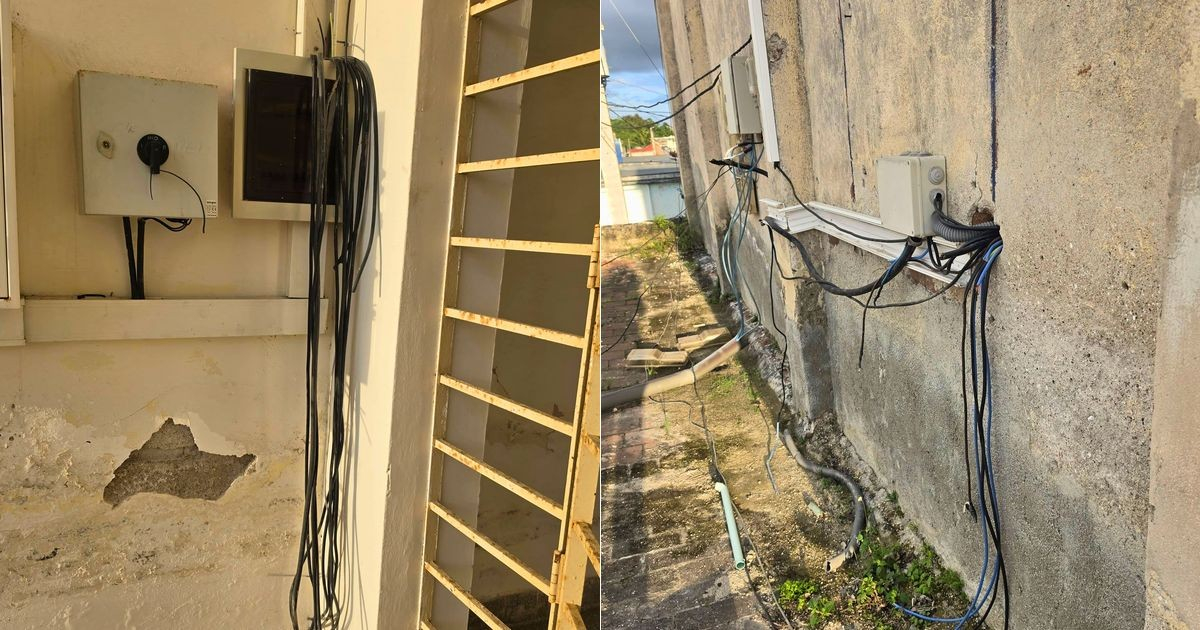
The head of the National Seismological Service of Cuba and specialist at the National Center for Seismological Research (CENAIS), Enrique Diego Arango Arias, publicly denounced this Friday the theft and destruction of all electrical and communication connections at the CITMA headquarters in Holguín, where the National Seismological Service's Central Backup Station, the provincial CENAIS, the Meteorology Department, and CITMATEL operate.
Arango Arias reproduced the information about the looting published hours earlier by Zelma Corona, director of CENAIS, who recounted a journey that a team from the center was making through the seismological stations in Granma and Holguín: in Las Mercedes, Granma, they found no problems, but in Holguín the situation was radically different, Corona noted.
"Upon arriving in Holguín, despite the equipment being well safeguarded, it had to be moved to Santiago de Cuba because vandals […] cut all the electrical and connectivity cables of the building that houses CITMA in Holguín and stole them, leaving all the centers located at the site without electricity and connectivity (Meteorology, Seismology, CITMATEL, etc.)," wrote Corona.
Arango Arias was emphatic in his denunciation: "How far will impunity go? Where are we headed with the issue of thefts? In this case, it involves destroying and removing all the electrical and communication connections of the CITMA institutions in Holguín, among which are the Central Backup Station of the National Seismological Service and the Departments of CENAIS and Meteorology in this province."
The official confirmed that "everything that remained of CENAIS in Holguín has been collected" and warned that without drastic sanctions, the situation "will continue to escalate to catastrophic levels that affect both family and national economies."
Corona questioned whether this act constitutes vandalism or directly "an attack on the security of the country," given that these institutions are part of the Early Warning System of Cuba for earthquakes and tsunamis, and demanded "to unite all law enforcement and strongly sanction the bandits who are acting with impunity."
The incident is not the first that CENAIS has experienced. In September 2026, Arango Arias had already reported the complete theft of equipment from the seismic station of Isla de la Juventud — inaugurated in March 2024 — including solar panels, batteries, a seismometer, and a digitizer, as well as thefts in Moa and at the backup station in Holguín.
Holguín has a recent history of vandalism against critical infrastructure: in 2025, ETECSA reported 27 acts of vandalism in that province with losses exceeding 529,000 Cuban pesos, and in October 2026, the theft of cables from a 4G antenna left a neighborhood in Holguín with connectivity that was "almost non-existent."
At the national level, the General Prosecutor's Office of the Republic of Cuba reported that between 2025 and the first half of 2026, more than 460 criminal investigations were initiated for offenses against the National Electric System, including sabotage, damage, burglary, theft, and receiving stolen property.
As of May 2025, the People's Supreme Court establishes criteria to classify certain acts of theft or damage to electrical infrastructures as sabotage, in accordance with Articles 125 and 126 of the Penal Code. The penalties range from seven to 30 years in prison, and in aggravated circumstances, they can reach perpetual deprivation of liberty or the death penalty.
The CENAIS operates a network of seismological stations distributed throughout the country that transmit real-time data to detect earthquakes and issue alerts. The eastern region of Cuba, where Holguín is located, has historically concentrated the highest seismic activity on the island, making any disruption in this monitoring network particularly concerning.
Related videos:
Filed under: