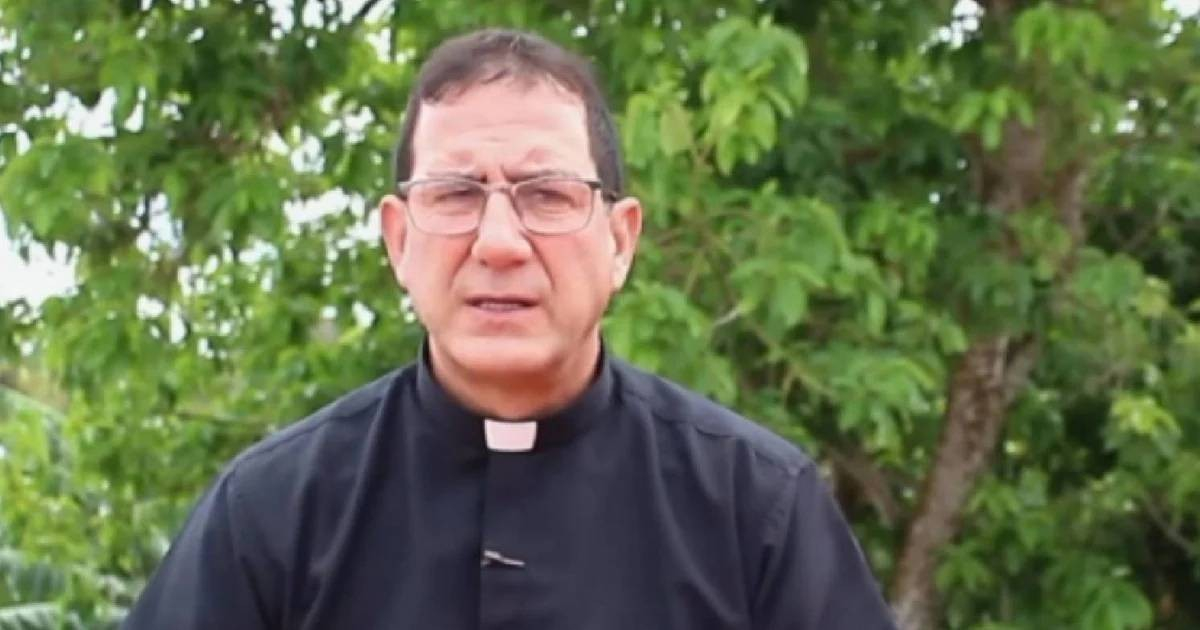
The Cuban priest Alberto Reyes Pías published this Saturday on Facebook the 183rd installment of his column "I've been thinking," in which he uses the recent apostolic trip of Pope León XIV to South America as a mirror to reflect on the political and social reality of Cuba.
The parish priest of Esmeralda, Camagüey, poses a simple yet deeply meaningful question: how would the Cuban regime receive the pontiff if he were to repeat what he said in Uruguay, Argentina, and Peru during his first tour of the region, held between November 6 and 17?
The first contrast that Reyes draws is with Uruguay, where León XIV celebrated four decades of uninterrupted democracy and the alternation of governments elected by the citizens. In light of this praise, the priest recalls that Cuba has endured nearly 70 years of dictatorship.
"In our land, from the frantic applause for a Fidel who could say: 'Elections for what?', to the theater of elections where every political alternative is already condemned by the current Constitution, almost 70 years have passed under the imposition of a single party that has always denied this people the opportunity to express themselves freely at the polls," wrote Reyes.
The second point of friction is located in Buenos Aires, where the Pope urged authorities to "recognize the limits of the power that has been entrusted to them" and defended the freedom to dissent and to "freely express one's own convictions" as fundamental aspects of democracy.
But the reality of Cuba is diametrically opposite: "There are no democratic mechanisms in our land today that provide our people with real opportunities to change those who wield power," he recalled.
The priest also points out the irony of a system that proclaims the people's loyalty to the revolution but does not allow that loyalty to be demonstrated in multi-party elections, nor does it tolerate the slightest questioning of its power.
And remember the repression of the Cuban regime against anyone who dares to oppose the official narrative: "In our land, we already know that today's dissident is tomorrow's political prisoner."
The third contrast comes from Lima, where León XIV stated that for families, peace has a concrete meaning: "to go out to work without fear, to take care of the children, and to return home with tranquility."
Reyes contrasts this ideal with the everyday reality of Cuba, where "men and women leave each day amidst the struggle to provide food for their children, necessary medicine, and essential money; and return to their homes with insecurity, with eternal fatigue, to face life without electricity, to cook with charcoal."
Reyes, one of the most critical voices of the regime within the Catholic Church, concludes his reflection with the phrase that León XIV pronounced on November 8 before authorities, civil society, and the diplomatic corps at the Palacio Libertad in Buenos Aires, implicitly applying it to Cuba: "A nation must seriously ask itself where it has failed when its youth must leave their homeland to pursue their dreams."
Related videos:
Filed under: