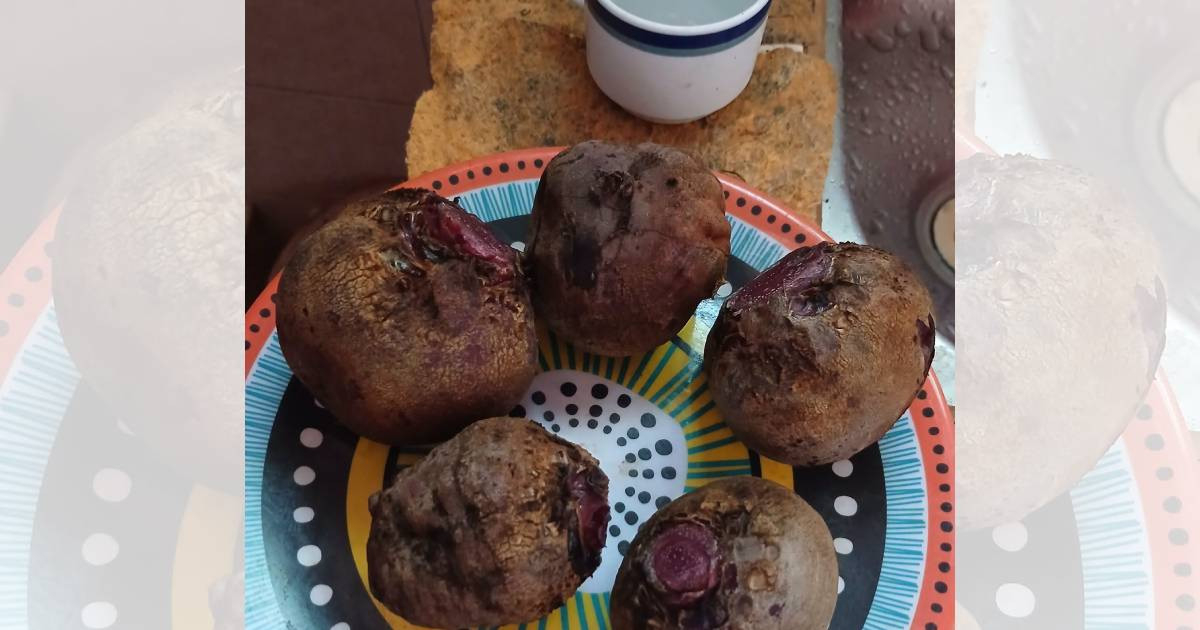
The set designer Luis Lacosta expressed his dismay on social media this Sunday that five small beets cost 650 pesos and questioned what future a generation that fought for the victory of the Cuban Revolution of 1959 received.
The post on Facebook, accompanied by a photograph of the tubers on a plate and a small cup of coffee for scale, began with a cry of desperation that captures the decline of purchasing power on the island: "Help! Help! Help!".
Lacosta did not limit himself to questioning the price. His reflection highlighted the contrast between the expectations of those who supported the revolutionary process and the reality they face decades later.
"Every day I wake up and I ask myself. My generation, in one way or another, fought for the revolution to succeed and for us to have a better future. Is what we are living now what we were meant to have?" he wrote.
The artist also directed his criticisms toward the leaders of the country, whom he reproached for having taken power without participating in the struggles of previous generations and enjoying privileges at the expense of the sacrifices of the population.
"Leaders who did not experience the previous governments never fought, not even with words; they took this country on a silver platter, they live extraordinarily well, and we can even say that they thrive at the expense of our sacrifices," he expressed. His post ended with a question filled with disappointment: "Am I asleep and is this all a nightmare?"
Lacosta, with over 65 years of continuous work, is a set designer, decorator, and costume and lighting designer. A member of the Union of Writers and Artists of Cuba (Uneac), he has worked on numerous feature films, short films, and commercials for Cuba and abroad. In September, it was revealed that he receives a pension of 3,800 pesos per month, which he himself describes as "begging."
Other users' responses indicated that the reported 650 pesos does not necessarily represent the highest price. One woman claimed that in her area, beets cost 800 pesos, while another reported seeing them for 700 at the fair in John Lennon Park in Havana.
Another commentator expanded the list of products whose prices hit consumers' wallets: "A cabbage, 1,000 pesos; La Llave coffee, 6,500." Another user turned to irony to question the results of the government's economic policies: "The achievements of the 176 measures are already being seen."
The rise in food prices is happening in a country where food insecurity affects a significant portion of the population. According to a 2025 survey, 33.9% of Cuban households had at least one person who went to bed hungry.
Other basic products are also registering prices that are hard to afford for a large part of families. A recent publication about the price of a pound of black beans at 700 pesos sparked a flood of reactions on social media, with Cubans from all over the country reporting even higher figures and expressing a mix of indignation, dark humor, and despair.
Reports on social media have shown places where the pound of tomato costs 2,000 pesos, while a basic purchase of salad with tomato, onion, and herbs exceeded 3,300 pesos in the capital in mid-November.
In Placetas, a 16-pound pumpkin cost 2,400 pesos a few weeks ago, an amount equivalent to 80% of a retired person's monthly pension.
According to the latest data from the National Office of Statistics and Information (ONEI), the year-on-year inflation rate reached 32.70% in October, more than double the 15.41% recorded in the same month of 2025.
Food and beverages experienced an increase of 50.72% over 12 months and accounted for 71.70% of the monthly impact on the price index.
The current minimum wage is 3,210 pesos per month, while the minimum reference pension is 4,000 pesos per month, effective from September 2025 for beneficiaries included in Resolution 14/2025. The Ministry of Labor itself acknowledged in July that the minimum wage still does not cover the cost of the basic basket.
The economist Javier Pérez Capdevila estimated that a person needs around 96,000 pesos per month to cover their basic needs, nearly 30 times the minimum wage.
Cuba imports between 70% and 80% of the food it consumes, while national agricultural production has faced significant setbacks. The bean harvest, for example, declined by 60.2% between 2020 and 2024.
In June, Prime Minister Manuel Marrero presented a package of 176 economic reforms that included the removal of price caps on several staple foods.
Related videos:
Filed under: