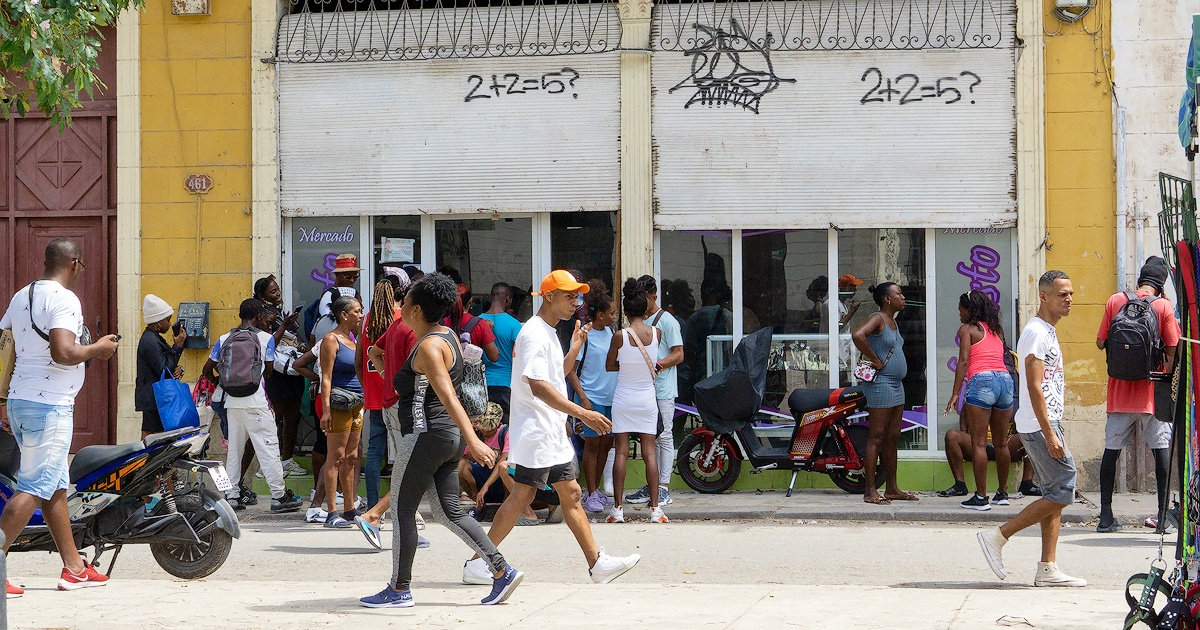
The inflation is accelerating again in Cuba, and food stands out among the most affected products, according to the October 2026 data released by the National Bureau of Statistics and Information (ONEI).
The report identifies sharp increases in pasta, pork, and other everyday consumer products, while salaries and pensions remain insufficient to cover the cost of living.
Spaghetti, elbow macaroni, and powdered soda saw the largest percentage increases of the month.
Pork and ham also saw significant increases, while rice and eggs were among the products most affecting the evolution of food prices.
The , released on November 18, places the year-on-year inflation rate at 32.70%, more than double the 15.41% recorded in October 2025.
The category of food and non-alcoholic beverages has seen an even greater increase: 50.72% in one year.
These are the foods that increased the most in Cuba
According to official statistics, the selected products with the highest percentage increases during October were spaghetti, which saw a rise of 22.73%, followed by elbow macaroni, which increased by 18.47%, and powdered drink, which grew by 15.26%.
Pork also saw a significant price increase, with a monthly rise of 13.29%, while ham increased by 7.28%.
In the case of pork, the cumulative increase during September and October exceeds 25%.
Rice and chicken eggs emerged among the products with the greatest impact on the monthly variation of the food index, although this does not mean that both recorded the highest percentage increases.
In fact, ONEI reported a monthly decrease of 6.90% in eggs.
There was also a 12.99% decrease in the price of cooking oil during October.
However, these occasional decreases did not offset the significant rise in food prices that has accumulated over the past twelve months.
Overall, food and non-alcoholic beverages increased by 6.97% just in October and accounted for 71.70% of the monthly impact on the Consumer Price Index (CPI), confirming the decisive role of food in the acceleration of inflation.
Up to 5,000 pesos for a liter of oil and 2,000 for a pound of pork
The supplementary bulletin on minimum and maximum prices published by the ONEI provides information on how much certain basic products cost in different regions of the country.
In Havana, the pound of bone-in pork loin reached a maximum price of 2,000 pesos, while the pound of leg reached 1,800 pesos. In Las Tunas, the pound of pork leg was sold for as much as 1,900 pesos.
Black beans reached 1,200 pesos per pound in Artemisa.
In Santa Clara, garlic reached 2,600 pesos per pound, while onion prices peaked at 2,000 pesos in Cienfuegos and Camagüey.
Packaged products also show significant differences between territories.
In Guantánamo, the highest price observed for a liter of cooking oil was 5,000 pesos, while a half-kilogram package of whole powdered milk reached 4,800 pesos in Santiago de Cuba.
These amounts correspond to the maximum values recorded by the ONEI during October and do not represent the average prices of each province.
They should not be confused with the monthly variation of the CPI, which measures the change in prices of a sample of products and establishments.
The comparison with the income is particularly significant.
A package of powdered milk sold for 4,800 pesos exceeds the monthly minimum wage of 3,210 pesos and also surpasses the minimum pension of 3,056 pesos received by certain retirees after the adjustment applied in 2025.
The official inflation rate has already doubled compared to a year ago
The evolution of the CPI shows a sustained acceleration of year-on-year inflation during the second half of 2026.
In July, the year-on-year rate was at 20.70%.
A month later, it had risen to 25.19%, reached 28.44% in September, and climbed to 32.70% in October.
Only during October, prices increased by 4.30%, above the 3.37% recorded in September.
Between January and October 2026, the accumulated inflation reached 30.23%, compared to 11.94% for the same period in 2025.
Food was not the only category affected.
Alcoholic beverages and cigars experienced a year-on-year increase of 62.66%, while restaurants and hotels recorded a rise of 43.89%.
The prices of furniture and household items increased by 26.77% in one year, transportation by 24.99%, and housing-related services by 22.69%.
Salaries and pensions increasingly far from the cost of food
The rising cost of food particularly affects Cubans who rely on state salaries and pensions, as the nominal increases have proven insufficient compared to current prices.
In July 2026, the Cuban government raised the national minimum wage from 2,100 to 3,210 pesos per month, according to Resolution 14/2026 of the Ministry of Labor and Social Security.
The measure represented a nominal increase of nearly 53%, accompanied by an update to the salary scale for the budgeted sector. However, the prices of numerous basic foods alone exceed that amount.
The average monthly state salary was 7,354 pesos in August, according to official figures.
With that income, a liter of oil sold at 5,000 pesos would represent nearly 68% of the monthly salary, while half a kilogram of powdered milk at 4,800 pesos would take up over 65%.
The situation for retirees is even more precarious. The pension increase implemented in September 2025 did not establish a uniform minimum benefit of 4,000 pesos, as has been claimed in some reports.
Resolution 14/2025 stipulated that pensions up to 2,472 pesos would receive a fixed increase of 1,528 pesos. Therefore, those who were receiving the former minimum pension of 1,528 pesos will now receive 3,056 pesos monthly.
Pensions ranging from 2,473 to 3,999 pesos were adjusted to 4,000 pesos, while higher benefits were excluded from this specific increase.
The loss of value of the Cuban peso also reduces purchasing power.
A person needs over 96,000 pesos per month to meet basic needs
The gap between income and the cost of living is also reflected in a study by the Cuban economist Javier Pérez Capdevila, published in May 2026 on the academic platform Horizonte Cubano, affiliated with Columbia University.
The researcher estimated that a person needed at least 96,060 pesos per month to cover a set of basic needs, based on a price survey conducted in 51 municipalities across all Cuban provinces.
Food accounted for the largest portion of that expenditure, with 70,070 pesos per month.
In addition to that amount, there were 11,450 pesos for personal hygiene, 5,800 for clothing and footwear, 4,740 for household cleaning, 2,000 for medication, and another 2,000 for transportation.
The estimate amounted to nearly 30 minimum monthly salaries and over 13 state average salaries, based on the official incomes of 2026.
The study also did not include all the usual expenses of a family, such as electricity, water, internet, housing maintenance, and interprovincial transportation.
This is an academic estimate made during the first half of the year, not an official basic basket updated to October.
What do the official figures reflect and what do they not reflect?
The Consumer Price Index produced by the ONEI serves as the primary official statistical reference for measuring inflation, but it has limitations that should be taken into account when interpreting its results.
To calculate this, the organization collects approximately 30,000 price observations from 7,761 establishments in 18 municipalities across the country.
The sample includes state establishments, non-state businesses, and agricultural markets. According to the methodological data for October, 86.84% of the included locations belong to the non-state sector.
Therefore, the CPI is not limited to prices set by the Government, although it also does not capture all transactions conducted in informal buying and selling circuits, where many Cubans purchase food and other items.
The index provides a national measurement and does not allow for a direct understanding of the specific inflation in each province, nor does it necessarily reflect the exact evolution of expenses for all households.
A significant limitation appears in the Health category, which recorded an annual variation of only 0.27%.
In October, the ONEI had to statistically impute 89.31% of the price observations in that category. Imputation involves estimating a value when the price of a product or service cannot be directly observed.
That high percentage of estimates necessitates a cautious interpretation of the low inflation recorded in Health, as it does not indicate that medications and other health products are typically available to the population.
The Cuban economy faces new declines
The rise in inflation coincides with a contraction in economic activity, which restricts the prospects for recovering purchasing power.
The Economic Commission for Latin America and the Caribbean (ECLAC) projected a 10.3% decline in Cuba's gross domestic product (GDP) by 2026, the largest contraction expected among the countries in Latin America and the Caribbean.
The organization also forecasted an additional decrease of 5.1% for 2027, which would extend the deterioration of the economy if its estimates hold true.
The difficulties have been acknowledged by the Cuban authorities. Recently, Miguel Díaz-Canel admitted that the economic reforms have yet to deliver the expected results, while Prime Minister Manuel Marrero acknowledged that the transformations approved in June have not yet resulted in a tangible improvement in quality of life.
Related videos:
Filed under: