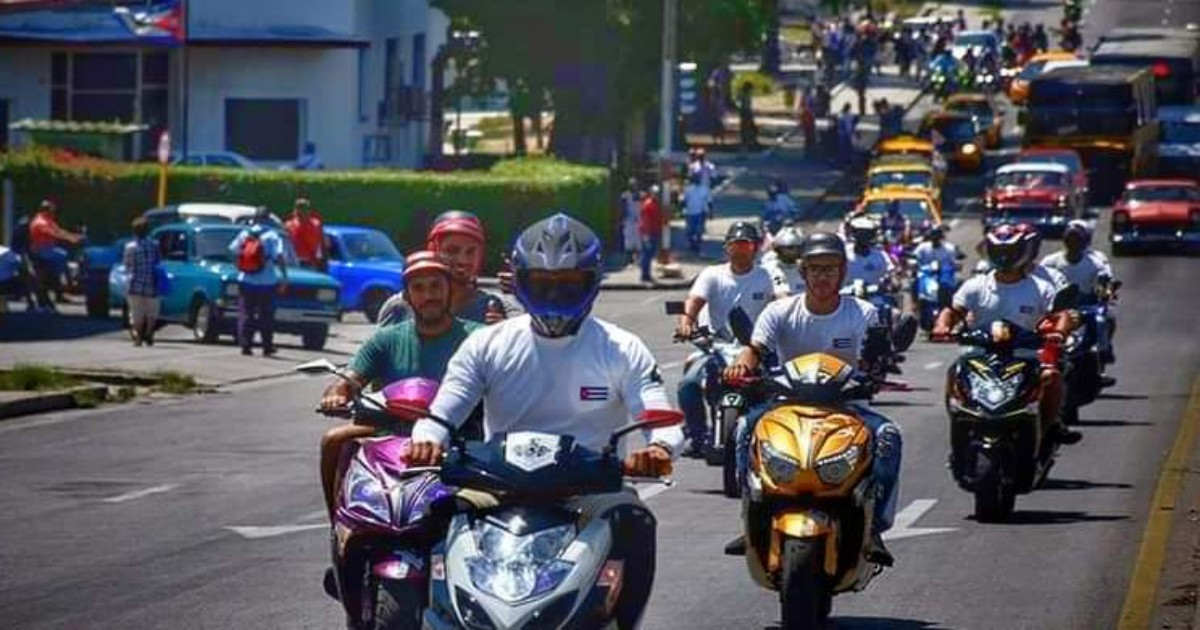
The Ministry of the Interior (MININT), through the National Revolutionary Police (PNR), exceptionally opened vehicle registration processing centers in Havana this Sunday so that the owners of electric scooters can register and legalize their vehicles.
The extraordinary event allows for official registration, obtaining the license plate and corresponding documentation, or regularizing vehicles that have been operating without being declared to the authorities.
To complete the process, citizens must present their identity card along with a document proving ownership of the moped: a purchase invoice, a sworn statement, or a certification issued by an authorized importing entity.
The PNR has made the phone numbers 76893531 and 54603379 available to guide the public on the exact locations of the centers in each municipality of Havana.
The regime presented the measure as a gesture of flexibility towards the citizenry.
"The exceptional opening of centers on Sunday is part of efforts aimed at expanding public access to these services and facilitating the registration of electric mopeds, with the goal of contributing to safer and more organized traffic," stated the note released by Cubadebate.
However, the measure only covers the capital, leaving the rest of the country out, where the registration process is even slower and more bureaucratic. Readers of Cubadebate pointed this out plainly in the comments: "Why only Havana? In the rest of the country, that process is very lengthy," wrote one user, while another noted: "So many initiatives, and this one could have been implemented at a national level."
The urgency to regularize these vehicles cannot be separated from the collapse of public transportation in Cuba, which Minister Eduardo Rodríguez Dávila himself described to Reuters as “one of its lowest levels of all time.”
The figures provided by the department head are staggering: daily departures of interprovincial buses from Havana have plummeted by 97.4%, falling from 419 daily trips in 2025 to just 11 this year. Intercity transport, essential for the daily commute of workers, is expected to contract by 90% in 2026.
Faced with that void, electric scooters and tricycles became the only mobility alternative for millions of Cubans: the fleet of electric vehicles hovers around 150,000 units, and these modes accounted for nearly 40% of vehicle sales in Cuba until August 2026, compared to 3.5% in 2025.
According to Rodríguez Dávila, in August of last year, 40% of vehicle imports were electric, compared to just 3.5% in January 2025. This is due to incentives for imports that exempt or reduce taxes on electric cars and bicycles.
But the accelerated proliferation—driven by desperation due to the collapse of state transport—has influenced road safety: during the first quarter of 2026, 1,234 accidents were recorded, resulting in 153 fatalities and 1,154 injuries. Motorcycles, mopeds, and electric tricycles are among the most vulnerable modes of transport, and were involved in 74% of the incidents.
The government first allowed the uncontrolled proliferation of these vehicles—many unregistered, without licenses, and driven by minors—as a release valve in response to the collapse of state transportation, and now it is urgently trying to regulate them through extraordinary measures.
Related videos:
Filed under: