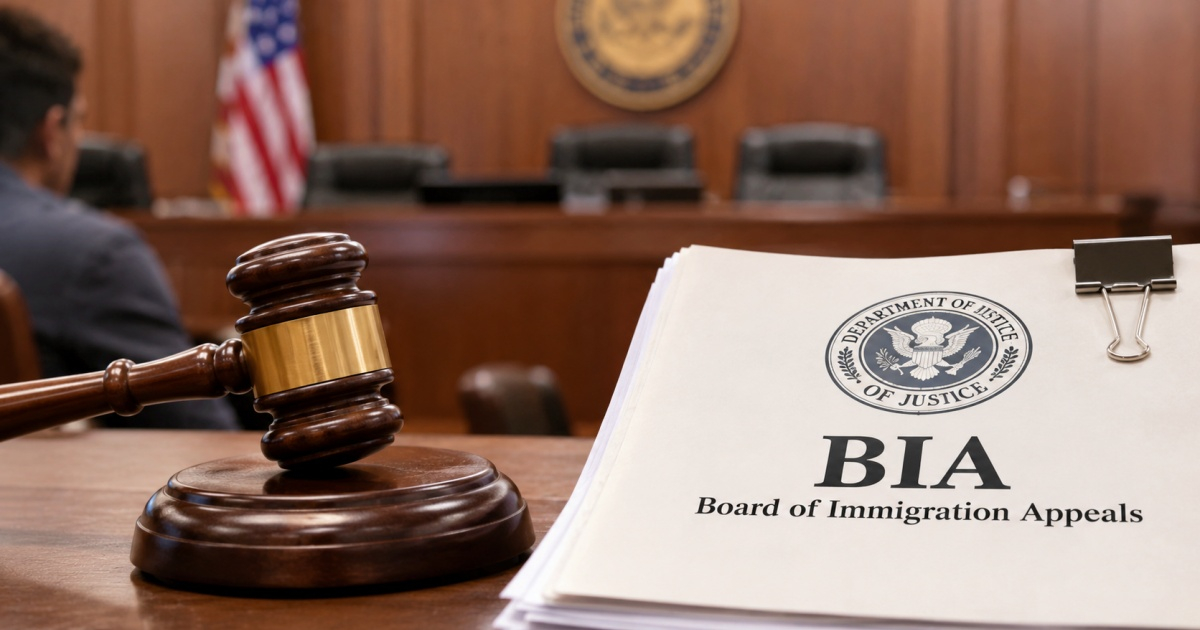
The Board of Immigration Appeals (BIA) of the United States issued a binding precedent on November 23 that eliminates the possibility of applying equitable criteria to admit late appeals.
He has done it just weeks before a regulation goes into effect that will reduce the time to appeal most immigration judges' decisions from 30 to 10 days.
The combination of both measures increases the risk that immigrants, including Cubans with open deportation proceedings in the United States, will lose the opportunity to appeal an unfavorable decision.
What does the new precedent of the BIA establish?
The resolution Matter of Gomez Pacheco, 30 I&N Dec. 249 (BIA 2026) arose from the case of a Honduran citizen who submitted an appeal after the deadline.
The BIA determined that neither immigration judges nor the board itself have inherent equitable authority to waive the deadlines established by the regulations.
It also established that the appeal period is a mandatory procedural rule, although not jurisdictional, that must be enforced when the opposing party duly invokes its noncompliance.
The decision explicitly revokes the precedent Matter of Morales-Morales, from 2023, which allowed the acceptance of late appeals when the party had acted diligently and extraordinary circumstances had prevented them from meeting the deadline.
The new ruling does not eliminate the extensions expressly provided for in the regulations, such as those applicable in certain cases of interruptions to the electronic document submission system.
The appeal period will be reduced to 10 days in December
The Department of Justice published on November 17 in the Federal Register a final rule set to take effect on December 17, 2026, unless a court decision prevents it.
The regulation reestablishes several provisions of a temporary reform from February that were partially annulled by a federal court in March.
The general deadline to appeal the new immigration decisions will be 10 calendar days. However, certain asylum cases will retain the 30-day period.
The shortened deadline will apply when the judge determines that the applicant cannot seek asylum for any of these reasons:
- Existence of an applicable safe third country agreement.
- Failure to comply with the one-year deadline to apply for asylum, except for legal exceptions.
- Prior denial of an asylum application that prevents submitting another.
If none of these grounds for inadmissibility apply, the 30-day deadline will remain in effect for the entire case, including requests for other forms of protection against deportation.
The regulation also establishes summary dismissal as the predetermined procedure within 15 days following the submission of the appeal, unless a majority of the permanent members of the BIA votes in favor of a broader review within the first 10 days.
The Department of Justice justifies the reform due to the backlog of pending cases before the BIA, which increased from 35,837 in fiscal year 2017 to 325,774 in 2026.
How it affects Cubans with I-220A
The tightening of appeals aligns with another judicial setback for Cuban immigrants.
On November 17, the Eleventh Circuit Court of Appeals ruled in the case Aguiar-Fernandez v. U.S. Attorney General that release under the I-220A form does not equate to the migration parole required by the Cuban Adjustment Act for those who were not legally admitted into the country.
The ruling is binding in Florida, Georgia, and Alabama, and it complicates access to permanent residency for Cubans who rely on that document to verify their eligibility.
What to do in the face of an unfavorable immigration decision
Those affected should immediately contact an authorized immigration attorney or a properly accredited representative to act before the BIA.
The form to file the appeal is the EOIR-26, for which the current fee is $1,060, payable electronically. Those who can demonstrate financial hardship may request a waiver using form EOIR-26A.
The deadline begins from the judge's oral decision or from the postal mailing or electronic notification of the written resolution. If it falls on a Saturday, Sunday, or legal holiday, it is extended to the next business day.
The appeal must be submitted within the timeframe and specifically identify the legal or factual errors being challenged. Under the new regulations, omitted arguments will be considered waived.
The reform does not eliminate the avenues for review before federal courts or the legally available requests for reopening or reconsideration. However, appealing to a federal court does not automatically suspend a deportation order.
Related videos:
Filed under: