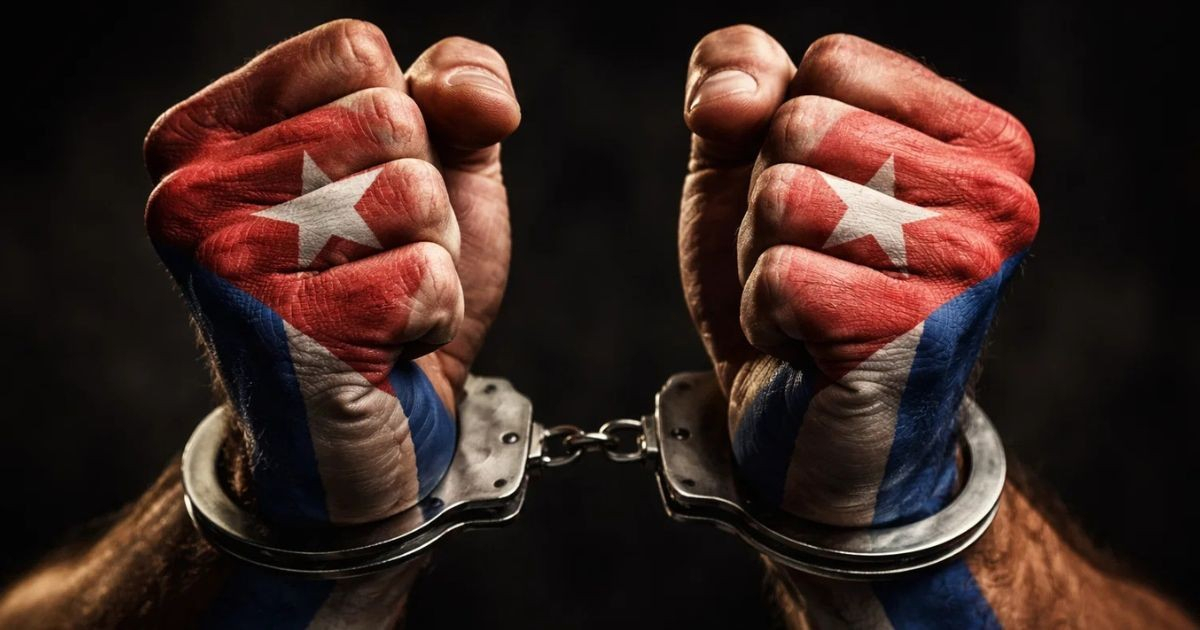
Repression against freedom of expression in Cuba increasingly relies on judicial and penal mechanisms, according to the latest report from the Cuban Observatory of Freedom of Expression (OCLE).
The organization recorded 141 violations of freedom of expression and the press in 115 incidents during October 2026, a figure more than double the 64 counted in the same month of 2025, marking a year-on-year increase of 120.3%.
The monthly report from OCLE, published by the Cuban Institute for Freedom of Expression and the Press (ICLEP), identifies the central feature of the month as the judicialization of censorship: the indicator of "abusive use of state power" topped the records with 61 violations (43.3% of the total), of which 52 involved prosecutors, courts, and the prison administration.
"The repression increasingly relies on criminal processes, precautionary measures, and sanctions within the prison," the report emphasizes.
Political prisoners were the most affected group: they appear as victims in 45 incidents, representing 39.5% of the 114 cases identified by the Observatory.
Of those 45 incidents, 18 correspond to the sentencing requests made by the Provincial Prosecutor's Office of Ciego de Ávila against individuals charged in connection with the protest on March 13 in Morón.
The Prosecutor's Office requested sentences ranging from 7 to 13 years in prison for sedition for the defendants, seven of whom were minors at the time of that protest, which was triggered by weeks of blackouts and food shortages.
Geographically, Havana accounted for 38 incidents (33% of the total), although this was a decline from the 63 recorded in September. Ciego de Ávila experienced the most significant increase, going from just one incident in September to 18 in October, all related to the Morón case. Camagüey ranked third with 13 incidents, 11 of which involved the prison system.
By institution, State Security was involved in 49 incidents, the National Revolutionary Police in 30, and the prison system in 24.
Among the most serious individual cases is that of journalist Henry Constantín Ferreiro, director of La Hora de Cuba, who has been imprisoned for over two months in the maximum-security Kilo 7 prison in Camagüey. On October 15, he was placed in solitary confinement following the discovery of a homemade knife during a search; he reported that the object was "planted" on him deliberately. This measure suspended his family visits and daily phone calls for at least 15 days.
On October 1st, the People's Municipal Court of Havana del Este sentenced content creator Anna Sofía Benítez Silvente (Anna Bensi), 21 years old, and her mother Caridad Silvente Laffita to two years of restriction of liberty each for recording and disseminating a video of a Ministry of Interior agent who visited their home in Alamar.
The independent journalist Adelth Bonne Gamboa was interrogated on October 20 in Havana and threatened with two to ten years in prison for "propaganda against the constitutional order" if he did not sever his ties with the independent portal CubaNet.
In Sancti Spíritus, the tattoo artist Óscar Echevarría Rubio was arrested on October 10 along with his wife, Cleidys García, after shouting slogans such as "Down with the dictatorship" and "Homeland and Life" from the rooftop of their home. Although there is no record of her participating in the protest, both were placed in provisional detention. On October 22, the activist's daughter, Aitana Echevarría Rivero, 18, was placed under house arrest.
From January to October 2026, the OCLE recorded 1,676 violations, compared to 1,004 in the same period of 2025, marking an increase of 66.9%.
According to Prisoners Defenders, Cuba reached a total of 1,353 political prisoners in October 2026, with hundreds of them suffering from malnutrition or lacking medical care.
Related videos:
Filed under: