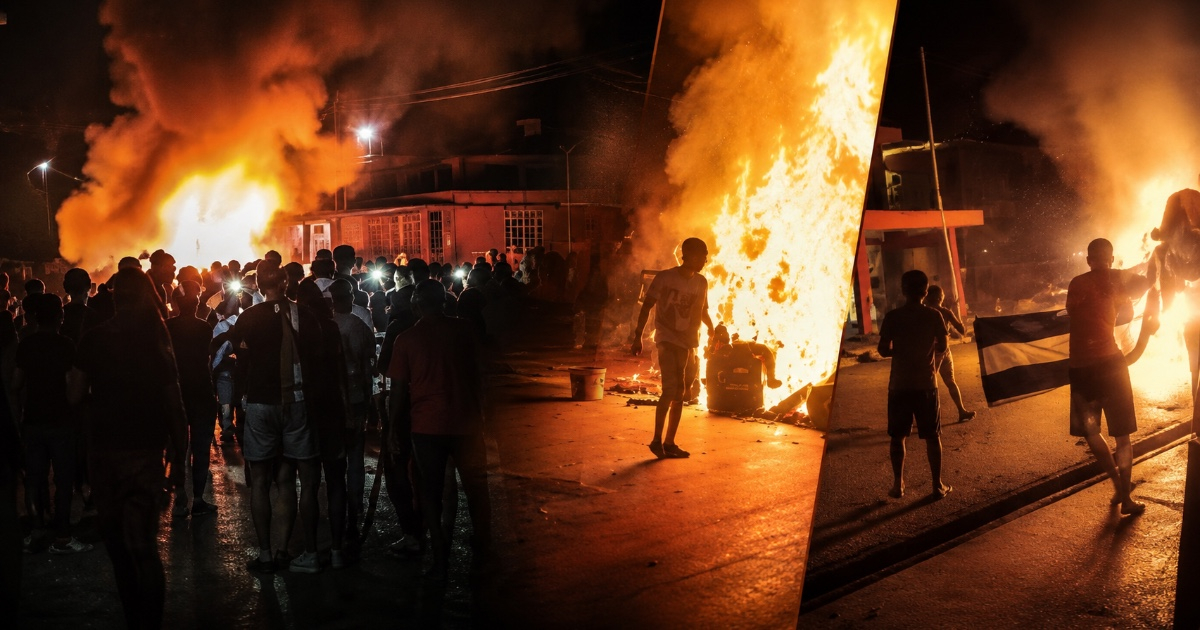
The Provincial Prosecutor's Office of Ciego de Ávila requested prison sentences of up to 13 years for 19 individuals charged in relation to the protests on March 13 in Morón, including several teenagers who were minors at the time of the events.
The accused face charges of sedition for the anti-government protests that shook the city, where hundreds of residents took to the streets to protest against the prolonged blackouts, food shortages, and difficult living conditions.
According to Martí Noticias, the requests from the Prosecutor's Office range from seven to thirteen years of imprisonment. The families reject the accusations and report that the authorities have not provided sufficient evidence to prove their children's involvement in the violent events that occurred during the protest.
Among those indicted are young individuals who have been incarcerated since March, while others, such as the adolescent Jonathan David Muir Burgos, were released later, although they remain subject to the criminal proceedings.
The requested penalties do not yet constitute judicial convictions. These are the provisional conclusions of the Prosecutor's Office, which must be reviewed during the proceedings.
Up to 13 years in prison for protests against blackouts
According to the report, the highest request corresponds to Hosuán Naranjo Chacón, for whom the prosecution is seeking 13 years in prison.
For Brian Pérez Muñoz, 28 years old, and the other adults involved in the case, authorities are requesting 12 years in prison.
Christian de Jesús Crespo Álvarez, 17 years old, faces a request for eight years in prison, while for the other minors being prosecuted, seven-year sentences are being sought.
Among these is Jonathan David Muir Burgos, whose imprisonment in an adult facility sparked denunciations from international human rights organizations.
The prosecution requests are known seven months after the protests, when several families continue to demand the release of their loved ones and question the application of the sedition charge.
Mother of detained youth questions the evidence: "He arrived when everything was already in disarray."
Dayarmé Muñoz, mother of Brian Pérez Muñoz, rejected the accusation against her son, who has been detained since the protests in March.
According to what he explained to Martí Noticias, Brian joined the demonstration after incidents had already occurred outside the municipal headquarters of the Communist Party of Cuba (PCC).
The woman acknowledged that her son participated in the protest and publicly expressed his discontent, but she denied that there was any evidence that he had thrown stones, set objects on fire, or entered the Party's premises.
"He arrived at the premises when everything was already in disarray," he stated when questioning the responsibility attributed to him by the Prosecutor's Office.
His son was transferred about a month after the arrest to the maximum security prison of Canaleta, in Ciego de Ávila, where he remains in provisional custody.
The mother reported that over the past seven months, the authorities have rejected four requests to change the precautionary measure and one complaint made on her behalf.
They are requesting eight years for a teenager whose mother claims that the forensic tests were negative
Another case is that of Christian de Jesús Crespo Álvarez, who was 16 years old when he was arrested on March 18, five days after the protests.
His mother, Marielkis Álvarez, reported that the authorities intend to sentence him to eight years in prison despite the fact that, according to her testimony, the forensic evidence conducted on the teenager did not link him to the damages caused at the PCC headquarters.
The woman stated that the fingerprint, shoe, and scent examinations yielded negative results.
He also explained that the accusation is based on a recording in which the young man's face is not distinguishable.
According to their account, the investigators would have identified Christian by his height and a tattoo, elements that the family considers insufficient to determine his involvement in the incidents.
The situation of the adolescent had already led to public denunciations. In May, his relatives raised concerns about the assaults and the conditions of his detention in Canaleta, where he allegedly endured a beating, the theft of his belongings, and was subsequently moved to a punishment cell.
Jonathan Muir also faces seven years in prison despite having been released
Among the adolescents processed is Jonathan David Muir Burgos, son of the evangelical pastor Elier Muir Ávila, who was detained on March 16 after attending a police summons with his father.
The young man, who was 16 years old at the time, spent over three months in detention, part of that time in the adult prison of Canaleta.
During his imprisonment, family members and human rights organizations reported the decline in his health and the conditions under which he was held.
In April, the Inter-American Commission on Human Rights (CIDH) granted precautionary measures, considering that his rights to life, personal integrity, and health were at risk.
Later, on June 24, Jonathan was released, although he still faces movement restrictions. According to the latest report published by Defensa CD, "he cannot leave his home without court authorization, except to go to work or school during his regular hours or to address his health."
What happened during the protests on March 13 in Morón?
The protests began amid residents' discontent over prolonged power outages, food shortages, and the decline in living conditions in Cuba.
That night, the neighbors walked through several streets of Morón, banging pots and shouting slogans like "Freedom!" and "Homeland and Life."
According to the provisional conclusions cited by Martí Noticias, the gathering brought together more than 800 people.
The protesters first headed toward a unit of the Revolutionary National Police (PNR) and later to the municipal headquarters of the PCC.
Videos shared during the protests showed people removing items from party facilities and setting them on fire in the street, as well as throwing stones, and causing damage to doors and windows.
The initial version from the Cuban government acknowledged that the protest had started peacefully, although it later labeled the incidents recorded outside the Party headquarters as vandalistic.
Related videos:
Filed under: