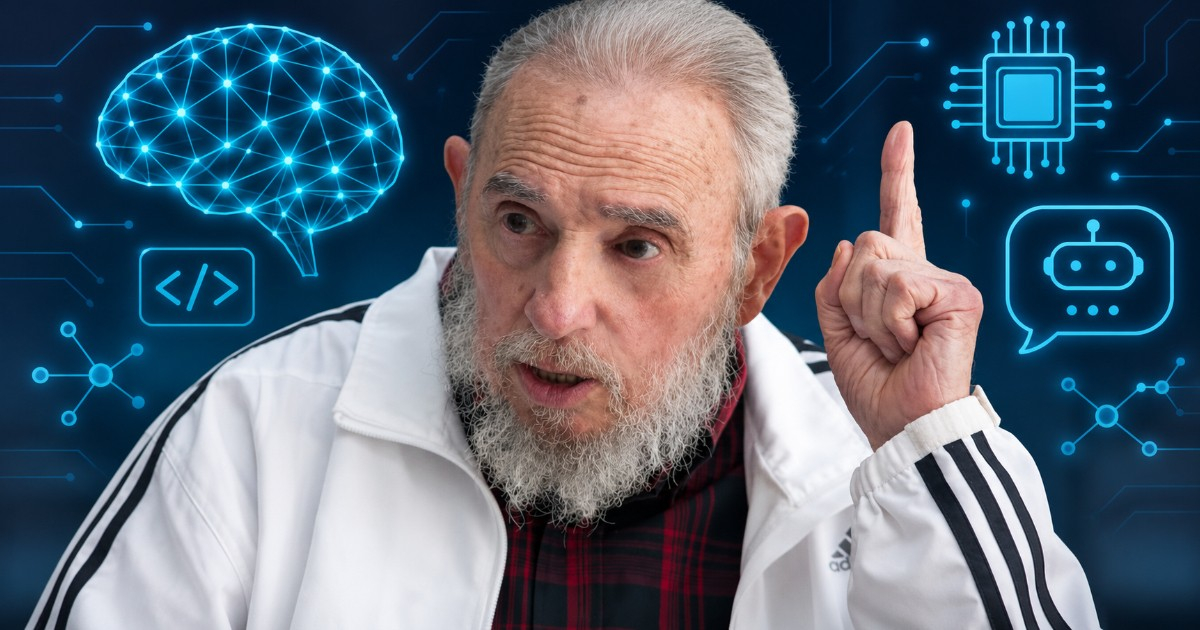
While the dollar hovers around 1,000 Cuban pesos in the informal market and power outages exceed 20 hours, the regime's propaganda machine has found a solution to the dilemmas of artificial intelligence: reviewing Fidel Castro's legacy. This is what a recent article published this Wednesday in the state media Cubadebate, signed by Rosa Miriam Elizalde, the first vice president of the Union of Journalists of Cuba and a member of the National Assembly of People's Power, proposes with complete seriousness.
The text, titled "What Fidel Tells Us About AI," is part of the official campaign for the "Year of the Centenary of Commander in Chief Fidel Castro Ruz" and argues that the dictator, who passed away ten years ago today, on November 25, 2016, would have asked the right questions about technology decades before modern artificial intelligence existed.
According to Elizalde, "Fidel did not leave a manual to resolve the dilemmas of artificial intelligence. He left a way to question technology: who controls it, who sets its objectives, who benefits from the gains in productivity, and who is left out."
As a central piece of evidence for this supposed visionary insight, the author highlights an episode from October 1963: after Cyclone Flora passed through eastern Cuba, Castro allegedly ordered the use of an IBM Ramac computer—which occupied an entire room—to calculate pensions for Caribbean workers in the Sierra Maestra. From this, Elizalde argues, a universal principle emerges: "what matters is whose life is improved."
The article also cites a speech by Castro from April 19, 1965, in which he asserted that "the electronic brains of the Pentagon" could not measure "the dignity, the morals, and the revolutionary spirit" of the Cuban people. It mentions that in April 1970, the dictator played a game of chess against the CID-201, the first computer manufactured in Cuba. Elizalde herself admits that "nobody needs to attribute to the Commander in Chief the gift of having foreseen ChatGPT," although that does not prevent the article from building exactly that narrative.
The piece is part of a well-established propaganda tradition. During the centenary, official organizations such as the Joven Club de Computación revived the phrase —attributed to former Algerian president Abdelaziz Bouteflika— that "Fidel traveled to the future and came back to tell about it," portraying the dictator as a technological prophet.
The reaction on social media was one of immediate mockery. Journalist José Raúl Gallego quipped on Facebook: "And the award for the ridiculous comment of the day goes to... Rosa Miriam Elizalde: 'What Fidel tells us about AI.' There are no limits."
The comments on the Cubadebate post were no more gracious. "I knew a lot about AI. What I didn't know was how to feed a country," wrote one user. Another pointed straight to the crisis: "How surreal everything is in this country. By the way, the dollar is almost 1,000 CUP. Did he leave a manual for that too?" There were also those who gave the proposal a name: "AI PalmicheGPT."
Elizalde, member of the National Assembly and founder of Cubadebate, received the National Social Communication Award 2026 in June of this year, awarded specifically for her work on "technological sovereignty" and artificial intelligence. Her contribution to the debate on AI, which consisted of invoking a dead dictator, did not go unnoticed by the Cubans who read her.
"The Messiah... The guy who knew everything, even what didn't exist in his time," summarized another commentator. The centennial campaign, which included 100 children's piñatas in Holguín, an animated series about Castro's childhood, and dozens of official events, continues to produce content that Cubans receive with a mix of disbelief and fatigue.
Related videos:
Filed under: