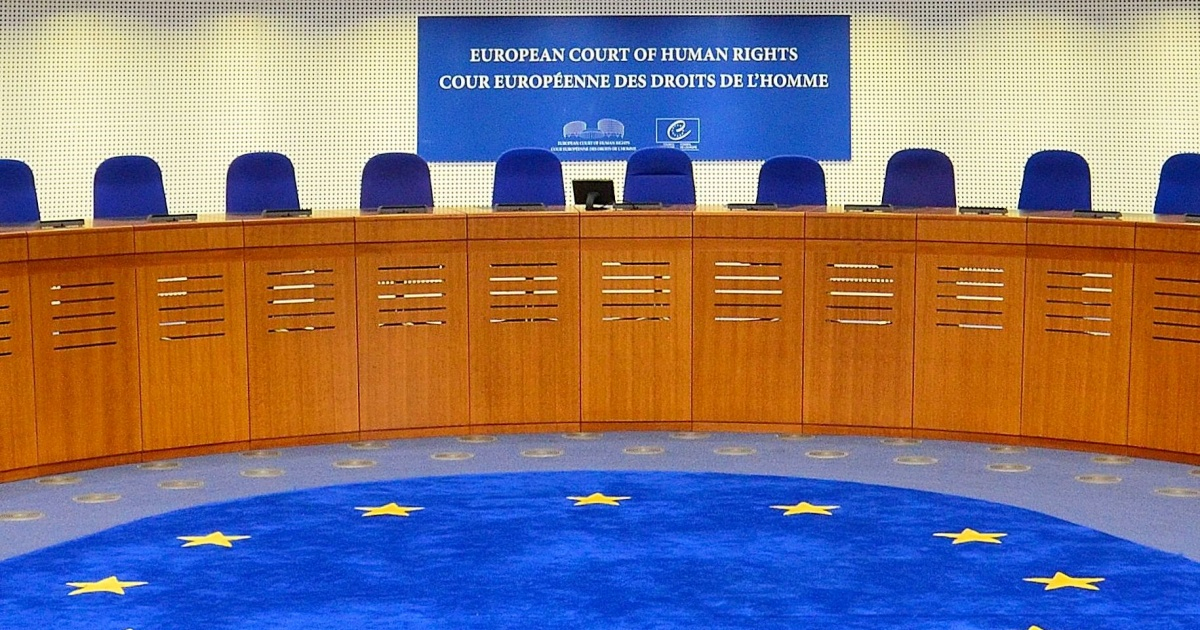
The European Court of Human Rights (ECHR) condemned Lithuania to compensate 60,000 euros to four Cuban migrants who were illegally detained for six months in 2022 after attempting to enter the country from Belarus in search of asylum.
The ruling, issued this Tuesday by the Grand Chamber of the court based in Strasbourg, establishes that the Lithuanian authorities violated the right to liberty and security of the four Cuban citizens.
According to the European Union Asylum Agency (EUAA), each individual is to receive 15,000 euros for moral damages, in addition to a total amount of 1,800 euros for expenses and legal costs.
The total amount that Lithuania will have to pay is €61,800.
The conviction is not based on the deportations of migrants to Belarus, but on the illegal deprivation of liberty they experienced once within Lithuanian territory.
The European Justice did not condemn the deportations to Belarus
Despite acknowledging the irregularities in the detention, the ECHR rejected another of the main claims made by Cubans: that regarding their repeated deportations to Belarus.
By 11 votes in favor and six against, the judges concluded that those expulsions did not violate Article 3 of the European Convention on Human Rights, which prohibits torture and inhumane or degrading treatment.
In its official statement, the court positioned the case within what it refers to as the "instrumentalization of migration" by the Belarusian authorities.
According to the ECHR, Belarus encouraged, facilitated, or forced the displacement of migrants towards the borders of neighboring countries with the intent to destabilize them.
Under those circumstances, the court determined that the return of a migrant to Belarus does not, by itself, constitute a violation of Article 3, although States remain obligated to identify and protect individuals who are particularly exposed to suffering serious harm.
The ruling distinguishes two categories of individuals who require this protection: those whose vulnerability is evident due to reasons such as age, illness, or disability, and those who can demonstrate a real and immediate threat to their life or an equivalent risk of suffering serious mistreatment.
The majority of the magistrates believed that the four Cubans did not fit into either of those two categories.
The court also did not find a violation of Article 34 of the Convention regarding the return made after the provisional measure was issued. It considered that the delay in communicating this to the border authorities had not been due to any act of bad faith.
Why must Lithuania compensate the four Cubans?
The case, identified as C.O.C.G. and others v. Lithuania, with file number 17764/22, dates back to the spring of 2022.
The four Cubans remained confined between April 15 and October 18 of that year in the foreign registration centers of Medininkai and Pabradė, closed facilities, surrounded and under constant surveillance by security forces.
During that period, they could not leave the premises and their freedom of movement within the facilities was even restricted.
The judges unanimously determined that Lithuania violated three fundamental guarantees enshrined in Article 5 of the European Convention on Human Rights:
- the right not to be unlawfully deprived of liberty.
- the right to be promptly informed of the reasons for the arrest.
- the right to challenge it before a court.
The migrants did not receive individual rulings justifying their detention nor did they have effective mechanisms to legally challenge the lawfulness of the measure.
The Constitutional Court of Lithuania itself had declared that the legal framework allowing for asylum seekers to be detained for six months without assessing their personal circumstances or considering less restrictive measures was unconstitutional.
The European Court of Human Rights concluded that the Lithuanian legislation in force at that time did not meet the minimum legal requirements even in situations of a massive influx of asylum seekers.
Who are the four Cuban plaintiffs?
The four claimants are Sonia Hernández, Carlos Cruz, Yarisledy Rodríguez, and a fourth woman who preferred to keep her identity anonymous, according to testimonies published in April of this year by the French newspaper Le Monde.
Born between 1991 and 2000, the four left Cuba in 2021 following the anti-government protests of July 11, citing fears for their safety.
Yarisledy Rodríguez, a young dancer from Ciego de Ávila who was 21 years old when the events occurred, witnessed how several of her friends were imprisoned following the protests of July 11th, one of whom was sentenced to four years in prison.
Fearing the same fate, he decided to leave the island.
The four traveled to Russia, a country that did not require visas for Cuban citizens for short stays.
On March 30, 2022, they flew from Moscow to Minsk, the capital of Belarus, with the intention of reaching Lithuania and seeking international protection.
Two weeks trapped between Lithuania and Belarus
What was meant to be an escape route turned into a traumatic experience for the four Cubans, who were trapped in the border area for approximately two weeks.
The migrants reported that they had been intercepted and repeatedly returned to Belarus, despite expressing their intention to seek asylum in Lithuania.
According to their testimonies, they remained in wooded areas, exposed to the cold, with a lack of food and subjected to alleged mistreatment by border agents from both countries.
Sonia Hernández recounted that the Belarusian guards chased them at night with infrared lights, and the group members fled, stumbled, and hid among the trees.
"She was so exhausted that she started hitting herself. They were laughing," recalled one of the migrants in statements collected by Le Monde.
On April 8, 2022, with the help of volunteers, Cubans succeeded in securing a provisional measure from the European Court of Human Rights to prevent their expulsion from Lithuania, as long as they remained within its territory.
However, they were returned to Belarus the following day. Lithuanian border authorities claimed that at that time they were unable to verify the authenticity of the information regarding the court order.
Finally, on April 13, they managed to enter Lithuania, where they were detained and were able to begin their asylum proceedings.
Between February and March 2023, the four received refugee status and permanent residency permits in Lithuania.
A ruling with implications for European borders
The resolution regarding the four Cubans is part of a set of three rulings from the Grand Chamber related to the returns of migrants and asylum seekers at the borders of Lithuania, Latvia, and Poland with Belarus.
Since 2021, the European Union has accused the government of Aleksandr Lukashenko of using migration flows as a tool of political pressure against member states.
In one of the parallel cases, the ECtHR condemned Poland for returning an Afghan citizen to Belarus despite a provisional measure from the court itself aimed at protecting him being in effect.
In the case of Latvia, the magistrates determined that the authorities violated the rights of several Iraqi minors and their accompanying family members by returning them to Belarusian territory.
Amnesty International criticizes the court's decision
Amnesty International described the resolutions as a “devastating blow” to the guarantees of protection against torture and ill-treatment at European borders.
Mandi Mudarikwa, head of Strategic Litigation for the organization, raised concerns about the fact that access to that protection is conditional on migrants' ability to demonstrate clear vulnerability or imminent danger.
The representative of Amnesty International denounced that migrants and refugees suffer repeated violations of their rights, first due to the abuses by Belarusian authorities and then because of the limitations in accessing justice.
The organization reminded that the rulings do not exempt states from fulfilling their international obligations regarding human rights and the protection of refugees, including the right to seek asylum.
The three rulings of the Grand Chamber are final and binding, and their implementation is under the supervision of the Committee of Ministers of the Council of Europe.
Related videos:
Filed under: