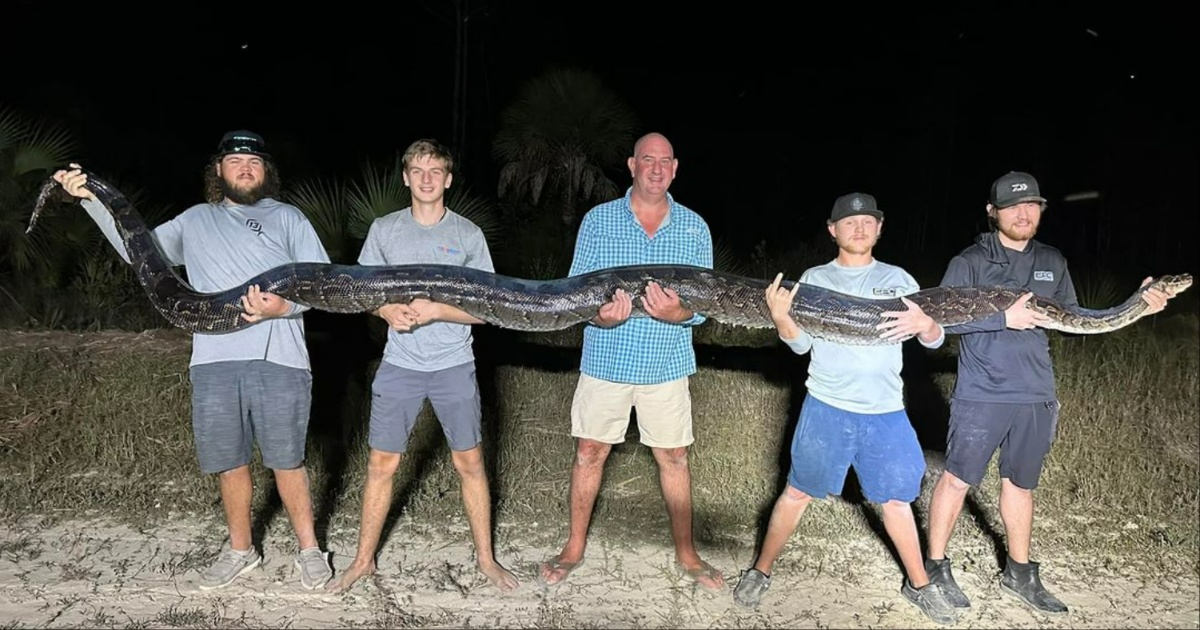
The Burmese pythons, one of the most destructive invasive species in Florida, have found a way to survive low temperatures that for years were considered a natural barrier to their expansion: taking refuge in burrows dug by other animals.
An article published this Wednesday by Fox 35 Orlando warns that researchers have documented how these snakes utilize underground shelters to protect themselves from the cold and even reproduce.
Amy Siewe, a professional python hunter known as The Python Huntress, explained that the reptiles take advantage of the burrows of Florida gopher tortoises and armadillos to keep warm during the colder nights.
The search for food also promotes their presence in new territories, where they could cause damage similar to that recorded over more than 25 years in the Everglades.
Pythons threaten new territories in Florida
The presence of these reptiles in the Brevard counties, on the Atlantic coast, and Charlotte, in the southwestern part of the state, has increased concern among specialists.
However, according to Siewe, researchers believe that these populations may have originated independently and not necessarily as a result of the natural expansion of the snakes established in the Everglades.
At the end of October, the Institute of Food and Agricultural Sciences at the University of Florida (UF/IFAS) confirmed the existence of an established population of Burmese pythons in Charlotte.
The Florida Fish and Wildlife Conservation Commission (FWC) suspects that this colony may have originated from captive specimens that escaped or were released.
The use of underground shelters is particularly important because low temperatures remain a threat to these reptiles native to Southeast Asia.
A study published in 2011 by the United States Geological Survey (USGS) documented the death of nine out of ten pythons that scientists were monitoring with radio transmitters during a severe cold snap recorded in January 2010 in southern Florida.
Some of those specimens tried to warm themselves by basking in the sun, instead of seeking shelters to protect themselves from the extreme temperatures.
A difficult invasion to control
According to figures from the FWC cited by Fox News, more than 23,000 Burmese pythons have been removed from Florida. However, it is estimated that there are still tens of thousands remaining in the Everglades region.
Its camouflage ability, prolonged periods of inactivity, and high reproductive capacity greatly complicate its location.
Females can lay between 20 and 40 eggs per year, although larger ones can exceed a hundred, according to Siewe.
Florida has been developing initiatives for years to control this species, which is responsible for severe damage to populations of mammals, birds, and other native animals.
In August, Tom Rahill, a resident of Tampa, became the winner of the annual Florida python hunting competition with a record of 96 specimens captured, for which he received a prize of $10,000.
During the ten days of competition, 907 participants managed to remove a total of 280 invasive snakes.
In September, it was revealed that researchers from the University of Florida had deployed around 90 robotic rabbits to lure pythons using heat signals, scents, movements, and vibrations that mimic their natural prey.
Specialists expect that this technology could also be used in areas where new populations begin to be detected.
Related videos:
Filed under: