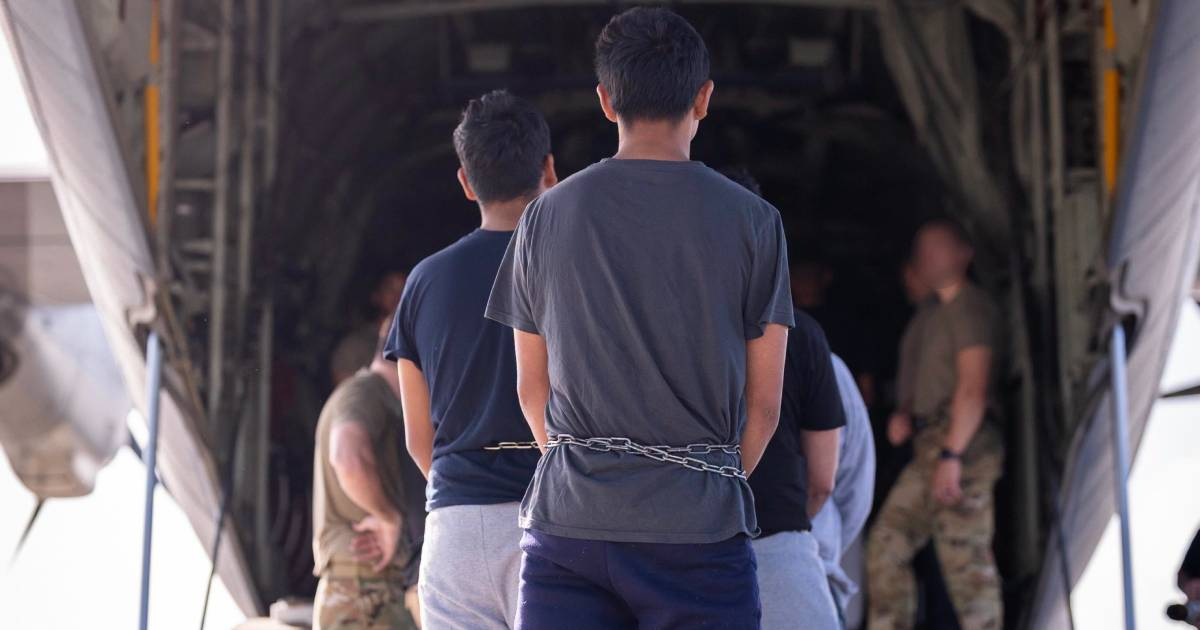
The Supreme Court of the United States has scheduled the oral hearing for Wednesday, December 9, for the case No. 26-426, DHS v. D.V.D., the most significant litigation regarding deportations to third countries that has reached the high court, and whose main plaintiff is a Cuban citizen identified by the pseudonym D.V.D.
Last Monday, a wave of amicus curiae briefs arrived at the Supreme Court against the government's policy: the United States Conference of Catholic Bishops (USCCB) along with eight religious denominations, Democratic senators Shaheen, Durbin, Peters, and others, the ACLU, the American Immigration Council and the AILA, the National Immigrant Justice Center (along with the Amica Center and the Florence Project), former officials, diplomats, UN rapporteurs, law professors, the NAACP LDF, and the Haitian Bridge Alliance.
D.V.D. is Cuban, arrived in the U.S. in 1999, is married to a U.S. citizen, has two children who are citizens, and suffers from severe mental illnesses; in 2017, an immigration judge ordered his deportation to Cuba, but the Cuban regime will not accept him back.
That situation is shared by thousands of Cubans in South Florida who live under ICE supervision with form I-220B, attend check-in appointments in Miramar, or are detained in the Krome and Broward facilities.
The case questions whether the Department of Homeland Security (DHS) can send individuals with final deportation orders to a third country—different from their country of origin—without notifying them or giving them a chance to argue that they would face persecution, torture, or death there.
The contested policy is the "Guidance Regarding Third Country Removals" issued by then Secretary Kristi Noem on March 30, 2025: it allows for deportation without notice if there are "diplomatic guarantees," or with only six to 24 hours' notice if there are none, and agents are not required to ask if the person fears the destination.
The brief submitted by the defendants on November 16 documents serious consequences: class members were sent to CECOT in El Salvador, where they endured "routine beatings, sexual assault, inhumane conditions, and psychological torment"; eight individuals were deported to South Sudan with less than 24 hours' notice, outside of business hours, using a form in English that everyone refused to sign.
A U.S. official stated in the report that "the goal [of the policy] is to scare people."
The impact on Cubans is direct: according to a report by Human Rights Watch, between January 2025 and March 2026 the government deported 4,353 Cubans to Mexico, the largest national group among over 18,000 nationals from third countries sent to that country, many of whom had lived there for decades and had no criminal records.
In addition, Cubans have been sent to African countries with which they have no ties. On October 21, an ICE flight transported 69 Cubans from Louisiana to Bangui, the capital of the Central African Republic.
The amicus brief from NIJC warns that since mid-September, individuals with final deportation orders are no longer visible in ICE's online public locator, making it difficult for lawyers and families to locate them before a transfer.
The USCCB and the co-signing denominations document the case of Sister Leticia Ugboaja, a 56-year-old Nigerian Catholic nun who has had protection against deportation since 2019. She was detained on June 28 while heading to Sunday Mass; she was released but remains at risk of being sent to a third country without the ability to contest that decision.
This is the third time that the Supreme Court is reviewing the policy: in June 2025, it suspended, by a 6-3 vote, the temporary injunction by Judge Brian Murphy that was blocking the deportations; on September 29, 2026, it suspended again —with Justices Sotomayor, Kagan, and Jackson dissenting— the ruling that had declared the guideline illegal. Now, for the first time, the high court will examine the substance of the matter.
Those who have a final deportation order and fear being sent to a third country should immediately and spontaneously express this to ICE agents—the current guidelines do not require officers to inquire—and consult with an immigration attorney before their next check-in appointment.
The government's response before the Supreme Court is due on December 1, one week before the oral hearing in which it will be determined whether the policy violates immigration law, due process, or the Convention Against Torture.
El caso DHS v. D.V.D. podría redefinir las reglas de las deportaciones a terceros países en Estados Unidos. Sigue todos los detalles y novedades en nuestra sección de .
Related videos:
Filed under: