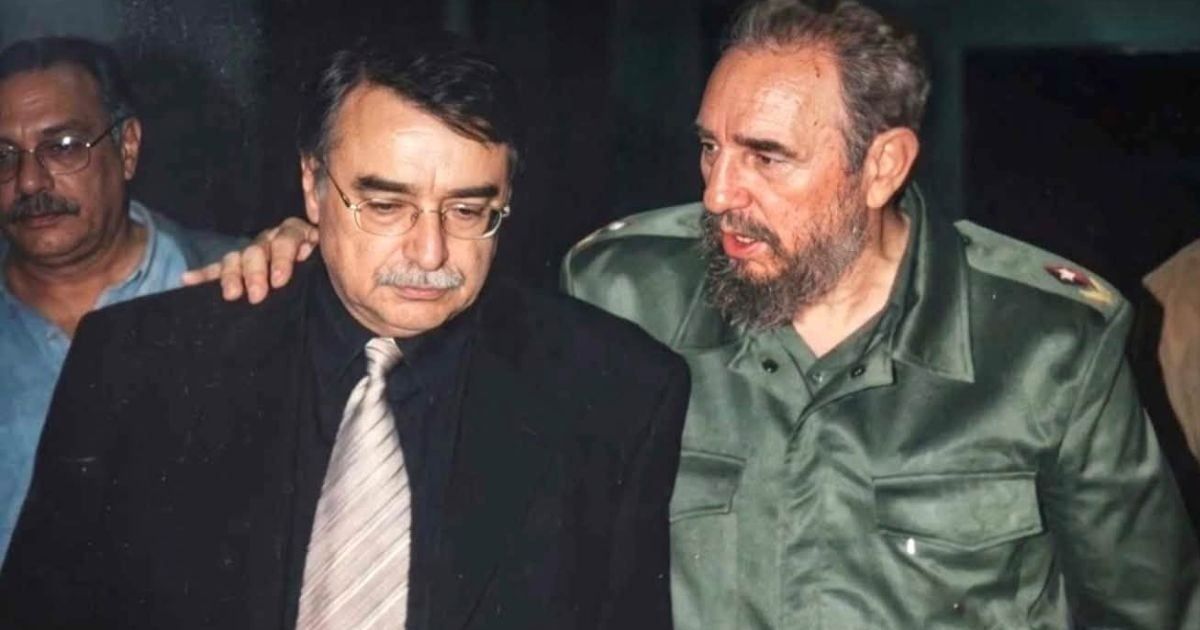
The Spanish-French journalist and essayist Ignacio Ramonet published a post this Friday in which he boasts about having been friends with three Latin American dictators and ironically recommends that his critics inflict physical harm on themselves, in a publication that sparked various reactions.
The text, which can be read on his Facebook profile, reads as follows: "Some failures rot with envy over the friendship that, generously, was shown to me by some political geniuses like, among others, Fidel Castro, Hugo Chávez, or Nicolás Maduro. I suggest they shorten their torture and cut their veins with a razor..."
The post, which seems to be an indirect response to a post from the Chavista activist and communicator Mario Silva, arrived just two days after Ramonet met in Caracas with the acting president of Venezuela, Delcy Rodríguez, on Wednesday, November 25, a meeting that the journalist himself was quick to enthusiastically share on social media.
On that occasion, Ramonet wrote: «In Caracas, I am welcomed by the Acting President of Venezuela, Dr. Delcy Rodríguez. I have known her for over 20 years. Her loyalty to Chavismo is unquestionable. Her great intelligence and immense work capacity are beyond doubt. […] Under her leadership, Venezuela pursues a central objective: prosperity.» The Venezuelan government publicized the meeting the following day, describing it as a "strategic meeting."
In a post early this Friday on his profile Lahojillaentv, Silva harshly criticized the propaganda made by Ramonet regarding the acting president, who many see as betraying Hugo Chávez's legacy due to her closeness to the U.S. government following the capture of dictator Nicolás Maduro by the U.S. military on January 3rd.
In the extensive article by Silva, titled "The Art of Deceiving Without Dying in the Attempt," he states that Ramonet "ultimately becomes a factor of confusion that legitimizes the surrender of our sovereignty in exchange for a generous stipend or the renewed use of his name as a bargaining chip." Silva also wrote that "after all, a traitor is a traitor; they are not wanted here or there, and history is relentless with all the Ramonets."
The trajectory of Ramonet as an apologist for authoritarian regimes in Latin America is long and well documented. He is the author of Cien horas con Fidel (2006), based on conversations with the Cuban dictator between 2003 and 2005, and of Hugo Chávez. My First Life (2013), resulting from over 200 hours of interviews with the Venezuelan leader.
In December 2025, he conducted a "podcar" interview with Nicolás Maduro —recorded while he was driving through Caracas on the 31st of that month— which turned out to be one of his last public appearances before being captured by U.S. forces on January 3, 2026.
In August of this year, Ramonet published a panegyric for the centenary of Fidel Castro in which he praised his "cerebral mechanisms" and "intellectual curiosity," in stark contrast to the reality of a collapsing Cuba: blackouts lasting between 15 and more than 24 consecutive hours, a contraction of GDP projected above 10 percentage points in 2026, making it the worst in Latin America; and more than 90% of the population lacking adequate access to food.
In May 2024, the journalist and essayist visited a Cuban state farm and compared it to a "Garden of Eden," while millions of Cubans stood in endless lines to obtain basic necessities.
On social media, the comments on Ramonet's post were devastating. One user wrote: "We already know, Ramonet, that you have always had a particular admiration for dictators; this is nothing new." Another comment was more direct: "Friendship... You are known as the bootlicker of dictators." A third voice, more measured, reminded him that "not everything that motivates people is envy. Sometimes there are things that from the outside are perceived as an insurmountable incoherence."
While Ramonet celebrates his ties with those who governed Cuba and Venezuela for decades, an independent survey conducted between April and May 2026, with over 42,000 participants inside and outside of Cuba, revealed that 82.2% of respondents identified the lack of civil and political liberties as one of the country's main problems
Related videos:
Filed under: