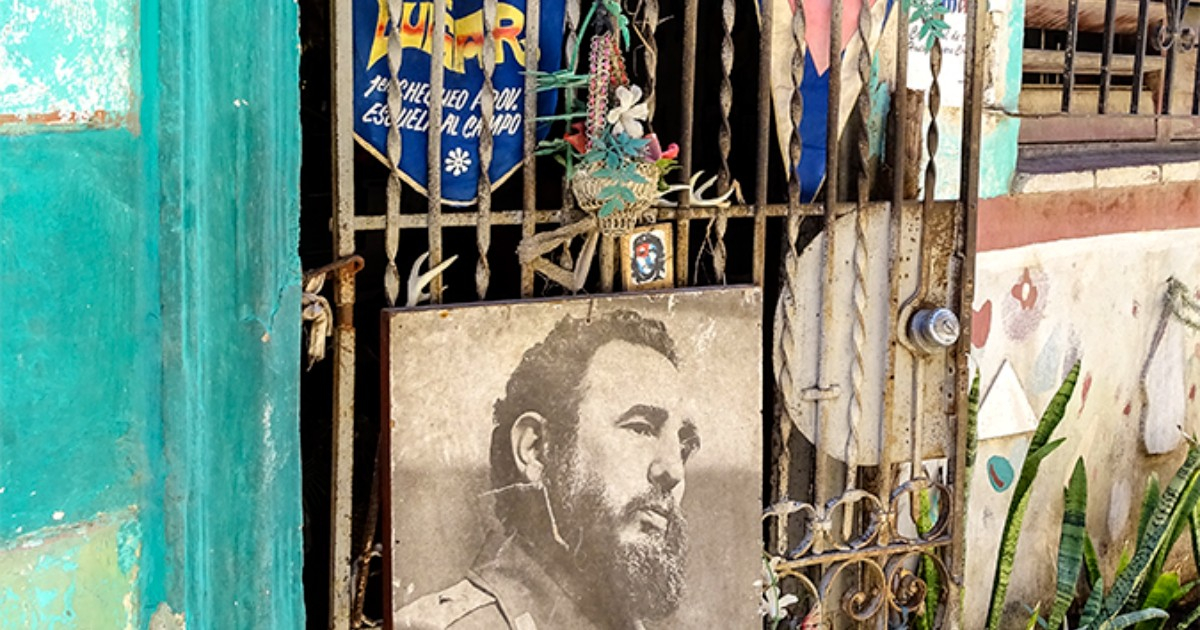
The Spanish journalist Ignacio Ramonet chose the centenary of Fidel Castro's birth to publish on Facebook an extensive panegyric titled "My friend Fidel Castro", in which the former director of Le Monde Diplomatique and official biographer of the Cuban dictator details, with an almost liturgical devotion, the intellectual virtues of the man who ruled Cuba for nearly half a century and left it in ruins.
Ramonet, known for his accommodating interviews with the Cuban regime's leadership, spares no praise. What first caught his attention in Castro, he writes, "was not his uniform, nor his height, nor his beard, nor even his eloquence. It was his curiosity." A curiosity that, according to the Spanish journalist, would have been "the secret to his political longevity."
The text accumulates praises with the generosity of someone who has never stood in a food line in Havana. "His cerebral mechanisms were impressive. He had a prodigious memory. But even more remarkable, I insist, was his intellectual curiosity, which remained intact until the end of his days. Nothing that pertained to the world was foreign to him," writes Ramonet, seemingly unaware of the contrast that these words present against the reality of the island in 2026.
The author of Cien horas con Fidel —based on conversations with Castro between 2003 and 2005— describes the dictator as "a strategist and visionary; sometimes obstinate, often bold, and even reckless, but always convinced that peoples can write their own history." That history, in the case of Cuba, he wrote alone and with an iron fist for decades.
Ramonet concedes, with elegant circumlocution, that the dictator's ambition "was not to build a perfect society—he knew that such a thing did not exist—but to preserve national independence, a fundamental requirement, in his view, for any policy of social justice." An independence that, it is important to remember, was exercised by suppressing that of the rest of the Cubans.
The Spanish journalist also celebrates that Castro "had foreseen the emergence of a Global South and the advent of a multipolar and multicentric international order." Admirable foresight from a man who could not foresee—or chose not to prevent—that his island would ultimately become one of the worst-performing economies in Latin America, with an accumulated decline of nearly 15% between 2020 and 2025 and an estimated contraction of between 6.5% and 7.2% of GDP just in 2026.
While Ramonet suggests "capturing the complexity of an extraordinary life without falling into hagiography," the Food Monitor Program reports that more than 90% of the Cuban population lacks adequate access to food. Almost one in three households acknowledged that at least one person went to bed hungry in the 30 days prior to the survey, and the majority of households experienced limitations in their ability to cook due to blackouts, which in 2026 last between 15 and over 24 consecutive hours, with some areas experiencing extremes of several days.
The panegyric is part of the commemorative apparatus of the regime, which declared 2026 "Year of the Centennial of Commander-in-Chief Fidel Castro Ruz" and organized the I International Colloquium "Fidel: Legacy and Future" at the Palacio de Convenciones in Havana, with more than 1,500 delegates from 63 countries. Ramonet also appears among the contributors to the book Voices with Fidel, alongside Evo Morales, Atilio Borón, and Willy Toledo — a lineup that, on its own, speaks volumes about the kind of "complexity" it aims to analyze.
Ramonet concludes convinced that "revisiting the figure of Fidel Castro in this context is not an exercise in nostalgia; it is a way to better understand certain key dynamics of our present." He is right about one thing: the present of Cuba is indeed a key dynamic. It's just that this dynamic has a name: collapse. And only 4.7% of Cubans blame the U.S. embargo for that disaster in the country, according to a survey released last April by an alliance of independent media, while 82.2% point to the lack of civil and political liberties as the main problem of the island; something that surely does not fit into the fidelista vision of the Spanish journalist.
In the context of the official celebration for the dictator's centenary, Raúl Castro made a public appearance at the Karl Marx Theater for the closing ceremony of the festivities, completing the family portrait of a dictatorship that celebrates its own legacy while the country is sinking.
Related videos:
Filed under: