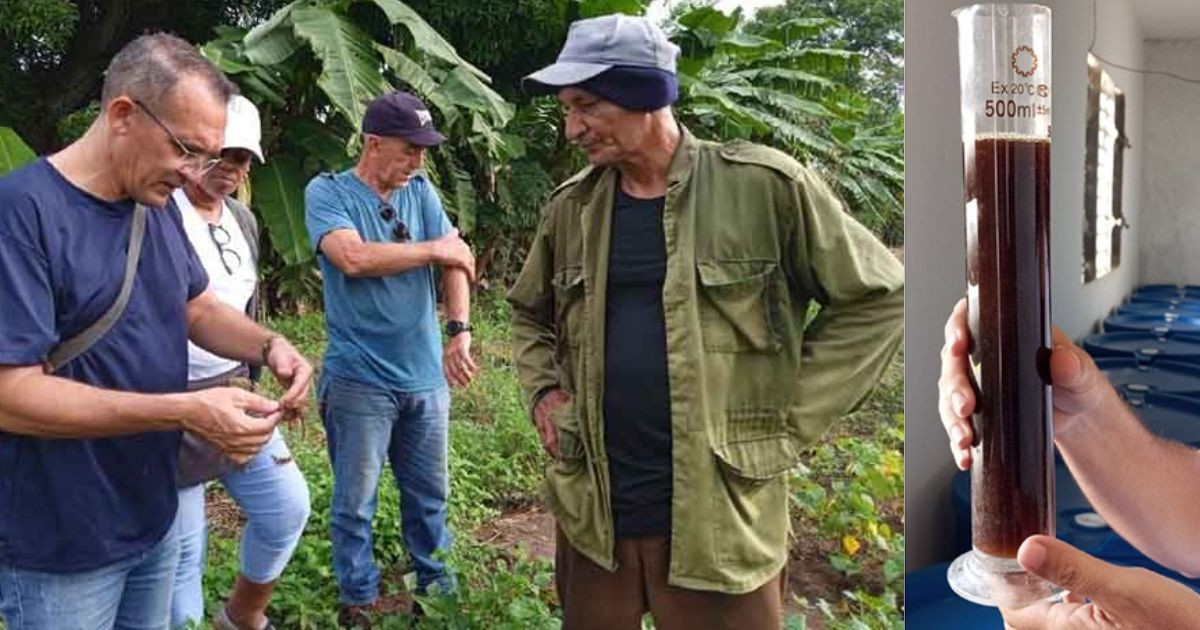
The Centre for Environmental Engineering and Biodiversity of Ciego de Ávila (CIBA-CA) presented a homemade biofertilizer amidst the worst agricultural crisis that Cuba has faced in decades, as reported on Friday by the state agency ACN.
The product, called ME Biohumedal-01, is described by CIBA-CA as a cultivation of efficient microorganisms of natural origin that "enhances soil fertility, accelerates plant growth, and increases yield in crops."
According to the official agency, the bioproduct is composed of "a compatible mixture of photosynthetic and lactic bacteria, yeasts, and fermentation fungi" and is marketed in two formats: liquid, ready to dilute, or solid, inoculated in dry materials such as husks or worm humus.
Biotechnologist Lázaro Rodríguez, a specialist at the Environmental Testing Laboratory of CIBA-CA, explained that the biofertilizer works on two fronts: in the soil, it "enhances the structure of the particles, reduces compaction, and solubilizes nutrients, in addition to suppressing pathogenic microorganisms through natural competition"; while in plants, it "accelerates germination, increases the vigor of stems and roots, and promotes optimal flowering and fruiting."
Rodríguez added that "the use of efficient microorganisms has a positive impact on the environment by eliminating unpleasant odors associated with gases such as methane and hydrogen sulfide; and accelerates the composting process to one-third of the conventional time."
A small farmer from the municipality of Morón, Roberto González, backed the results after applying the product on bean and peanut crops, where he managed to control a pest and observed that "the fruiting process is proceeding smoothly."
González also highlighted the quick germination and vitality of the bean plants in another plot of his farm, and he expressed gratitude for the support from researchers and specialists from CIBA-CA during the process, as reported by the state media.
Yamilé Jiménez Peña, director of the scientific center—subordinate to the Environmental Agency of the Ministry of Science, Technology, and Environment—stated that with this development, "they reaffirm their commitment to sustainable development in a prioritized sector like agriculture and maintain the traditional research lines that support food production."
The presentation of the biofertilizer takes place at a time when Cuba's agricultural production saw a decline of 53% in 2024, according to data from the National Office of Statistics and Information (ONEI). Between 2020 and 2024, rice production plummeted by 62.3%, bean production by 60.2%, vegetable production by 54.5%, and citrus production by 82.7%.
The shortage of diesel, fertilizers, seeds, and machinery exacerbates the collapse of Cuban agriculture. In the first quarter of 2026, the price of a liter of diesel on the black market reached between 1,500 and 3,000 Cuban pesos, a price that is unaffordable for most producers.
Given this scenario, the regime has turned to alternative solutions such as agricultural bioproducts to reduce reliance on imported supplies, in a country that spends nearly 2 billion dollars annually on food imports.
It is not the first time that the regime has presented bioproducts as a response to the food crisis. In July 2025, a Russian nanosilicon was promoted as a solution for crops, with no verifiable results reported on a national scale.
The ME Biohumedal-01 joins that list of targeted technological investments that, so far, have not managed to reverse the structural decline of Cuban agriculture, caused by decades of centralization, lack of incentives for producers, and absence of basic inputs.
Related videos:
Filed under: