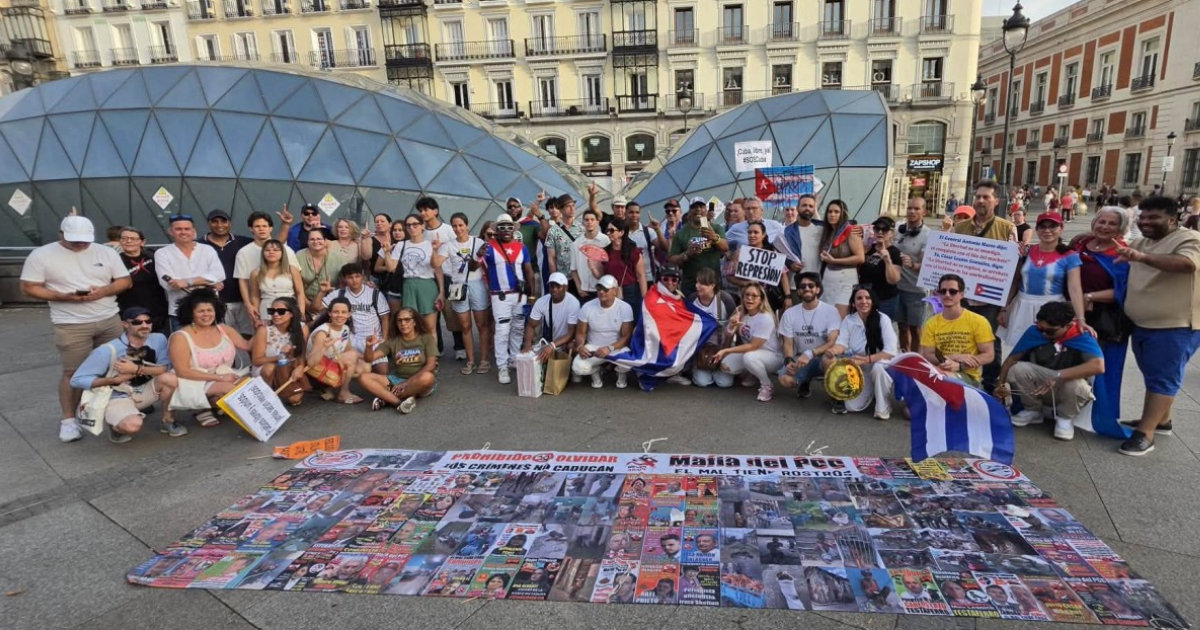
A report published in Diario Red —a Spanish digital media outlet led by Pablo Iglesias and whose editorial line is openly leftist— presents the meetings of the Cuban exile community in Madrid with U.S. diplomats as suspicious, just hours before the general elections on November 29.
The text, signed by political scientist Irene Zugasti, is titled “The U.S. Embassy and the Cuban Opposition in Madrid: Meetings, Photos, and Affinities with Vox on the Eve of November 29.” It includes photos of meetings between exiled Cuban activists and Washington officials in 2025 and 2026, insinuating electoral interference in the Spanish elections.
Zugasti recalls that more than 160,000 individuals of Cuban origin are eligible to vote this Sunday — the census increased from 122,038 in 2023 to 160,038 in 2025 — and notes that messages are circulating among Cubans urging support for Vox, whose intended vote among that community reaches 27% according to microdata from the CIS, compared to 26% for the PP.
The article reviews two visits by the U.S. mission chief in Havana, Mike Hammer, to Madrid: the first one in February 2025, when he met with activists, political prisoners, and Cuban exiled journalists accompanied by the political advisor of the U.S. Embassy in Spain. The second visit took place a year later, when he spoke before more than a hundred Cubans residing in various European countries and stated that change in Cuba "is going to happen."
Both meetings were publicly reported by the U.S. Embassy itself and covered by independent media.
Meeting with foreign diplomats is a legal and common practice; Hammer has maintained a schedule of visits with opponents, political prisoners, and families of inmates both inside and outside of Cuba, which earned him a formal note of protest from the Cuban regime in 2025, accusing him of "interfering, unfriendly, disrespectful, provocative, and irresponsible behavior."
But the author of the report questions those meetings. "What objectives do their meetings with the undemocratic opposition in Spain serve?" she asks, a formulation that the Cuban exile community would outright reject, given that the activists mentioned are victims of the dictatorship's repression.
Diario Red particularly focuses on Lázaro Mireles, president of the Actions for Democracy Movement, whom Zugasti describes as a "noted ultra" with ties to organizations he labels as neo-Nazi and declared sympathies with Vox and the Italian party Fratelli d'Italia led by Giorgia Meloni. He also mentions Iliana Hernández and Guillermo Ponce as attendees of the meeting in February 2026 with Hammer.
The text also notes that Benjamín León Jr., the U.S. ambassador to Spain, is a Cuban-American businessman close to Donald Trump, and cites his meetings with Cuban opposition figures José Daniel Ferrer, Javier Larrondo, and Guillermo Ponce.
The intention contrasts with the history of Diario Red itself regarding Cuba. In March, Iglesias traveled to Havana with the so-called "Caravana Nuestra América," interviewed Díaz-Canel for over an hour at the Palace of the Revolution, and Canal Red broadcasted the conversation. The visit provoked protests from the Cuban exile community outside the Podemos headquarters in Madrid, with the participation of Mireles himself and other activists.
Zugasti states that the "vote of the Cuban far-right is contested between PP and Vox," and points out a "paradox" among Cuban-Spanish voters: Vox includes in its electoral program for November 29 a tax on remittances sent abroad and migration restrictions that would directly affect part of that community. The PP, for its part, proposes to repeal the Law of Democratic Memory, which would thwart the dreams of hundreds of Cubans seeking to obtain Spanish citizenship.
In conclusion, the journalist characterizes the Cuban exile in Spain as "organized, nurtured by U.S. diplomacy, and funded for years from Washington."
Related videos:
Filed under: