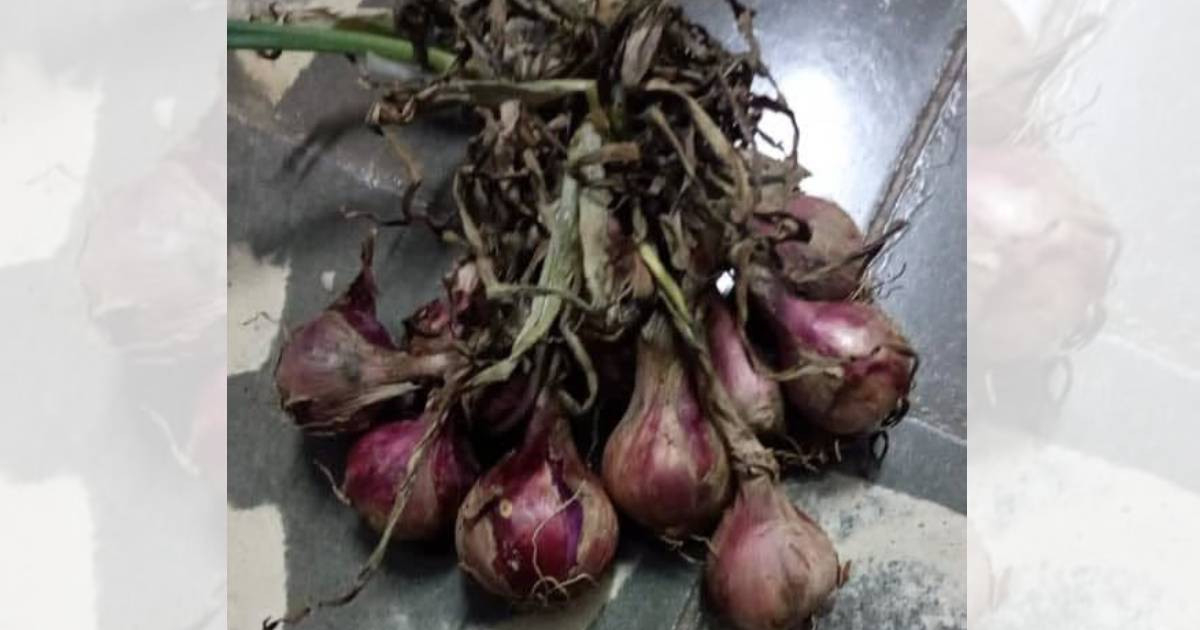
A bunch of small red onions costs 750 pesos in Placetas, in the province of Villa Clara, but testimonials from consumers in other provinces revealed even higher prices for one of the typical seasonings in Cuban cuisine.
The complaint was published this Saturday on Facebook by content creator Rubén Carrillo, who questioned why Cuban families have to spend increasing amounts even for seasoning their food.
The comments highlighted that the problem spans the entire country. In the Isle of Youth, a similar bundle reached 1,500 pesos; in Matanzas and Caibarién, prices were also reported to be higher than those in Placetas, while in Havana, a single onion was being sold for between 500 and 700 pesos.
"None of the regions in the country are free from high prices, whether it's produced there or not," noted a user. Another commented sarcastically on the rising cost of a staple ingredient in Cuban cuisine: "If cutting onions didn't make someone cry, these prices definitely will."
An experienced commentator on agricultural mobilizations in the areas of Banao and Pojabo in Sancti Spíritus also questioned the prices set by vendors. He explained that some producers harvest onions as bulbs, without stems, to cut down on labor and spraying costs, yet still sell the product at what he described as exorbitant prices.
Onion is not the only food that has become difficult to obtain. According to other reports from the same publication, a pound of beans cost 1,000 pesos in Villa Clara, and a cabbage reached 1,500 pesos.
"The Cuban people are dying of hunger," wrote a user in response to the complaint.
Weeks ago, a Cuban living abroad paid more than 16,500 pesos for onions and cilantro during a visit to the island. In October, another woman from Havana showed a small onion she had bought for 610 pesos, while the price per pound soared to 1,700.
Cuba's horticultural production dropped by 55% between 2021 and 2024, according to data from the National Office of Statistics and Information (ONEI). Additionally, between 1.1 and 1.7 million hectares that were previously productive are now infested with marabou bush, and the country imports between 70% and 80% of the food it consumes, according to some estimates.
The official inflation rate for food and non-alcoholic beverages reached 50.72% year-on-year in October, according to the ONEI. This category also accounted for 71.70% of the monthly impact on the consumer price index.
The minimum wage in effect since July is 3,210 pesos per month, while the average state salary is around 7,354 pesos, equivalent to less than 10 dollars at the informal exchange rate.
The economist Javier Pérez Capdevila estimated in June that a person needs around 96,000 pesos per month to cover their basic needs, of which more than 70,000 pertains solely to food.
The situation is especially difficult for the approximately 1,774,310 retirees in the country, whose minimum pensions range between 3,056 and 4,000 pesos. A bundle of onions priced at 750 pesos can represent between 19% and 23% of their monthly income.
The gap between the officially set prices and those faced by the population was also revealed. In September, the approved price for onions in Havana markets was 180 pesos per pound, but consumers reported that sellers were charging up to five times more, with no visible consequences.
Related videos:
Filed under: