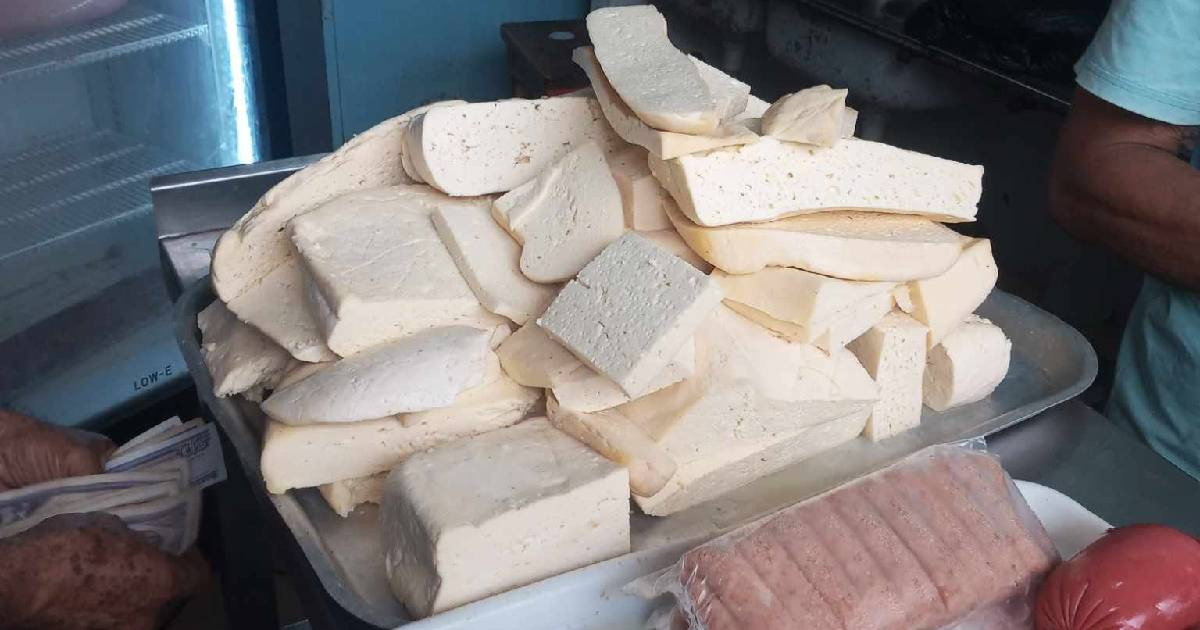
A Cuban reported this Friday that a pound of cheese costs 1,600 pesos and questioned the ongoing rise in food prices, while other consumers noted prices of up to 2,000 pesos in various parts of the country.
"It is a lack of respect. Look at the price of cheese, 1,600 pesos per pound. Every day it rises more and we don't know where this will end. How long will this go on?" wrote Ayansan Sánchez in the Facebook "buying and selling cheese in bulk" group. However, the user did not specify the location where the photograph accompanying her post was taken.
The complaint adds to other citizen reports regarding the price of the product. Some consumers said they paid up to 2,000 pesos for a pound, while others reported prices of 1,900 pesos in the agropecuary market area of EJT, in the capital's Plaza de la Revolución municipality, and 1,700 in La Palma, in Arroyo Naranjo. There were also reports of offers at 1,000 pesos, although this is still below the prices reported most frequently.
With a monthly minimum wage of 3,210 pesos set in July, a pound of cheese priced at 1,600 pesos represents almost half of the earnings of a worker earning that salary. Compared to the average state salary of 7,354 pesos, it accounts for more than one-fifth of the monthly income.
The reasons for the price increase also sparked debate among consumers. Some pointed to informal dollarization and speculation by resellers, while others defended the production costs.
"A cow that produces milk for making cheese costs 300,000 pesos, and it requires overnight vigil without sleep," argued a user.
Another participant challenged that explanation and argued that there had not been enough changes to justify the price doubling in less than a month. According to their comment, the rise of the dollar was under 100 pesos, and fuel, another factor affecting transportation, had decreased.
Concern is growing with the approach of December, when demand for dairy products and pork traditionally increases. "People have to eat, and the worst has yet to come: December," warned another commentator.
The price increase occurs amid a contraction in the dairy sector. National milk production fell by 58% between 2018 and 2023, and Cuba generates less than 200 million liters annually, while the estimated demand is 500 million. In some areas, the lack of fuel prevents milk from being collected, forcing producers to transform it manually into cheese to avoid losses.
Other foods are also reaching prices that are difficult for a large part of the population to afford. Recent reports on social media highlighted prices of up to 2,500 pesos per pound of pork in Havana and red beans are priced at around between 1,300 and 1,400 pesos.
To this scenario is added an official year-on-year inflation rate of 32.70% in October, according to the National Office of Statistics and Information (ONEI). Food prices have risen by 50.72% over the past 12 months, a trend that continues to erode the purchasing power of Cuban households.
Related videos:
Filed under: