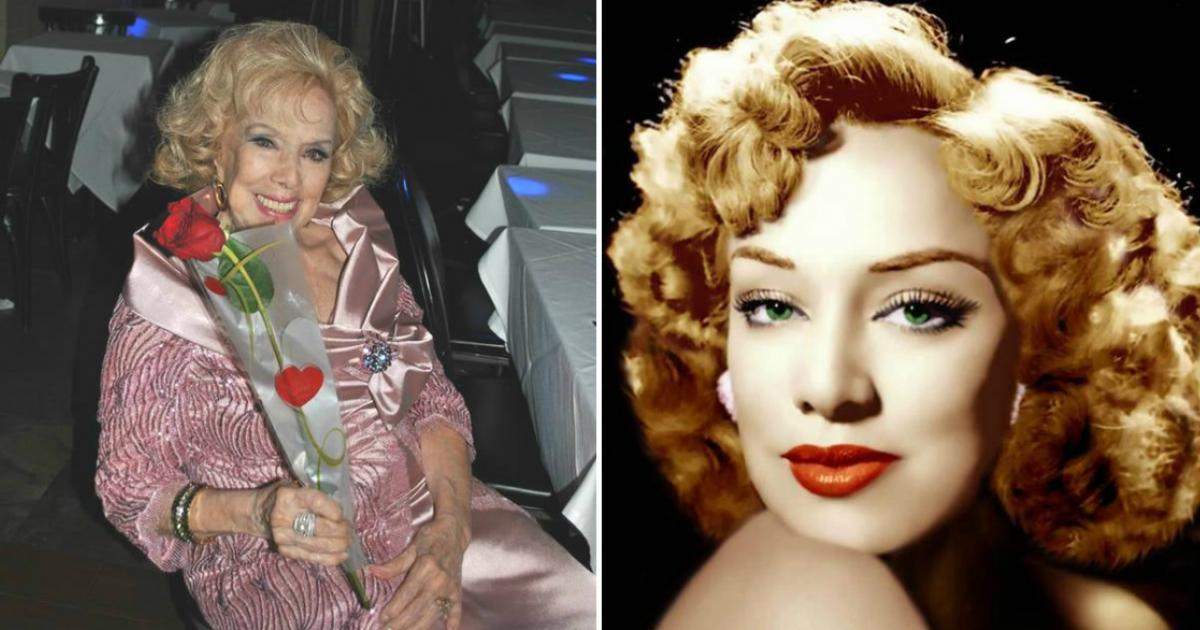
Rosita Fornés is a Cuban actress, television personality, singer, and vedette.
Rosalía Lourdes Elisa Palet Bonavia, our Rosita Fornés, was born in New York on February 11, 1923, and passed away in Miami on June 10, 2020, at the age of 97. She was buried, at the actress's express wish, in Colón Cemetery in Havana, Cuba, after her remains arrived on the island and the funeral procession traveled through the streets of Havana, where thousands of Cubans said their final goodbyes.
She was the daughter of two Spanish emigrants residing in Cuba who lived in New York in 1922. Rosita, who returned to Havana in 1925, came from a family with a strong background in various branches of the art world, which influenced her early inclination towards music and acting. In 1933, her family emigrated to Valencia, Spain, the homeland of her stepfather, who gave her the surname Fornés. There, she began to take an interest in the musical styles of the time, and upon her return to Havana in 1936, after the outbreak of the Spanish Civil War, she auditioned at just 15 years old for the talent show La Corte Suprema del Arte, which was being broadcast by the Cuban radio station CMQ-Radio. For her debut, she performed the milonga "La hija de Juan Simón," accompanied by the Andalusian Manolo Tirado on guitar. Rosita won the contest and from that point on adopted the artistic name that would accompany her throughout her unstoppable career, during which she would share the stage with great personalities from the worlds of music, cinema, and theater.
Under the direction of the great conductor Germán Pinelli, she continued to participate in tours and radio programs, and her first appearance at the National Theater was as part of the chorus and as a dancer in the contradanza of a production of the Cuban operetta Cecilia Valdés, by composer Gonzalo Roig.
In 1939, he made his film debut singing the Cuban song "Intrusa," composed by Ramiro Bonachea for the movie Una aventura Peligrosa.
She would also make her debut that year for the first time in the cabaret genre at the National Theater, and in 1940 she would venture into the lyrical genre through radio, where she would be discovered by the Spanish comic tenor Antonio Palacios.
In 1941, at the age of 18, she stepped onto the stage of the Principal Theatre of Comedy in the operetta The Amazement of Damascus, in the role of Zobeida, where she met the maestro Ernesto Lecuona, who invited her to join his lyrical company. With them, she achieved great success in various performances, including the legendary Siboney and Always in My Heart.
In the following years, she remained immersed in the operetta performance season that took her to the most famous Cuban stages of the time, such as the Teatro Nacional, the Teatro Martí, Campoamor, and the Teatro Principal de la Comedia, connecting her with the most renowned musical directors and the best companies. Lecuona, Rodrigo Prats, among others, featured her on Cuban stages. However, Rosita never forgot the radio that continued to accompany her theatrical work, and she also pursued her film career, participating in her second movie, Romance Musical (1941).
In 1945, at the age of 22, he had already had a significant part of his successful career on the island and decided to travel to Mexico and the United States, where he performed in several films and musical revues.
In 1947, she married the Mexican actor and businessman Manuel Medel, the father of her only daughter, Rosa María, born on March 10, 1949.
In the 1950s, she co-founded the Medel-Fornés Lyric Theater Company with her husband, but in February 1952, amid marital disagreements, she returned permanently to Cuba with her daughter, where she would begin a new era in Cuban television marked by the triumph of the revolution.
She was one of the founders of the National Lyrical Theatre group and adapted to the new demands of socialist television by joining tours across the socialist bloc. With the musical production "Variedades de La Habana," she visited the Soviet Union, Hungary, Bulgaria, and Romania. She participated in the Varadero International Song Festival in 1967, 1970, and 1981; attended the Sopot Festival (in Poland), and represented Cuba on the musical tour "Melodías de los Países Amigos," which traveled through European countries for three months. That same year, she took part as a promoter of Cuban music at the Golden Orpheus Festival (Bulgaria).
In the memories of Cubans, iconic films will remain such as:
For exchange. Address: Juan Carlos Tabío, 1984
1986: Plácido. Directed by: Sergio Giral (Cuba).
1987: Today Like Yesterday Director: Constante Rapi Diego (Cuba-Mexico).
1987: The Rhythm Barbarian. Directed by: Sergio Véjar (Cuba-Mexico).
1989: Supporting Papers. Director: Orlando Rojas (Cuba).
1994: Love Me and You'll See. Directed by Daniel Díaz Torres (Cuba).
2001: The Nights of Constantinople. Directed by: Orlando Rojas (Cuba).
2001: At Dusk. Directed by Tomás Piard (Cuba).
2002: Los Zafiros, music from the edge of time (documentary), as itself (Cuba-United States).
In 2001, he was awarded the National Theater Prize (Havana), along with María de los Ángeles Santana. Additionally, he received the National Television Prize (2003) and the National Music Prize (2005).
In February 2011, Don Juan Carlos I, King of Spain, awarded him the Order of Civil Merit.
On April 2, 2019, a tribute was held for her in the García Lorca hall of the Gran Teatro de La Habana to honor her 80 years in the artistic field, and to celebrate her 96 years of life. After this, the star decided to settle in Miami, citing health reasons.